TIL tilde (~) as "home" in unix and web directories:

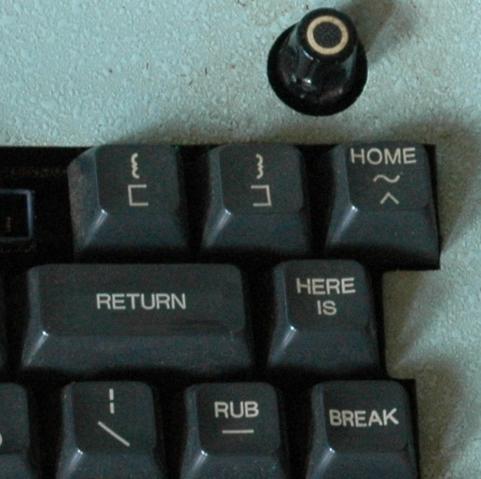
On Unix-like operating systems (including AIX, BSD, Linux and macOS), tilde normally indicates the current user's home directory. [...] This convention derives from the Lear-Siegler ADM-3A terminal in common use during the 1970s, which happened to have the tilde symbol and the word "Home" (for moving the cursor to the upper left) on the same key.

https://en.wikipedia.org/wiki/Tilde#Directories_and_URLs

pic: the ADM-3A
picture of a ADM-3A terminal, w…
Tilde - Wikipedia

@shrik3 for the longest time in the early days of the web you could find all kinds of interesting things by looking at either whatever.com/~username or even whatever.com/users/username
@shrik3 are you sure of that? I think the convention started with uucp which was version 7 Unix and only hardcopy terminals.
@rsalz @shrik3 Unix v7 had a termcap database (directory) and ADM-3A was the baseline for any app claiming full-screen terminal support
@cliffordheath I thought termcap was invented at Berkeley.
@rsalz you're probably right. My first exposure was in 1980 at Uni of Melbourne, and there was a lot of cross-pollination happening already. I'm not sure how much of that flowed in the direction of Bell Labs. kre was writing the Berkeley tty driver, and I was reading his discarded listings on fanfold. I never saw a Unix system without termcap though, I don't think
@cliffordheath that reading listings comment is great!
@rsalz kre used to work at night, watching the cricket in England, and be absent through the day when he might otherwise be coerced into helping lusers :). One listing had two circles in biro highlighting arguments reversed to a function. TG we have type-checking now, so we can catch such things before the kernel crashes!

@rsalz @shrik3

It was a csh feature originally. I don't think it became a part of Bell Labs shells until Korn.

BBN Unix (v6) put the idea in the kernel, but used "..." instead of "~".

@lain_7 Perhaps in the shells, but according to https://wolfram.schneider.org/bsd/7thEdManVol2/uucp.implement/uucp.implement.pdf it was in the v7 UUCP which is probably where CSH got the idea.

@shrik3 @nblr It also has the arrows for cursor movement on H J K L, guess where vi adopted those.

(or the ^ for the beginning of a line in regex syntax – from that same HOME key)

@dentaku @shrik3 something something ^W for a word and ^H for a letter, but that might have been a different platform.

@nblr @shrik3 That's just plain ASCII:
H is 0x48 and backspace is 0x08
G is 0x47 and bell is 0x07

Guess which bit the control-key shifts.

@shrik3 Cool! I never knew that about ~

Wasn't vi created on this terminal also which explains the use of hjkl being motion keys because they had arrows on them? I think escape was in a convenient place also.

Yep, just zoomed in and there are the arrows. And escape is at least connected to number row and not a separate key way up top left.

@shrik3 Why do I want one of these beautiful objects? Also interesting history!
@shrik3 Oh my I think I used one of these in high school. But no numeric keypad.
@shrik3 I spent my first two years of university working on these. I still have one lying around
@shrik3 That very line says “citation needed.” It would be interesting if a quote from any of the Unix creators could be found to support this.
Welcome to ~tilde.club~

@shrik3
This is one beautiful machine