If I think about everything I've learned about the world since I was a kid, the thing that would've most surprised kid-me is how privileged the median or even 10%-ile person with a "good" job is, e.g., what's the rate of tech folks at top companies who were too poor to get dental care and have crooked teeth?

1/1000 seems like the right order of magnitude for someone my age or younger in tech and maybe it's 1/100 but, at a population level in the U.S., seems more like 1/5 or maybe 1/10.
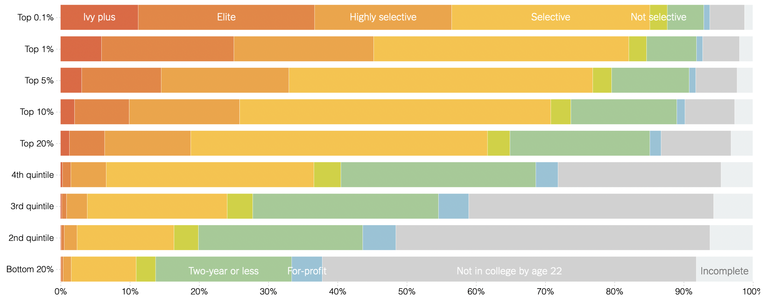
Where are all the people who grew up too poor to get dental care ending up? Not in high-end tech jobs, and tech is less highly selected on this than finance, law, etc.

I've interacted with quite a few interns and new grads at big tech companies and, among U.S. born folks, I think the rate of people who were on the U.S. Olympic team is pretty similar to the rate of people who haven't had dental care (IME, the Olympic team rate has been higher, but sampling from tails like this is noisy)

For a less extreme example, a large group of tech folks I was hanging out with compared notes on US high schools. My high school was ok (one random site ranked it 35%-ile among schools in WI, another one rated it well above median), which made it bottom of the barrel among tech folks. Most people went to high schools where basically everyone graduated, very few people were in the "reduced price lunch" income bracket, etc., which means they were in high-end high schools.

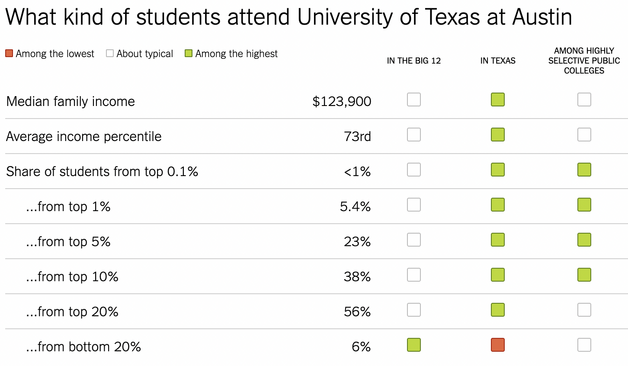
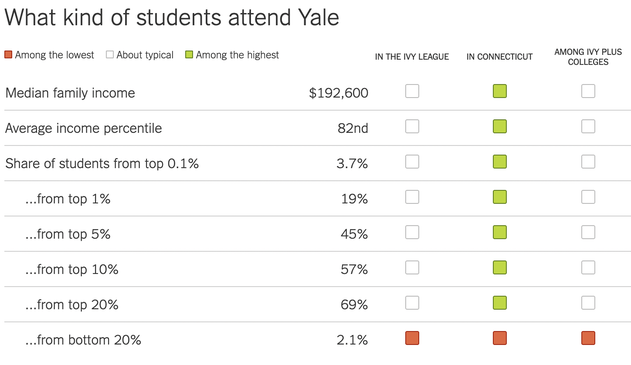
I don't think there's anything wrong with attending an elite private high school or being wealthy enough to live in a great school district, but the rate feels surreal to me. The thing that really surprised me when I looked at the data is how heavily top companies recruit from top schools and then how heavily top schools "recruit from" high income families.

The median student at a top school is > p90 parental income and even at a "merely good" school, the median student is > p80.

BTW, I consider myself extremely lucky to have grown up in the U.S., but poor enough that I have crooked teeth, lightheaded from hunger often enough that I had standard strategies for dealing with it, malnourished enough that I once broke my collarbone from from gently rolling off the couch onto the floor, in an abusive home where I was regularly beaten, etc.

I definitely had better opportunities than the p99 person in Vietnam and likely even p99.9.

@danluu is wealth really the primary factor here? I'm obviously biased, but I find it that no amount of wealth compensates for severe childhood abuse--having more resources in this case makes no real difference to the agony that your existence often becomes. assuming i have stable housing and can get healthcare--something that requires only a relatively small amount of wealth--i would have much rather had, say, one person who stood up to the guy who beaten and sa'd me than zero

@whitequark I don't know that it's the primary factor, but find it fairly useful for mitigating various chronic pain and disability issues, which would be a lot worse if I was poor.

In terms of stopping things while they were happening, in retrospect, I think I should've rolled the dice on the foster care system (I thought about this a lot and didn't do it because I didn't know how to get almost any info on the tail risk there), which wouldn't have been a serious option in Vietnam.

@whitequark But I guess if the question is p99 lifestyle in Vietnam *and* a nice home life vs. what I have now, IDK, I guess if a lot of the medical issues I have stem from starvation or other abuse, then p99 lifestyle in Vietnam is plausibly better (this is below median U.S. lifestyle w.r.t. a lot of amenities and has a lot of risks that are worse as well) but if it's due to an unlucky genetic roll of the dice, then what I have now is overwhelmingly likely better.

@whitequark In the counterfactual worlds where I didn't have these medical problems in either instance, then I think I'd take the abusive U.S. upbrigning over the non-abusive Vietnamese upbringing.

I definitely have some not-so-great emotional scars from that, but a lot of people I know with more mundane upbringings often have worse emotional scars, so I don't know that I'd be that much happier or better adjusted or w/e if you swapped by upbringing for a random Vietnamese one.

@danluu It's interesting that that's the choice you would make! I do think that the way people respond to having emotional scars is highly varied and also is a skill one can learn and apply very effectively, but also how or whether you learn that skill is correlated with your environment in first place and a great deal of luck. I'm pretty okay with mine today, but I only narrowly avoided dying, and there was a *lot* of luck involved, so not relying on it feels like it'd be nice.

@whitequark I think it's impossible for me to really reason about what would've happened in the other case.

Compared to most people, I used to have an extremely high tolerance for stress. Maybe that came out of my bad childhood experiences, in which case that's an ok silver lining. Or maybe I had a large reservoir of capacity that got half used up in childhood, which would then just be bad with no upside. Hard to say which of these models is correct.

@danluu oh, I'm similar, and that's actually how I initially read your post, i.e. that you'd prefer to have an awful US upbringing to a p99 Vietnamese one because it gave you tolerance for awful conditions.

While morbid this is a line of thought I've entertained before and I do feel that the skills I got from going through utterly horrific experiences are valued tools that are likely to serve me well in the future.

@danluu I'm actively testing the "tolerance for stress and adversity in general is a learnable skill or something that can be habituated to" hypothesis; I'm under much less stress than before but I want to tolerate it better so I have more time that's useful to me, so I'm very interested in practicing this skill or otherwise finding ways to adapt. It's hard to robustly account for changes here though.

@whitequark Oh, I meant the post as something like "what are the odds of hitting, say, senior staff engineering compensation" plus maybe "having lots of intellectually stimulating opportunities" and I think, when I was born, the odds were much better for a very poor American than a p99 Vietnamese person (and I would bet this is not true today, but we won't know for 30 years).

I think one thing a lot of commenters (not saying this is you) don't understand is how poor Vietnam was.

@whitequark E.g., someone replied with how this didn't seem true at all in Poland and, well, I bet it was true, but also, in the year I was born, the GDP per capita of Poland was 50x the GDP per capita of Vietnam (US:Poland was 8x).

Average annual income in Vietnam was ~$200/yr-$300/yr, with large scale starvation due to famine; people who were senior leaders in govt didn't get three meals a day worth of rice (unless they were corrupt and stealing it). p99 lifestyle wasn't that great.

@danluu I was definitely underestimating just how poor Vietnam was.