If I think about everything I've learned about the world since I was a kid, the thing that would've most surprised kid-me is how privileged the median or even 10%-ile person with a "good" job is, e.g., what's the rate of tech folks at top companies who were too poor to get dental care and have crooked teeth?

1/1000 seems like the right order of magnitude for someone my age or younger in tech and maybe it's 1/100 but, at a population level in the U.S., seems more like 1/5 or maybe 1/10.
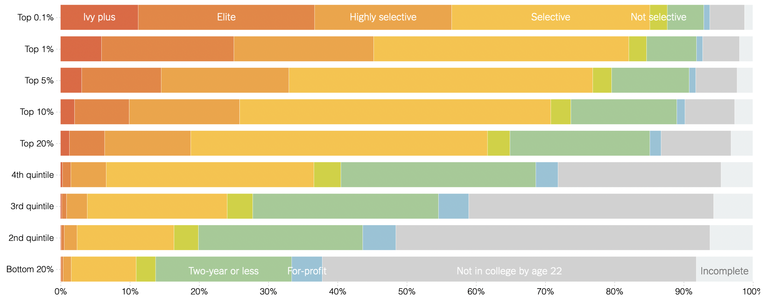
Where are all the people who grew up too poor to get dental care ending up? Not in high-end tech jobs, and tech is less highly selected on this than finance, law, etc.

I've interacted with quite a few interns and new grads at big tech companies and, among U.S. born folks, I think the rate of people who were on the U.S. Olympic team is pretty similar to the rate of people who haven't had dental care (IME, the Olympic team rate has been higher, but sampling from tails like this is noisy)

For a less extreme example, a large group of tech folks I was hanging out with compared notes on US high schools. My high school was ok (one random site ranked it 35%-ile among schools in WI, another one rated it well above median), which made it bottom of the barrel among tech folks. Most people went to high schools where basically everyone graduated, very few people were in the "reduced price lunch" income bracket, etc., which means they were in high-end high schools.

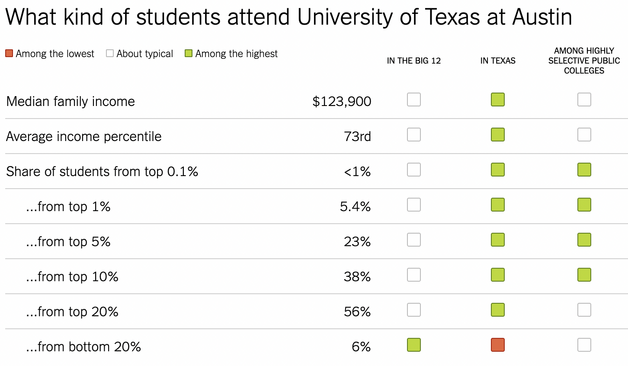
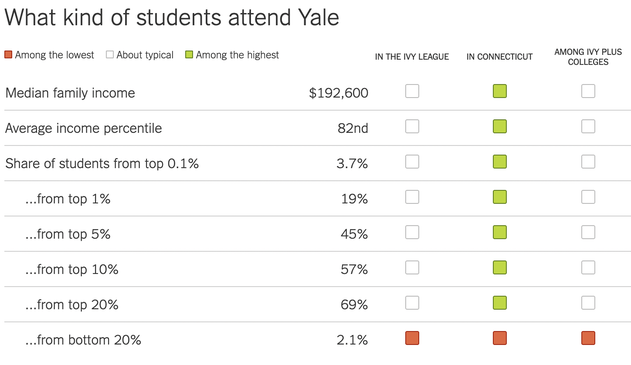
I don't think there's anything wrong with attending an elite private high school or being wealthy enough to live in a great school district, but the rate feels surreal to me. The thing that really surprised me when I looked at the data is how heavily top companies recruit from top schools and then how heavily top schools "recruit from" high income families.

The median student at a top school is > p90 parental income and even at a "merely good" school, the median student is > p80.

BTW, I consider myself extremely lucky to have grown up in the U.S., but poor enough that I have crooked teeth, lightheaded from hunger often enough that I had standard strategies for dealing with it, malnourished enough that I once broke my collarbone from from gently rolling off the couch onto the floor, in an abusive home where I was regularly beaten, etc.

I definitely had better opportunities than the p99 person in Vietnam and likely even p99.9.

@danluu is wealth really the primary factor here? I'm obviously biased, but I find it that no amount of wealth compensates for severe childhood abuse--having more resources in this case makes no real difference to the agony that your existence often becomes. assuming i have stable housing and can get healthcare--something that requires only a relatively small amount of wealth--i would have much rather had, say, one person who stood up to the guy who beaten and sa'd me than zero

@whitequark I don't know that it's the primary factor, but find it fairly useful for mitigating various chronic pain and disability issues, which would be a lot worse if I was poor.

In terms of stopping things while they were happening, in retrospect, I think I should've rolled the dice on the foster care system (I thought about this a lot and didn't do it because I didn't know how to get almost any info on the tail risk there), which wouldn't have been a serious option in Vietnam.

@danluu oh damn, that bad, huh. I'm sorry.

I personally do not find that wealth helps a lot with chronic pain and disability issues. My partner, who is in state-mandated poverty (SSI), certainly has it worse, but that's less because of lacking wealth and more because of the state threatening to actively take what little you get away if you so much as get one wrong cheque.

@danluu In my case, while I can spend money to offset chronic pain and disability, generating that income in first place worsens it by almost the same extent, so it seems largely neutral. I don't even have time for anything I find personally fulfilling with the current job I have, so the main benefit it brings to me is being able to pay for my partner's trips from US to UK and back.
@danluu Having more wealth would potentially offset more things, but all of the options I've looked into which would generate more income would also definitely make my disability worse at the same time, so it doesn't seem like the effort is worth it, without a foreseen change in quality of life.
@danluu (By far the biggest impact on chronic pain and fatigue that I have is from pharmaceutical management of it, at this point, mainly tramadol/pregabalin prescribed by the NHS. It is basically free regardless of SES. Everything else is just paying somebody else to do a thing I cannot do because I spent more time working and instead of doing that thing, e.g. food. It's only worth it disability wise because this job lets me work on an ambitious FOSS project.)

@whitequark For me personally, the biggest expense categories are paying to reduce the amount of physical labor that's problematic for me and paying for things like physical therapy, which aren't covered if you have moderate income in Canada and are only covered for a very small number of visits if you have low income

I've been extremely hesitant to try opioids although doctors here hand them out like candy (at least if you're not on them; I've heard they can be hard to get long-term)

@danluu @whitequark IME, the effect of wealth in the context of public healthcare depends very heavily on: (a) the nitty gritty of implementation details of the applicable healthcare system (b) the specifics of the condition.
In my case, despite a fairly robust healthcare system (Austria) I would have died without the privilege of being in a position to question doctors’ (non-)diagnoses & paying to see >10 different ones until one was willing to diagnose.
@danluu @whitequark Now, almost 10 years later, it’s virtually impossible to get any meaningful diagnostics let alone treatment for post-Covid issues unless I pay privately. On the other hand, throwing money at the problem would have no substantive effect on the outcome of diagnosing and treating a broken leg or whatever.
@danluu I've been avoiding trying them for over 5 years and it's one of the biggest mistakes of my life that has resulted in so much lost time and unnecessary suffering. Tramadol MR/pregabalin specifically is a pairing that interacts pharmaceutically to make tramadol much more effective and the habituation much slower, so in practical terms, I can stay on the same dose for a year, take a 3 day break to reset tolerance, then repeat indefinitely.
@danluu I've never been able to work full time in my life before getting on tramadol/pregabalin; chronic pain from fibromyalgia wasn't the *only* issue but it was on the critical path and now that it's cleared it has made my life better in more ways I can describe. I'm still in substantial to severe pain daily, of course; it's just that it no longer overwhelmingly defines my every waking moment, as it did before.
@danluu Another option I've been looking into is low dose naltrexone and ganglion block, both of which are very promising, and both theoretically available in the UK, but the amount of effort to get those treatments just doesn't seem worth it right now given how much time my job takes and how effective the meds I'm on are. The benefit is that if they work I wouldn't need to stay on an exact 12 hour spaced schedule to remain able to do my job.

@whitequark Thanks for the comments on specific painkillers. I haven't looked into what I'd want to do, but doctors generally offer up T3s and, most recently, in the hospital (outpatient), one handed me a bunch of Dilaudid / Hydromorphone which I'd never heard of, but on looking it up, seemed like an even worse idea than taking T3s all the time for chronic pain.

I don't know that I'll do anything with this at the moment, but it gives me a starting point if/when I go down this route.

@danluu Oh yeah, can't imagine how either of those options would go over well for you.

In a perfect world where I can get any medication I would try LDN first. Counterintuitively, LDN can actually be combined with tramadol (despite the fact that it's used in opioid overdose; it's a mixed agonist-antagonist so in low doses it acts in the other direction), and it's a combination that some people use when, like with me, tramadol is a good short to medium term option.

@danluu You will probably find yourself with doctors suggesting SSRIs and TCAs. Personally I would rather experience acute opioid withdrawal every week than be on an SSRI or a TCA, but I think some of that is my personal hypersensitivity to these drugs. It's unclear why they would work for pain, and while they do work for some people, I see it as really a much more of a "I don't want to treat you" option than a serious treatment in many, maybe most, cases.

Good luck