 Yogthos
People love to talk about what the intentions are. However, when a system constantly produces a different outcome than the one it is "intended" for then it's perfectly reasonable to assume the actual intention is the outcome it continues to produce.

@escarpment @notroot again, there is no secret purpose. There is the intent and then there's the implementation.
The goal is to understand what results the implementation produces, which is the implicit purpose of the system, and to reconcile that against the intent.
The purpose of the system (actual implementation) is always what the system is doing.
This can often be at odds with the stated intent. Understanding whether that's the case or not is the purpose of POSIWID.
@notroot @escarpment I was approaching this from the dialectical materialism perspective, but cybernetics one is a good way to frame it as well.
The rules of the system create an entity with its own purpose that's the expression of these rules.
And this entity can be quite different from might've been originally envisioned.
@notroot @escarpment I like to look at this from the perspective of natural selection myself. You have the environment and it exerts some pressures on the agents within the environment. These pressures end up selecting for particular behaviors. I find this is a useful way to look at complex systems.
There is also a dialectical aspect to this where the behavior of the agents also shapes the system in turn.
@notroot @escarpment for sure human systems are complex, but that doesn't preclude us from being able to look at the outcomes the systems produce, and try to improve the areas where we identify problems.
I think the goal should be to define a desirable state of things and then to reflect on whether the rules of the system are getting us closer or further from that.
When we make changes we can reflect and compare to see if they move us closer or further from the goal.
> I think the goal should be to define a desirable state of things
Most likely people have shockingly different opinions about this. Desirable is sadly subjective. I suspect this is like a "ask 100 people get 100 different answers" type of question.
The moral anti-realist would say "of course they disagree on this subjective question because there are no objective mind-independent values."
@notroot @escarpment I actually think it's very important to note that alternative approaches exist. One example being democratic centralism as seen in Cuba, Vietnam, and China.
Public opinion surveys show that people in China see their system as being more democratic than people in US.
And this should be no surprise given that their system objectively does a better job of implementing the will of the majority.
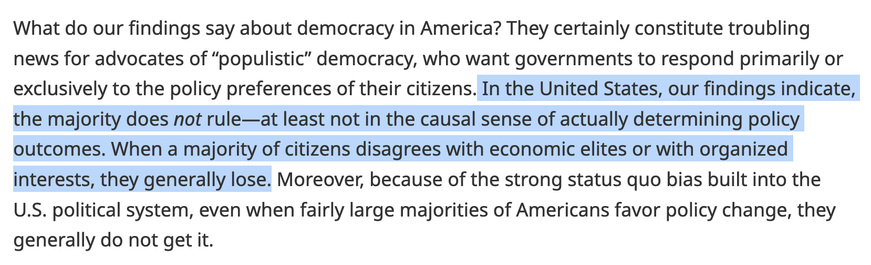
@escarpment @notroot it's true the US system is designed to protect the views of the ruling capital owning minority first and foremost as a recent study analyzing decades of US policy clearly shows
@escarpment @notroot there is plenty of evidence that this was the original intent, and this is discussed in detail by Michael Parenti in his excellent book Democracy for the Few
https://archive.org/details/DemocracyForTheFew16147062951821
@notroot @yogthos It's interesting how you think of POSIWID as a technique or method. It seems like the method you are describing is, "try to reverse engineer the intent of a system by observing what it does. Then, compare what you concluded the intent was to what you know the intent to be."
That seems like a reasonable approach to "debugging." Just unfortunate that the acronym / catchphrase / slogan is a pseudo philosophical oxymoron.
Could be "try to determine the purpose from what it does"
 Escarpment
 Word of Mouth

