
People love to talk about what the intentions are. However, when a system constantly produces a different outcome than the one it is "intended" for then it's perfectly reasonable to assume the actual intention is the outcome it continues to produce.
@yogthos I characterize this idea as false. It stretches the basic meanings of words. Simply producing one example of a system whose purpose is not what it does disproves this statement. Take a car that drove for 100,000 miles then crashed into a ditch. The purpose of the car was to transport passengers and cargo, and it did so effectively for 100,000 miles. Now it sits in a ditch. Sitting in a ditch is not its intended purpose.
@escarpment that example is just sophistry
@yogthos This "principle" is just sophistry. Someone stated it confidently enough that people take it as true and interesting.
@yogthos "Purpose" is a word that means people's intentions. This "principle" amounts to "people's intentions are not people's intentions". Or "people's intentions are something other than their intentions." Or "people have secret intentions."
@escarpment people act according to systemic pressures they're exposed to
@yogthos @escarpment Sorry to butt in on this awesome dialogue, but I'm just interested.

This seems crucial to me:

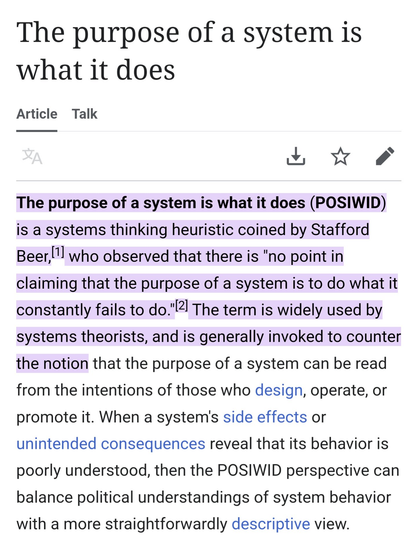
"When a system's side effects or unintended consequences reveal that its behavior is poorly understood, then the POSIWID perspective can balance political understandings of system behavior with a more straightforwardly descriptive view."

This suggests the use of POSIWID as, essentially, a debugging methodology, to fix the system so that it
does serve it's intended purpose, rather than it's currently implemented purpose. We take the perspective, "What would I say the purpose of this system is, if I didn't already know the intended purpose?"

This seems to me a misuse of "purpose" to say it is what it does, so I have to agree with your interlocutor, there. "Function" might be a better word.

But then, this isn't some sort of philosophical principle, either. It's a cybernetics concept, so it may or may not be generalized to all complex systems. That's debatable.
@notroot @yogthos Thanks for the input. I guess to give the most favorable interpretation, upon rereading the Wikipedia article, the statement "there is no point in claiming that the purpose of a system is to do what it constantly fails to do" is a valid frustration. I see this pattern a lot though- in frustration, people *exaggerate*. They go from "this system is so bad that it's almost *as if* it were designed to be bad!" And that morphs into "it *must have been* designed to be bad!"
@notroot @yogthos It is true that a lot of systems do not meet their intended purposes because people are bad at designing against real requirements, instead using intuition and feelings as a guide. Like the criminal justice system: "we should probably punish people for using drugs because that makes intuitive sense", without necessarily running a pilot study to see if that has the desired effect of reducing drug use.
@escarpment @yogthos That's really a great example. It has been convincingly argued that in this case there really was a "secret intention" to the "War on Drugs" -- to disenfranchise Black Americans and the poor, more generally, by branding them felons and taking away the right to vote. A continuation of Jim Crow tactics.

Which is where I agree with you over your interlocutor -- POSIWID is very valuable when analyzing a system without full knowledge of intent. In particular, in human systems, where full motives of parties involved in designing systems are frequently shrouded. Machiavelli, baby.
@notroot @yogthos In that case, though, the principle is not POSIWID. It is "sometimes there is a secret purpose." STIASP. I do not dispute STIASP. I dispute POSIWID.

@escarpment @notroot again, there is no secret purpose. There is the intent and then there's the implementation.

The goal is to understand what results the implementation produces, which is the implicit purpose of the system, and to reconcile that against the intent.

The purpose of the system (actual implementation) is always what the system is doing.

This can often be at odds with the stated intent. Understanding whether that's the case or not is the purpose of POSIWID.

@yogthos @notroot So you view a distinction between purpose and intent? I view them as synonyms. "The purpose of a system is what it does" === "the intent of a system is what it does". How are intent and purpose different?
@escarpment @yogthos I think it comes back to peculiarities of cybernetics and the way they think about systems. They study feedback, and rhetorically ascribe agency to systems. In their way of talking, a system can have its own purpose, separate from the purpose of the individuals who designed and built it.

Again, from my admittedly basic understanding, the whole idea of POSIWID is properly understood in context of cybernetics. In general it's more applicable to thinking about neural nets than human society, though it's proponents would no doubt disagree.

What interests me is that POSIWID seems pretty useful to me, when applied to society. I think it's not wrong, as a methodology. It's like having an independent analysis of the system, which makes no assumptions about the intended purpose. CRT would seem an example, to me, on the surface at least.