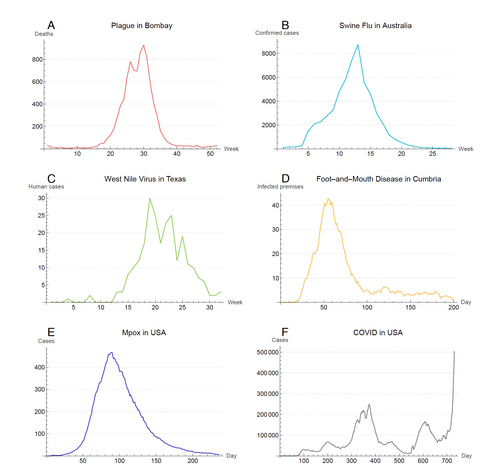
One of these epidemic curves is unlike all the others
Carl Bergstrom and Bill Hanage in PNAS today explain why
http://carlbergstrom.com/publications/pdfs/2023PNAS.pdf

@erictopol
Edit: ahh itโ€™s #Covid data until 2021 ๐Ÿ˜… The author is probably quite surprised by now. ๐Ÿ˜ณ

I read it twice, but the article didn't explain anything? We just act differently now, but why? I don't get it. Sorry. I am really confused by this article.

Have we acted more cautiously in other pandemics? If I remember what I read in old newspapers, I don't think so.

And the author only makes suggestions and has no evidence other than that the "#endemic" doesn't look like one.

@tobi82 Is your confusion about our commentary, or about the Saad-Roy and Traulsen piece what we are commenting on?
@ct_bergstrom I detailed the question ๐Ÿ™‹โ€โ™‚๏ธ

@tobi82 Again, are you talking about the commentary that I wrote and that Eric has linked to, or about the Saad-Roy paper that it itโ€™s commenting on?

There seem to be an awful lot of layers of confusion here. Yes, the Covid data are from the early part of the pandemic, illustrating multiple waves, as opposed to a single wave as predicted by SIR models. ##

I doubt the author was particularly surprised because I am he and I wrote this commentary in November 2023.

@tobi82 Perhaps you think we are saying that behavior explains why Covid is different than these other examples?

Because thatโ€™s not what weโ€™re saying at all. We are saying SIR model canโ€™t explain the dynamics that weโ€™ve seen for Covid, and we are point out that even epidemics that look SIR like, are not driven solely by those dynamics. Thatโ€™s why we explicitly describe the role of behavior/intervention in the MPox and Foot and Mouth curves.

@ct_bergstrom Thank you. Now our messages have crossed.

Now I get it. If your point is that the SIR model is not complex enough and ignores half the story, I can follow you.

Thanks very much!

@ct_bergstrom
Thank you very much. So yeah, I'm confused about the article, the link ๐Ÿ”— Eric posted. There is only one, the pdf.

And the SIR model, why do you think it should only be one wave? I have attached the calculations from the University of Bern (Christian Althaus). Look at the red line. I think that's it. And the current wave, well, the virus has mutated so much that we could call it a new pandemic. And so it fits the SIR model again.
That was my understanding so far.

@tobi82 It seems youโ€™re also confused about the nature of a commentary. This is not a research paper, it is like an ad for a paper with some background and associated context. Ours is a commentary about reference 3, Saad-Roy and Traulson, for what that is worth.

The equations you show from Christianโ€™s slides are from an SIRS model, not an SIR model. Thatโ€™s why you can get multiple waves.

@tobi82 @ct_bergstrom The problem here: this describes a SIRS model, not a SIR-model as given on the slide, imho.

@mavori @ct_bergstrom

Of course. And sorry, total immunity (SIR) was not really an option I had in mind ๐Ÿซฃ So yeah, SIRS of course.

@erictopol leaned to heavily on NPI, gave the virus more time to linger and mutate, and created a second overlapping pandemic?

I'm sure that's not it, but what is it?

@erictopol
Don't need anyone's explanation, just look at it. I suspect the lack of masking is a part. I wish ppl would look closer at wastewater for a leading indicator and set advisories based on that, not hospitalizations. #yowzer
@erictopol @ct_bergstrom Wonderful to see this exploration of the behaviour of the โ€œcrooked timber of humanityโ€ in a pandemic. I worry that our national Public Health bureaucracies, like the Public Health Agency of Canada PHAC), have cultural barriers that prevent them from accepting this type of model.
@erictopol To spare some time for the curious, here's a look at how that curve has been shaping up until now: