 BeaD
BeaD Wolfgang Hagen
In einer Podiumsdiskussion des Falter über die Verhältnismäßigkeit der #COVID19 Pandemiemaßnahmen durfte Kurt Langbein das tun, was er seit ca. April 2020 immer wieder tut: den schwedischen Weg loben.
Er erwähnte dabei nicht, dass im soziokulturell am ehesten mit SWE vergleichbaren Norwegen
▫️zweieinhalb Mal weniger Menschen an COVID-19 gestorben sind, wobei in SWE v.a. in der Anfangszeit in Pflegeheimen auf Tests verzichtet wurde.
Und erwähnt nicht ein immerhin im Nature-Verlag erschienenes Paper von 2022, in dem schwedische Wissenschaftler:innen den "schwedischen Weg" analysieren.
Sie beschreiben u.a., wie
▫️wissenschaftliche Erkenntnisse ignoriert wurden
▫️der Bevölkerung absichtlich über asymptomatische Übertragung, Aerosole und Masken im Unklaren gelassen wurden
▫️Bewohner von Pensionisten- und Pflegeheimen Opiate für ein leichteres Sterben statt Sauerstofftherapie erhielten
▫️Dokumente nachträglich geändert oder gelöscht wurden, um das eigene Handeln in einem besseren Licht erscheinen zu lassen.
Das sind Aspekte des schwedischen Wegs, die Langbein nie erwähnt.
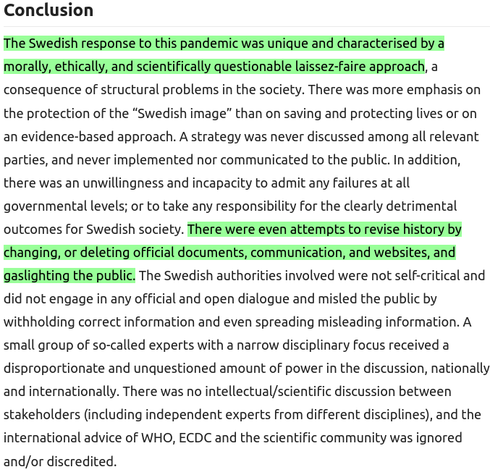

Evaluation of science advice during the COVID-19 pandemic in Sweden - Humanities and Social Sciences Communications
Sweden was well equipped to prevent the pandemic of COVID-19 from becoming serious. Over 280 years of collaboration between political bodies, authorities, and the scientific community had yielded many successes in preventive medicine. Sweden’s population is literate and has a high level of trust in authorities and those in power. During 2020, however, Sweden had ten times higher COVID-19 death rates compared with neighbouring Norway. In this report, we try to understand why, using a narrative approach to evaluate the Swedish COVID-19 policy and the role of scientific evidence and integrity. We argue that that scientific methodology was not followed by the major figures in the acting authorities—or the responsible politicians—with alternative narratives being considered as valid, resulting in arbitrary policy decisions. In 2014, the Public Health Agency, after 5 years of rearrangement, merged with the Institute for Infectious Disease Control, with six professors leaving between 2010 and 2012 going to the Karolinska Institute. With this setup, the authority lost scientific expertise. The Swedish pandemic strategy seemed targeted towards “natural” herd-immunity and avoiding a societal shutdown. The Public Health Agency labelled advice from national scientists and international authorities as extreme positions, resulting in media and political bodies to accept their own policy instead. The Swedish people were kept in ignorance of basic facts such as the airborne SARS-CoV-2 transmission, that asymptomatic individuals can be contagious and that face masks protect both the carrier and others. Mandatory legislation was seldom used; recommendations relying upon personal responsibility and without any sanctions were the norm. Many elderly people were administered morphine instead of oxygen despite available supplies, effectively ending their lives. If Sweden wants to do better in future pandemics, the scientific method must be re-established, not least within the Public Health Agency. It would likely make a large difference if a separate, independent Institute for Infectious Disease Control is recreated. We recommend Sweden begins a self-critical process about its political culture and the lack of accountability of decision-makers to avoid future failures, as occurred with the COVID-19 pandemic.
 Lars Marowsky-Brée 😷
 Clemens Grabmayer

 Barbara Maria-Evelin