Im Entwurf für ihr Europawahlprogramm setzt die FDP weiter auf "bezahlbare Energieversorgung" mithilfe kleiner Atomreaktoren (SMRs).

In der realen Welt wurde das einzige konkret geplante SMR-Projekt vor vier Wochen wegen zu hoher Kosten gestoppt: https://www.reuters.com/business/energy/nuscale-power-uamps-agree-terminate-nuclear-project-2023-11-08/

NuScale ends Utah project, in blow to US nuclear power ambitions

(This Nov. 8 story has been corrected to show that the Energy Department provided $600 million to NuScale and others to commercialize small reactor technology, not $600 million provided to NuScale, in paragraph 2)

Reuters
@mkreutzfeldt Nunja, vielleicht wären die großen Reaktoren ja ne sinnvolle Sache, um den co2 ausstoß schnell zu verringern. Das hat sich international sogar bei vielen Grünen rumgesprochen. Aber die sind ja total bekloppt. Die einzig wahren Lösungen kennt man in Deutschland!?

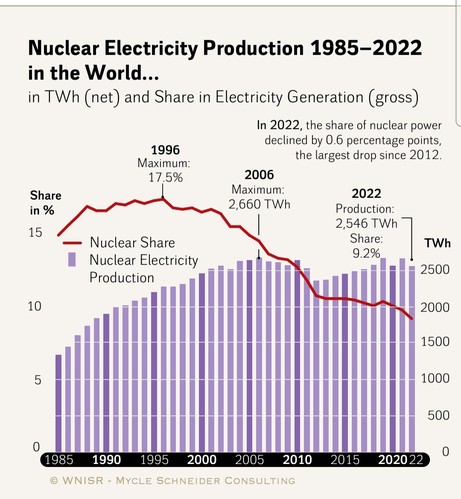
@timothei @mkreutzfeldt Die Wirklichkeit sieht anders aus. Es ist ja gerade _nicht_ so, dass Atomkraft international boomen würde; sehr gut zusammengefasst im World Nuclear Industry Status Report: https://www.worldnuclearreport.org/-World-Nuclear-Industry-Status-Report-2023-.html

Darin enthalten sind Kapitel zu SMRs, Wirtschaft und Finanzen, sowie ein Vergleich der weltweiten Investitionen in Kernkraft vs. Erneuerbare Energien.

#WNISR2023 #kernkraft #erneuerbareenergien #fdp

World Nuclear Industry Status Report 2023

The World Nuclear Industry Status Report 2023 (WNISR2023) assesses on 549 pages the status and trends of the international nuclear industry. It provides a comprehensive overview of nuclear power plant data, including information on operation, production, fleet age, and construction. The WNISR assesses the status of newbuild programs in existing as well as in potential newcomer nuclear countries, and looks at the status of Small Modular Reactor (SMR) development. WNISR2023 contains a special focus chapter on Nuclear Power Economics and Finance that assesses how persistent competitive pressures force the nuclear sector to rely on increasing state support. Further focus chapters include an expanded analysis of U.S. nuclear policy, including its multiple new subsidy mechanisms, as well as an assessment of the struggling South African nuclear program amidst a continued electricity crisis. The report also looks at the history of Germany’s phased-out nuclear fleet until its last three reactors were closed in April 2023, and scrutinizes the difficulties that neighboring France has been facing in a historically catastrophic year of nuclear performance. The situation of the Russian nuclear industry, as well as complex implications of the international interdependencies with nuclear players in other countries, are subject to closer scrutiny. A United Kingdom Focus looks at the many challenges of operation, decommissioning, ongoing construction, and future prospects. The Fukushima Status Report provides an overview of ongoing onsite/offsite challenges of the 2011-disaster, as well as legal developments regarding citizens’ health and compensation claims. The Decommissioning Status Report looks at the current situation of the now over 210 closed nuclear power reactors, close to one third of all units in the world that have generated electricity at some point. The chapter Nuclear Power vs. Renewable Energy Deployment provides an overview of the increasing gap between the development patterns of the two electricity generating technologies. Annex 1 offers an overview by region and country of all operating nuclear programs not covered in the focus chapters.

World Nuclear Industry Status Report
@StephanB @mkreutzfeldt Runter geht's laut dem Bericht aber aktuell auch nicht wirklich. Danach sind wir weltweit quasi noch auf dem Peak. Und ich denk ja auch, dass langfristig andere Techniken sinnvoller sind. In dem Moment, wo man co2 einsparen will, alle Kraftwerke abzuschalten und dafür auf Kohle zu setzen, ist imho aber ziemlich bescheuert. Aber im Sinne der Völkerverständigung in Ordnung! Ich gönn den Franzosen den Export ihres Atomstroms.

@timothei

S. 45/46: "In 2022, the share of nuclear power [in global electricity generation] declined by 0.6 percentage points, the largest drop since 2012."

S. 98: "For the first time since 1980, France turned into a net importer of electricity (16.7 TWh) [in 2022] with Germany playing a key role exporting 15.3 TWh net."

Lasst uns so schnell wie möglich #erneuerbareenergien fördern - das hilft schneller, ist wirtschaftlicher und hat weniger Risiko.

@mkreutzfeldt