Nervous System is a strange business. We are a computational design and digital fabrication studio known for things like a no-assembly 3D printed dress or designing 3D printed organs.

However neither of those things actually make any money. Monetarily we are primarily a jigsaw puzzle company. How did that happen?

So here’s a thread about jigsaw puzzles.

15 years ago, like most people, we knew jigsaw puzzles as mass produced die cut cardboard toys. While fun, the shapes are very simple and repetitive. In fact, the same die is usually used for multiple designs, so puzzles from the same company can swap pieces

However, puzzles were originally made of wood and hand cut by an artist using a scroll saw. Jigsaw puzzles have a rich history going back to the industrial revolution. Individual artists had their own unique style and puzzles often included "whimsy" or figure pieces thematic to each puzzle. Being cut by hand, often with no pattern, each one was different. With the advent of mass production this art form was largely lost, though there is a small community still dedicated to the craft today

Here is an example from master puzzle maker John Stokes III

https://www.custompuzzlecraft.com/

JSS III Design & Custom Puzzle Craft

Custom Puzzle Craft is closed permanently. This website remains up for legacy purposes.

We found out about hand cut wooden puzzles while on vacation in Paris. We followed a guide book to a small shop called Puzzle Michele Wilson. In it a woman sat with a saw, cutting out puzzles as we perused the store. We were delighted and amazed. They specialized in a technique called "color cutting" where the cut of the puzzle follows the image, making it extra challenging

https://puzzlemichelewilson.com/en/

We loved the style and uniqueness of hand cut puzzles, and we thought we could use our techniques of computational design and digital fabrication to reinterpret this craft. Not simply trying to mimic what artists did by hand but to explore the spirit of this art form in new ways.

We created a series of one of a kind puzzles which are computationally generated and laser cut. The cuts are created in a simulation based on a crystal growth process called dendritic solidification and the images are generated by a fellow computational artist name Jonathan McCabe and were based on reaction diffusion. We even went out a limb and bought our first laser cutter, an Epilog Helix.

You can read more about our first puzzles here:

https://n-e-r-v-o-u-s.com/blog/?p=2368

Generative jigsaw puzzles

Jigsaw puzzles for the 21st century! Each generative puzzle is a one of a kind creation with unique art and pieces. Our goal was to marry the artistry of traditional, hand-crafted jigsaw puzzles wi…

Nervous System blog

However, for years puzzles were not a major part of our business. They were my pet project. In fact, they weren't really something we talked about when discussing our work. Jigsaw puzzles just weren't very cool.

We still kept working on them though. One of the questions we asked was what can we do with our method of working that would be difficult or impossible to do by hand? This led to the "Challenge" puzzle, a puzzle I originally designed as a Christmas present for my brother. The puzzle has no image, no border, and there is a set of colored pieces scattered throughout the puzzle that pulls out to make their own mini sub puzzle. This puzzle within a puzzle is what is enabled by computation and digital fabrication that is otherwise impossible to create.

https://n-e-r-v-o-u-s.com/shop/product.php?code=182

Nervous System | Shop | 2-in-1 Challenge Puzzle

While I said the challenge puzzle has no border, it really does. The border just looks like the other pieces. So we started to ask what if a puzzle really had no border, What would that look like? Pieces from the left could connect to the right and the top to the bottom. In that way, we create a tiling puzzle, which can be assembled in thousands of different ways. We can think of this topologically like a closed surface. Mathematics teaches us that something that tiles like this has the same topology as a torus. We decided to call this an "infinity" puzzle.
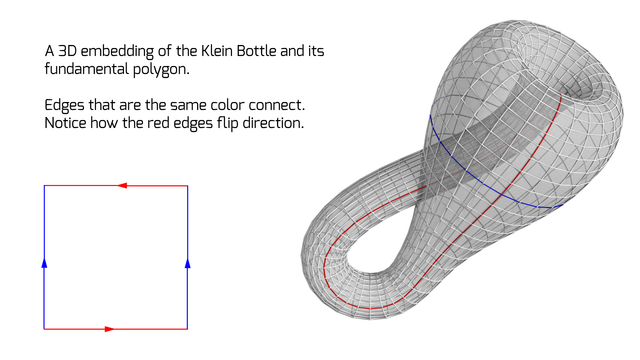
We can then ask, what other topologies are out there and what kind of puzzles might they create. A Klein bottle is a non-orientable surface which has no inside or outside. It's not possible to make in the real world without intersecting itself. However, it's topology is a lot like the torus except the top and the bottom connect in opposite directions. What happens when we make a puzzle like this? This is the question that changed our business forever

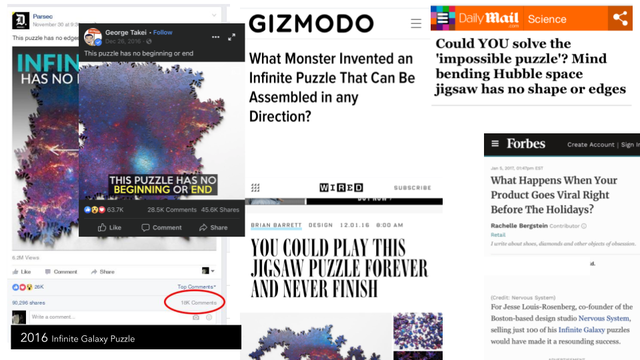
What you get is a non-orientable puzzle. Just like the Klein bottle has no inside or outside, the puzzle has no top or bottom. Pieces from the left flip over and connect to the right. We put an image from the Hubble space telescope on it and dubbed it the "Infinite Galaxy Puzzle". It is a double sided puzzle that makes a continuous image from the top to the bottom and every time you assemble it, you see a different part of the Milky Way galaxy.

https://n-e-r-v-o-u-s.com/shop/product.php?code=336

Nervous System | Shop | Infinite Galaxy Puzzle

This is the first and only thing we've created that went well and truly viral. We released it in 2016 during the hayday of Facebook video and it was reshared by various random aggregator accounts like "Bored Panda" and had millions of views on multiple accounts. There were tens of thousands of comments, like "What kind of evil person made this impossible puzzle"

And we were completely unprepared. Remember at this point, puzzles were just a side thing we basically did for fun. When we released this puzzle, we hadn't even finished designing the packaging. Everything about our puzzle making process was inefficient. As orders piled in, we changed "ships in 2 weeks" to "ships in 4 weeks" to "ships sometime next year". It was basically like doing a kickstarter but instead of shipping in 1 year, we shipped immediately. Jessica and I switched our sleep schedules so we could work alternating 14-15 hour shifts (no lunch break) keeping our single laser running 24 hours a day. At the same time we were trying to hire more help and buy a second laser cutter. This is by far the hardest thing I've done in my life and nothing else comes close

And so the next year we released another puzzle. And we thought, surely this can't happen again. This time no one will care about these puzzle. It was another computationally generated, one-of-a-kind puzzle called Geode. It was inspired by the formation of banded agates, and each puzzle had a different shape, image and cut.

Once again, we did not learn our lesson and were completely unprepared, and while it didn't have the same virality as the galaxy puzzle, it still went crazy. This time we had added the extra challenge to ourselves that each one was unique, so as we uploaded batches of 40 designs at a time, they would sell out within an hour. People complained that the one in their cart kept getting sniped because we hadn't designed a system to reserve items that had been added your shopping cart.

And once again, we had to buy an additional laser cutter.

https://n-e-r-v-o-u-s.com/shop/generativeProduct.php?code=339
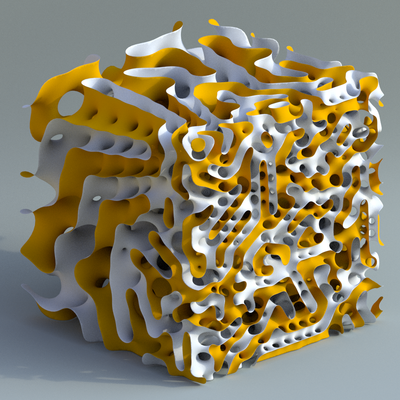
Nervous System | Generative Jigsaw Puzzles | Agate Puzzle

And so every year we've been releasing new puzzles around the time of the holidays. Always trying to explore new ideas in the world of jigsaw puzzles, computation, and digital fabrication. And somehow we've found ourselves running a little puzzle factory at the foothills of the Catskill mountains.

This year's puzzle is the Bismuth puzzle, the conceptual follow up to the Geode. You can get it here and support the continuation of our strange little studio.

https://n-e-r-v-o-u-s.com/shop/generativeProduct.php?code=411

Nervous System | Generative Jigsaw Puzzles | Big Bismuth Crystal Puzzle

And just to cite my sources, we certainly didn't invent laser cut puzzles. Liberty Puzzles is the company we saw that showed us laser cut wooden jigsaw puzzles were possible in large production

https://libertypuzzles.com/

And the Puzzle Parley is a gathering of (mostly hand cut) wooden puzzle enthusiasts. They have welcomed our strange digital ways, and it's where I met John Stokes who originally suggested the idea of a puzzle in a puzzle to me.

https://www.puzzleparley.org/

Liberty Puzzles | Wooden Jigsaw Puzzles

The original wooden jigsaw puzzle maker. Established in 2005, all of our 1000+ puzzles are handmade in Boulder, CO with exquisite quality & craftsmanship. Full of odd-shaped "whimsy" pieces, our wooden jigsaw puzzles are unique and entertaining. Custom puzzles with your image are also available.

Liberty Puzzles
@nervous_jesse this thread is amazing. I’ve been following y’all for years but didn’t know the full story, thanks for sharing it! I encourage you to turn this thread into a blog post,
as those are easier to share with people who aren’t on Mastodon
@nervous_jesse Thanks! I love these how-our-business-actually-works stories.
@nervous_jesse I have that puzzle! It was hard (it took me three weeks to solve). I had a lot of fun however. 🙂
@nervous_jesse love that such a simple tweak made such a huge difference
@nervous_jesse I wonder why did you go for a Klein bottle when a Möbius strip has a similar flip effect and is actually constructable. Then Möbius+Escher is a ready classic. I have it cut and glued from paper somewhere in the basement
https://www.weedist.com/wp-content/uploads/2013/05/Escher_Metamorphosis_II.jpg
@nervous_jesse probably exactly the jump - from what is a conceivable next step (Möbius strip, torus) to skipping several steps in order to get the mind perceiving it as an impossible magic - is what made the difference for the wow-bang effect
@mapto well for precisely that reason. A Klein bottle is a bit more mind boggling and surprising when trying to understand the puzzle (a projective plane is even worse). We also were working on the concept of a borderless puzzles and a mobius strip does have a border. Also, the Escher estate is very litigious so an Escher puzzle is a no go.
@nervous_jesse I love it. As you can see I'm a bit slow to follow through what you did, but it is genius
@nervous_jesse ...but I don't understand what "the Escher estate is very litigious" means. Is it about IP? Surely, there's no copyright on tiling patterns, and if one is after a related effect, it is all about transitive textures, which can be made procedurally. Then one gets into fractals... Even simple ones are difficult to conceive without at least a piece of paper :) Sorry, an amateur here fantasising in front of a professional, but you really got me way back into combinatorics

@mapto I’m just saying you can’t just slap an Escher image on a product and sell it. Nor can you use Escher’s name in marketing a product. You could however make an Escher-like tessellation as long as it isn’t an exact copy. In fact, we did that for an Escher exhibit at the MFA

https://n-e-r-v-o-u-s.com/shop/product.php?code=387

Nervous System | Shop | Lizard Infinity Puzzle ™

@nervous_jesse ok, I get it. Sure, just used the reference to pass a complex idea quickly. One gets inspired, then needs to grow out of the shadow of others
@nervous_jesse oh fun! reminds me of the puzzle lab puzzles in that they too have wacky pieces (though completely different shapes to yours) that are only achieved by laser. but they're not unique pieces per copy of the puzzle, just unique per design.

@leftpaddotpy I don't want to be "that guy" but puzzle lab is basically copying our work. There puzzle piece style is based on our Maze cut, which we released in 2017

https://n-e-r-v-o-u-s.com/blog/?p=7821

Geode, Maze, and Custom Jigsaw Puzzles

Geode is the latest fiendishly difficult jigsaw puzzle from “the monsters” who created the Infinite Galaxy Puzzle (that’s us!). It features a new style of puzzle cut we’re c…

Nervous System blog
@nervous_jesse i don't think that there's not room for two groups doing it but that's really unfortunate if they did get it from you that I've not seen any credit given.
@leftpaddotpy For sure, and it's way better than the Chinese direct copies. However, it still makes me a bit sad. It's also a failure of our own sort of marketing I suppose.