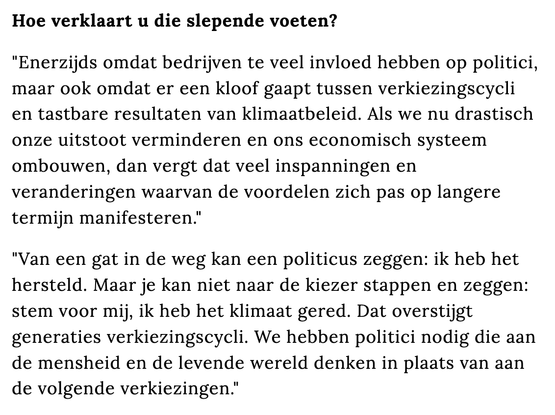
Politicians don't do enough about climate because there is a time scale mismatch between election cycles and tangible results of climate policies.

A politician can say: "Look, I fixed the pothole!" But she can't go to the voter and say: "Vote for me; I saved the climate." That transcends generations of election cycles.

We need politicians who think about humanity and the living world instead of the next election.
https://www.apache.be/2023/11/29/oceanograaf-david-ho-klimaatstrijd-heeft-disruptieve-actie-nodig-COP28

Oceanograaf David Ho: 'Klimaatstrijd heeft disruptieve actie nodig'

Aan de vooravond van COP28 hekelt de oceanograaf dat zeker fossiele bedrijven te veel invloed hebben op politici.

@davidho

Politicians are also hampered by the nature of preventative action: if you simply repave the streets frequently, to point and say “look a pothole never formed” seems weak.
“Look a whole bunch of people didn’t die in a bunch of disasters and from a bunch of diseases that didn’t happen” is the greatest achievement of modern society, and most of the electorate can’t see it.

@davidho Maybe we need to play up the short-term solutions and benefits more than long term catastrophe.

Examples:
Update home’s insulation means lower energy bills;
Livable communities with transit means less (expensive!) car dependency;
Bike cheaper than e-bike, which is cheaper than EV, which is cheaper to fuel than ICE;
Carbon tax and per capita dividend would mean more money in your pocket now & help pay for efficiency upgrades;
Etc.

@davidho we need voters who vote for people based on policy. Sadly we don’t have them. The idea that this problem can be solved by the right guy is flawed. The right guy lost in 2000 because another right guy decided to run against him because he wasn’t right enough.

@davidho

Yes, and it’s also useful to look at the dominant system of corporation and billionaire-funded political parties and think tanks, which includes active campaigns to shape both political discourse and policy in favour of vested interests.

Voters might have some influence on who gets into office, but who influences voters, and what happens when elected people get into office are probably the more significant leverage point.

@davidho
there are tangible things they can do that can produce results right away, along with the party investing in platforming a longterm vision. Showing phases, timelines, being accountable to deliver and provide good governance. Help people visualize different ideas.
Isn't that what a platform should be? And don't they have a party vision they want to be longterm, to keep voters voting for them? Isn't that why it's a party?
Or is it all egos seeking power for themselves in the moment?
@davidho for a moment I thought you were going to ask for election cycles as long as climate scales

@davidho I often implore young people to take names so that they know which graves to desecrate a few decades from now.

The ones that haven't gone underwater, anyway.

@davidho Consider also that there's little to disincentivize long-term damage in exchange for short-term gain, even in active decisions. A politician benefits from near-term results while the costs are borne by future generations. So this is a problem both for adverse action as well as inaction. 🙃