
Microsoft paid money for this. A lot of money. And they gave it to us for free.

I'm looking at a demo of this paper right now, which is kind of interesting - https://arxiv.org/pdf/2005.11401.pdf - but... it relies, the same way most AI models do, on a tectonic amount of human curation effort that's gone on behind the scenes to make it work.

I mean, it's nice I guess, and there's some nice features in a low-K-threshold, high-quality-training-data situation, but it sure looks like this will all fall apart if you point it at large, unvetted or adversarial data sets.

@mhoye I'm curious whether the problem is not the AI, but the expectation of "scaling"... that is, the way we'd need to train AIs is roughly the same way we need to train baby humans: "Here honey, this is a good book, read this one." "I liked this article but I'm not sure how I feel about X." "No no, don't lick the wall socket."

@mhoye also... it seems like most AI people have given up on...

1. Letting the AI ask questions to test its understanding (toddler)
2. Accepting corrections as input (elementary school).
3. Being able to research & cite sources (high school)
4. Being able to say "here's what I don't know" (college)

@bsmedberg My incomplete understanding of the state of the art is that there isn't really a path from where we are to self-interrogation or -correction in the models themselves, but that human feedback from ml-based chat services - "I don't think that's right..." - is driving those improvements. The biggest insights of the current AI cycle aren't coming from the ML tech, but from the questions being asked of it (which is, in yet another sense, just another mechanism for capturing free labor...)
@mhoye exactly. I'm not in the generative-AI business, but I am in the trained-model business, and I'm astounded by how little there is around "learning"... it's all train-from-scratch and models that cannot explain themselves or be corrected at all.
@bsmedberg @mhoye Same as how, from time to time, folks fascinated by the engineering side of cryptocurrencies would come up with some ideas that would actually do useful things... and everyone in the domain promptly ignored them because the point was never to do useful things, it was to make a facade of solving grandiose-sounding made-up problems as an excuse for scamming people.
@dalias @bsmedberg So, if you think of ML tools as "mechanical pattern recognition and repetition" - which is, fortunately _what they are_ - rather than falling into the trap of anthropomorphizing them even subtly (e.g. saying "learning" rather than "encoding") then their real utility becomes clear. I think there is a real tool here, somewhat-useful in itself but better as a dowsing rod for future improvement of tools & training, e.g. "Write this code" as hints for future language improvement.

@dalias @bsmedberg @mhoye @dalias @bsmedberg @mhoye The dreamers rarely can get the budget, and the implementors are rarely interested in working for free.

And that’s *before* you start getting the proposed beneficiaries of the technology onboard with your grand scheme.

(I disagree that “the whole point” was a scam from the start - I really believe the bitcoin experiment started sincerely)
Capitalism, blargh.
@cmdrmoto @bsmedberg @mhoye I mean "the whole point" from the standpoint of anyone with the influence to bring about adoption.
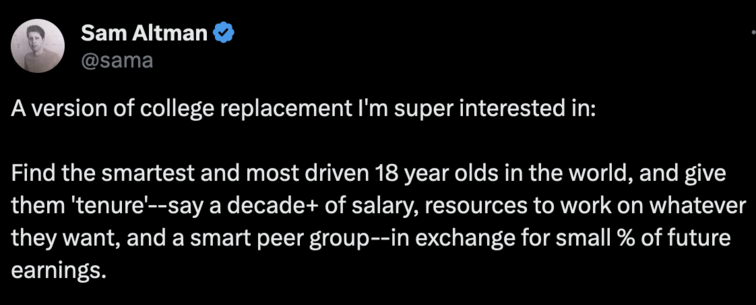
@bsmedberg Also, I just now remembered this tweet, which I think is a telling argument about the value some people put on the idea of learning.
@mhoye @bsmedberg
Tech bro reinvents *checks notes* the PhD
@bsmedberg @mhoye to be fair, people don’t do that either any more.

@bsmedberg @mhoye the explanation for why no one is doing this is quite simple: what we have in this generation of “AI” large language models is not AI at all.

It cannot learn. It cannot know. It cannot understand. It cannot cite sources because it does not know what a source is. It would not gain value from those kinds of questions.

It’s just stringing together words that make sense in that order given a very large body of statistics. That’s it. It is not anything resembling intelligent.

@trisweb @bsmedberg I agree with your premise, but I don't think that's the general question at hand. It's very possible to build tools and tool chains that are to some degree stochastically self-improving, for values of "self" that belong in waggly-fingers quotes; there's a path from "can you fashion a crude lathe" to modern precision machining. That increased-precision specialization isn't what current-AI types are after, though; they're looking for universal generalization (and getting mud.)

@mhoye @bsmedberg right, yeah. What we don’t really know yet, and will be interesting to find out, is whether the very premise of the current round of “AI” LLMs is fundamentally incompatible with that kind of development, or whether they could actually be a path to more generalized intelligence and human like characteristics.

It’ll still be more and more useful the more “extensions” we can add to the language, and maybe we’ll get close. Just hard to say right now.

@trisweb @mhoye do they need to be tied together? I’d love more traditional ml systems with iterative training, less certainty, and any kind of explanation pattern or feedback loop with the underlying features.
@trisweb @mhoye @bsmedberg I can see how LLMs could be an engine in an AGI. You set it up into a feedback loop that takes in external inputs and can output info from it's loop as it pleases. You have sub steps where you feed In the last N tokens and summarize the context analogous to short-term working memory, you have a database system for long-term memory that the AI can read and write from each cycle to bring long-term memory into short-term memory. It's believed human level intelligence arose from language and that Consciousness is the feedback loop of us thinking about our own thoughts so it's not the worst place to start. Once you can get something like that to start doing logical reasoning in a way that's meaningfully better than what the base llm is spitting out you're probably most of the way there
@trisweb @bsmedberg @mhoye indeed LLMs are just really good pattern matchers that got really really good all of a sudden and people's imaginations are running wild. Making it into something more is gonna take work.