It’s often the case that critics of anarchism will demand to know how we might obtain public goods without the state, because their entire frame of reference for public goods is in the context of state monopolies.

And I might reply that all sorts of public goods predate the state by thousands of years or more. Neolithic peoples were building trackway roads and monumental architecture and all kinds of neat things.

And critics of anarchism will often gleefully seize upon this as if it presents some clever gotcha. They think this means that *the best* we can hope to achieve without the state is a Neolithic-level of technology and cooperation.

And I find that response to be…so immensely sad. They see a dead-end; I see incredible achievements with only the barest of technologies and available knowledge, and can only wonder at the marvels we’d be able to achieve together now.

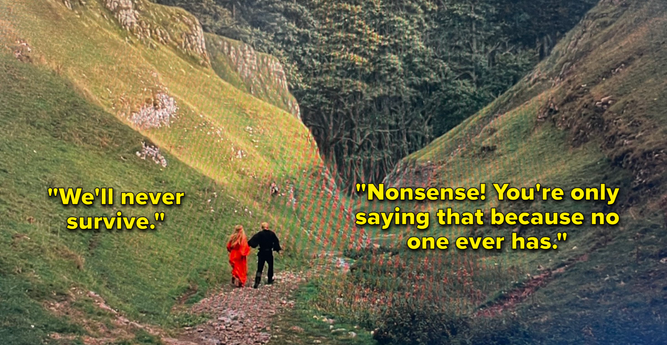
@HeavenlyPossum I generally wish anarchists the best, but most descriptions of how the world would work under anarchy widely-deployed remind me of this meme.

I can't fault the optimism though.

@mark

Human beings have been around as a distinct species for at least 300,000 years. States date back to the Bronze Age, at the absolute earliest about 6,000 years ago, and didn’t come to dominate a majority of the global population until about 500 years ago. There are still extant stateless societies that states haven’t been able to assimilate.

@HeavenlyPossum You look at those facts and see "We have a lot more experience, organismically, being small disconnected groups than large organized states. If anything has a claim to being the 'natural state' of humans, it's anarchy."

I look at those facts and see "Wow, this 'state' technology sure did completely dominate the paradigm, to the point where the stateless societies only exist at the benevolent largesse of their neighboring states anymore. I don't know how to get into a mindset where I'd think anarchy is possible when it can only live until the nearest large group of people organized around a common collective myth can just beat them up and take their stuff."

... were anarchy to succeed at scale in the modern era with 8 billion people on the planet, I think we'd need, somehow, to arrange things so that a large enough group to engage in group self-defense does so while simultaneously maintaining the purity of ideology to allow their members to act independently and self-organizationally when the whole group isn't threatened. And I have no idea how to square the circle of the apparent inherent contradiction in those goals.

Not saying it's impossible; definitely saying I'm not smart enough to see it.

@mark @HeavenlyPossum

That interpretation is consistent with the facts, but is it likely given the facts?

States existed for thousands of years simultaneously with stateless societies. Then something happened a few centuries ago and the state became the prevalent form of social organization.

Given those facts, the prevalence of states is almost surely more closely related to that ‘something’ that happened a few centuries ago than to the state ‘technology’ itself.

@magitweeter @mark @HeavenlyPossum

I believe the "something" that happened, was agriculture.

The moment we started claiming swaths of land as property, and building up populations too large for our tribe comprehension to keep pace with, our current path was in some ways inevitable.

@magitweeter @mark @HeavenlyPossum

Oh and another big "something" that happened, was the moment we figured out how paternity actually works.

That's when children became property, too.

@violetmadder @magitweeter @mark

I would encourage you to check out James Scott’s Against the Grain and Wengrow & Graeber’s Dawn of Everything, which both directly address this issue.

@violetmadder @mark @HeavenlyPossum

Agriculture didn't start a few hundred years ago.

Agriculture started several thousand years ago, and it's (very broadly speaking) what made states possible, but it would take thousands more years for them to become the dominant form of social organization.

“Something” is more probably somewhere between mercantilism and industrial capitalism.

@magitweeter @mark @HeavenlyPossum

Compared to the hundreds of thousands of years that came before, the 7,000ish it took to build up the new dynamics with sufficient population levels and tech to kick off massive invasions is a snap.

@violetmadder @mark @magitweeter

We do know of stateless agricultural societies, as well as non-agricultural societies that had deeply hierarchical state-like institutions. I don’t think the connection is as causal as this.