Holyday steps in to help Bradford out, asking Bradford if construction is risky and if the city has ever directly built a high-rise building. Bradford says no. Holyday asks if the City has a history of cost overruns and delays on other projects. Bradford says yes.
Bravo asks if Bradford agrees that recent experience with P3s show that the private sector does not in fact take on the risk and build projects better.
Bradford responds by claiming the Eglinton Crosstown is a “government agency-led project” with Metrolinx in charge.
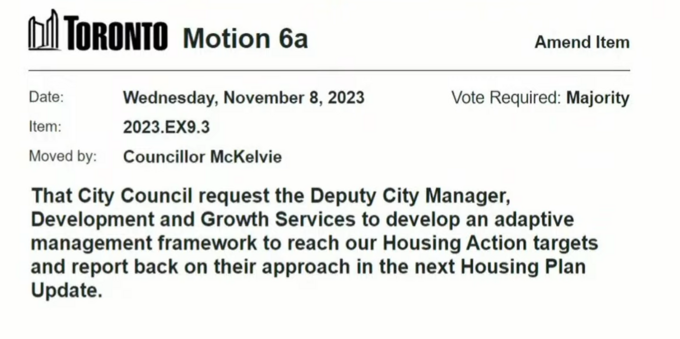
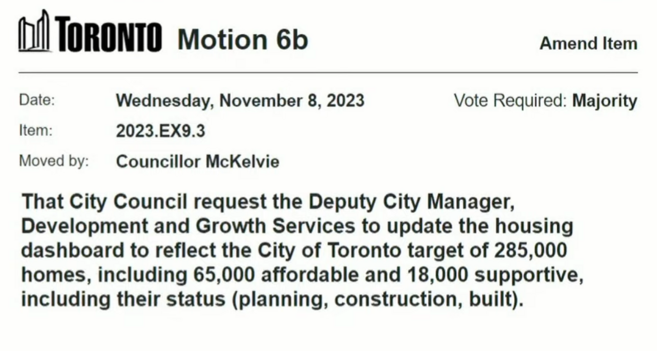
Councillor McKelvie has some motions too.
- To develop an “adaptive management framework” to meet the new housing targets.
- Update the housing dashboard with the new targets.
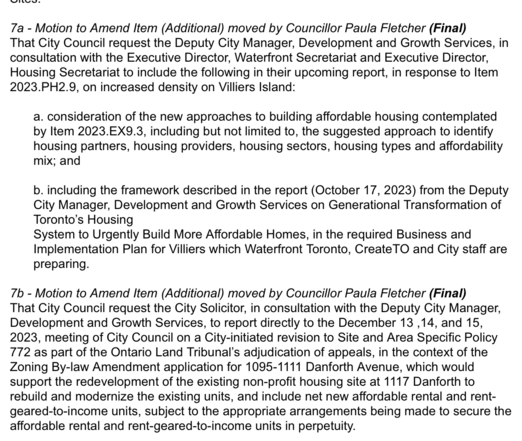
Councillor Paula Fletcher moves for staff to do analysis on approaches for building affordable housing on Villiers Island, and for a report on redeveloping a Danforth Ave site with additional affordable units.
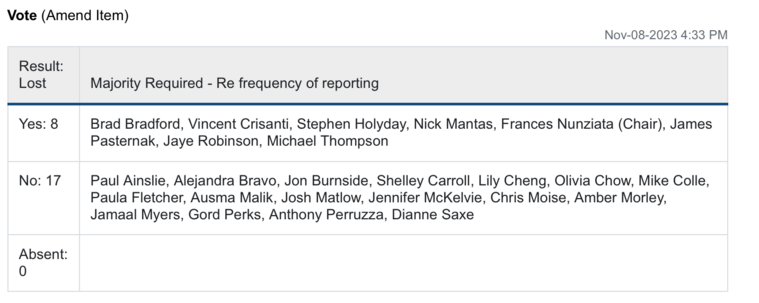
Time to vote. Holyday’s motion to provide quarterly reports on the new Housing Plan FAILS 8-17. They’ll stick with annual reports.
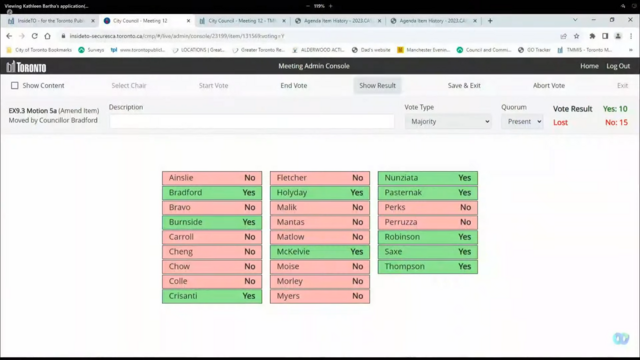
Councillor Bradford’s motion to request inclusionary zoning be applied only in areas “where supported by market analysis” FAILS 10-15.
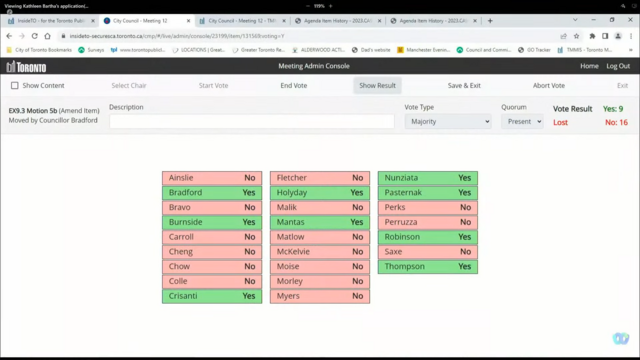
Councillor Bradford’s motion to delete the words “public builder model” and rule out the city serving as construction manager or general contractor on housing projects FAILS 9-16.
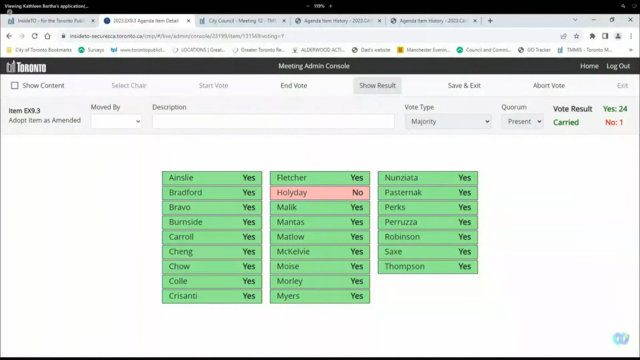
Mayor Olivia Chow’s new affordable housing plan, targeting 65K rent-controlled units by 2030, CARRIES 24-1.
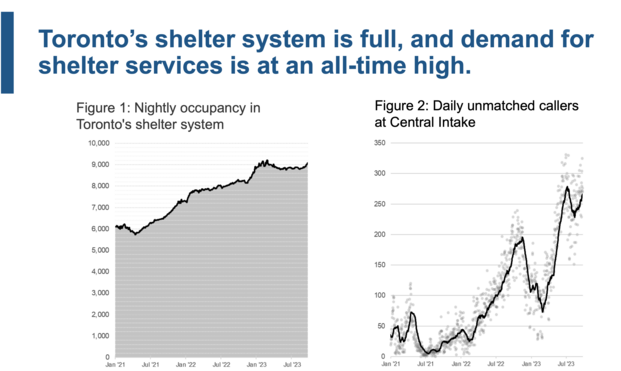
Up now: a debate on Toronto’s shelter system, and the readiness for the winter season. It all looks grim — the system is already at capacity, with hundreds of people unable to find beds each night.
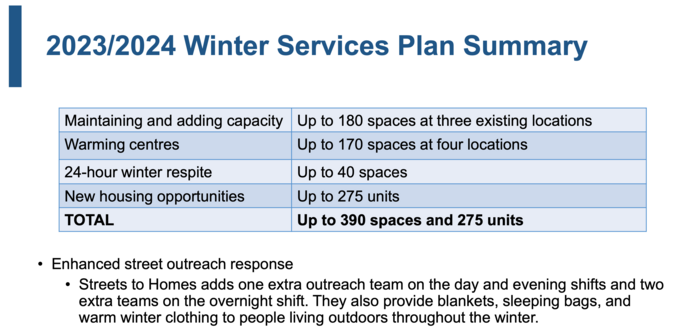
The city plans to add up to 390 indoor spaces (including a new 24-hour respite centre with 40 spaces) and offer up to 275 new housing opportunities this winter. (The inclusion of “up to” with numbers like these always makes me nervous.)
Deputy Mayor Ausma Malik asks about using the federal armouries in the city as shelters this winter. Shelter GM Gord Tanner says the inquiry has been made, and the city is waiting to get info from the federal government on whether they’ll be made available.
On the shelter plan, Mayor Chow notes the cold and wet weather outside right now. She says the fed gov must step up to help the ~40% of shelter users who are refugees. At same time, city must transition high-cost shelter hotels to lower-cost new purpose-built shelters, mayor says
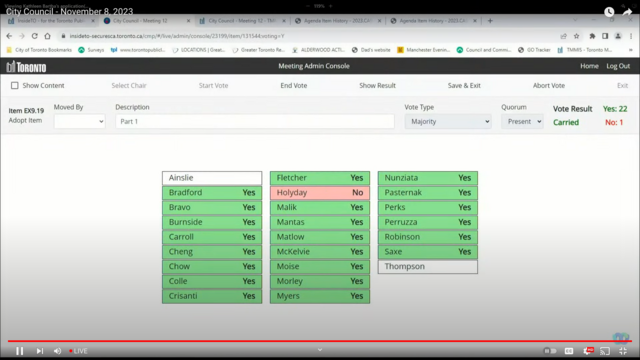
The request that the federal government open city armouries for use as shelter spaces CARRIES 22-1.
Request to look at using public land for permanent or temporary shelters, modular housing, tiny homes etc CARRIES 22-1.
And that’ll do it for today. Council breaks for the night.
Back at 9:30 a.m. with 44 items left on the agenda. Up first tomorrow: the expansion of the non-police crisis response service.
Council’s back for day two. Things are getting started with a tribute to the Toronto Youth Cabinet on the occasion of their 25th anniversary. Damn the youth cabinet is getting old.
Day two stream is here: https://www.youtube.com/watch?v=hdi7ZqJ23ec

City Council - November 9, 2023
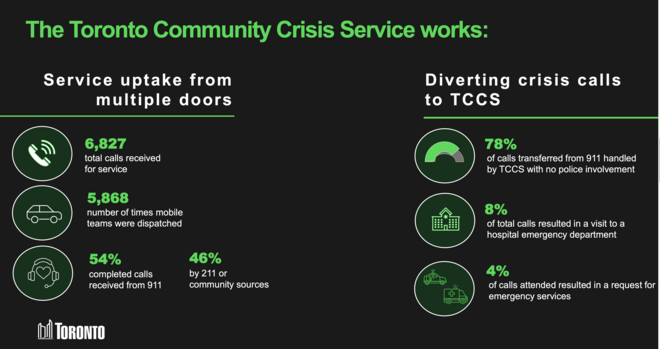
Up first: the recommended city-wide expansion of Toronto’s non-police crisis response service. A pilot project has gone pretty darn well, with nearly 7K calls received, and 78% handled with no police involvement.
https://secure.toronto.ca/council/agenda-item.do?item=2023.EX9.10Agenda Item History 2023.EX9.10
Agenda Item History 2023.EX9.10
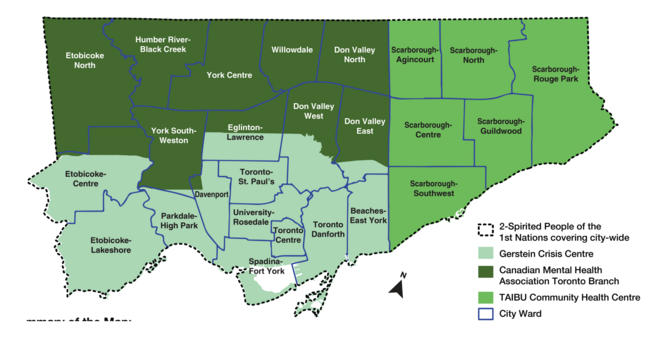
The proposed expansion will see calls for people experiencing mental crisis handled by four organizations, with three geographic districts and one city-wide Indigenous service.
The city-wide non-police crisis response program is expected to cost $35 million a year. Report recommends council ask the provincial government to fund it like they do other public health programs, with a 75%/25% provincial/city split. Will Queen’s Park agree? TBD.
(Seems like there’s a decent case this program should be funded via an offset from the police budget but I’m not sure there’s an appetite to have that argument right now.)
After staff questions, Mayor Olivia Chow is the first speaker on the item. She lauds the non-police crisis response service and the work that got city hall to this point, saying that adding this as Toronto’s fourth emergency service will have a “generational impact.”
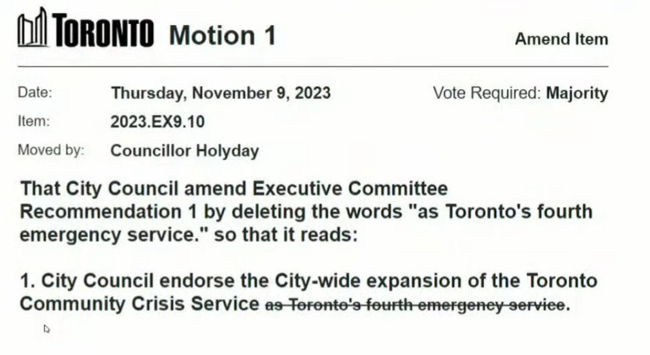
Councillor Stephen Holyday has a motion. He wants to strike the language about the crisis response service becoming “Toronto’s fourth emergency service.”
He worries those words may “haunt us” and create undue liability or expectation.
Councillor Chris Moise asks Holyday if he thinks people in mental health crisis are not, in fact, experiencing an emergency? Holyday deflects and says he’s not trying to devalue the experience of people, but just doesn’t like the use of the word “emergency” in this context.
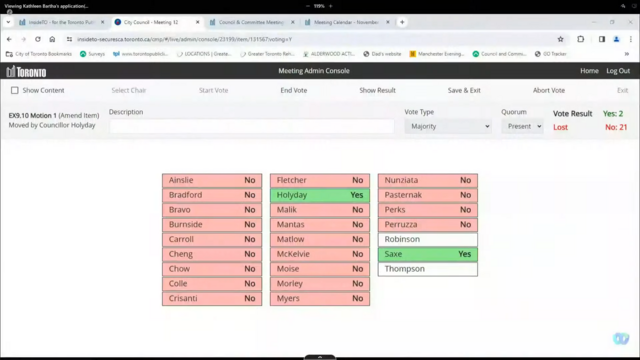
Holyday’s motion to NOT call Toronto’s non-police crisis response service an “emergency service” FAILS 2-21.
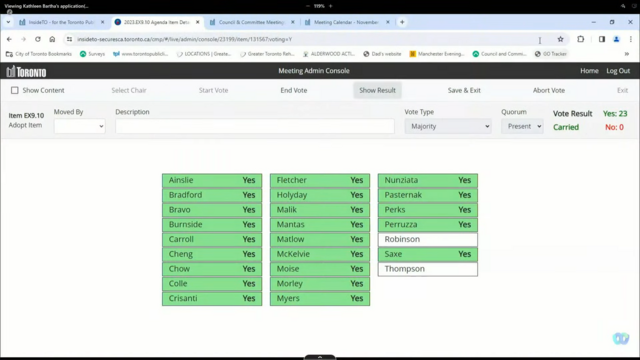
Council votes 23-0 to ENDORSE the city-wide expansion of the non-police crisis response service.
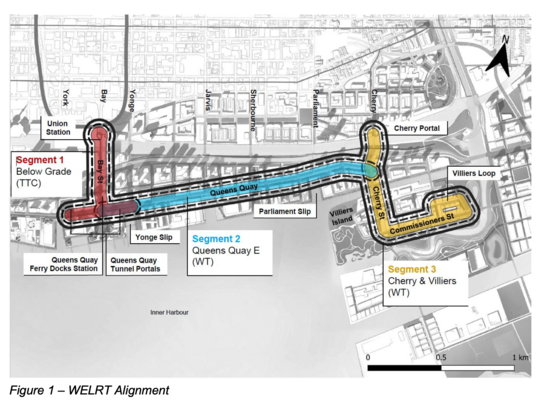
Up now: the Waterfront East LRT, which is way overdue and also way underfunded and years — maybe decades — away from construction. A sad story. I wrote about it in the Star this week:
https://www.thestar.com/opinion/contributors/massive-overhaul-of-the-toronto-port-lands-is-already-something-to-see-just-don-t/article_e0f8e9f0-7dd8-5763-8983-173d95600fb0.html
Matt Elliott: Massive overhaul of the Toronto Port Lands is already something to see. Just don’t plan to take the TTC
Council will be asked to spend $135 million on the Waterfront East LRT, but without funds from the province or Ottawa, it will be wasted money.
Council is being asked to advance parts of the Waterfront East LRT to 60% design, but there’s a risk of up to $135 million in prelim work being “sunk costs” if federal/provincial/other funding doesn’t materialize for construction.
https://secure.toronto.ca/council/agenda-item.do?item=2023.EX9.14Agenda Item History 2023.EX9.14
Agenda Item History 2023.EX9.14
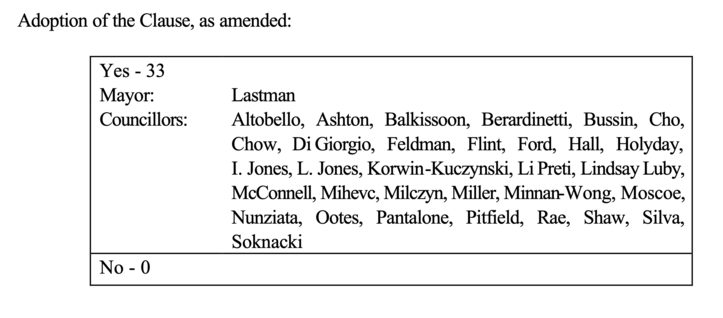
From the archives: a 2003 motion adopted unanimously by Toronto City Council that they “reaffirm the principle that transit is a core element of the future redevelopment of the Waterfront.”
Twenty years later, still waiting.
Councillor Nick Mantas asks if staff have considered “trackless transit” technology for the waterfront. Staff say they have not, and have concerns about adding new types of technology in terms of long-term maintenance, etc.
Councillor Lily Cheng asks about proportion of public space in the eastern waterfront, and how staff are making sure it isn’t “very cluttered, with a lot of housing which is what a lot of our current waterfront looks like.” Chief Planner says the vision is a complete community.
Staff say further delays on the Waterfront East LRT will undoubtedly increase project costs, potentially to the tune of 4.5% to 5% for every year of delay. Current full-project estimate is $2.6 billion.
Councillor Mike Colle is also asking about technology alternatives, saying “streetcar technology” is outdated. “Why spend billions building an obsolete thing on the waterfront?”
Colle points to how long it’s taken to build LRTs on Eglinton and Finch, and suggests the city must look at alternatives for the waterfront. “This could be another boondoggle that we could avoid.” He likes electric buses in dedicated lanes but isn’t making a motion. Okay then.
Mayor Olivia Chow is the final speaker on the Waterfront LRT. Nunziata accidentally calls her “Councillor Chow.” Chow jokes that’s appropriate, because she actually was a councillor when this line was first talked about, twenty years ago.
Chow says waterfront transit will benefit everyone, linking people to these new neighbourhoods. “It’s exciting, and we are starting — FINALLY — to do the planning.”
The vote on the Waterfront East LRT will be delayed until after lunch, because Councillor Paula Fletcher wants to be in the chamber for it, and she’s not now.
Back at 2 p.m. to do that, then the rest of everything. There are 37 items left on the agenda.
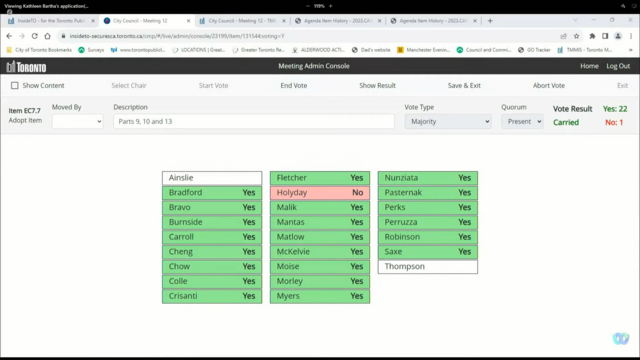
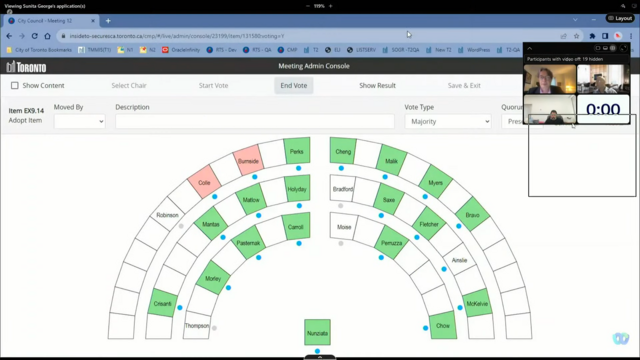
Council is back. The recommendation to go forward with design work on parts of the Waterfront East LRT — despite uncertainty about construction funding — CARRIES 18-2.
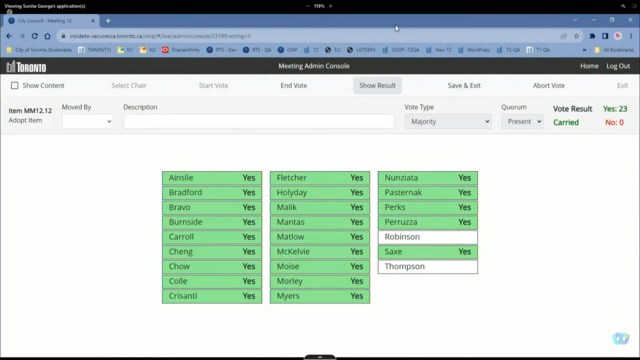
(Don’t know what’s up with that alternative vote results screen. Kind of neat you can see the seating chart for mayor and councillors, I guess!)
On to member motions. Councillor Chris Moise’s motion for a report on using photo radar to enforce the King Street transit corridor CARRIES via show of hands.
https://secure.toronto.ca/council/agenda-item.do?item=2023.MM12.1Agenda Item History 2023.MM12.1
Agenda Item History 2023.MM12.1
Councillor Dianne Saxe’s motion requesting the federal government create a Youth Climate Corps CARRIES via show of hands. By their powers combined… Earth, Fire, Wind, Water, Heart!
https://secure.toronto.ca/council/agenda-item.do?item=2023.MM12.4Agenda Item History 2023.MM12.4
Agenda Item History 2023.MM12.4
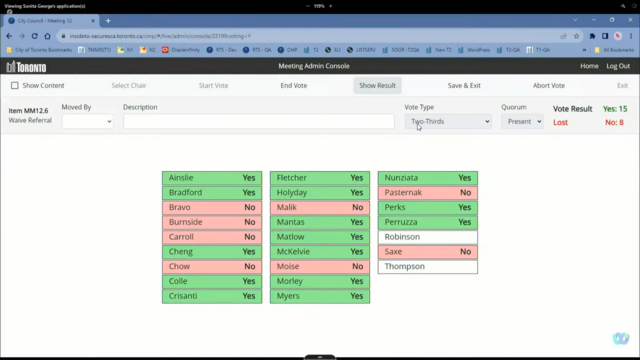
Councillor Stephen Holyday’s motion for a report on whether the Etobicoke Coat of Arms is, in fact, racist fails to make the agenda. Vote was 15-8. It needed a two-thirds majority. Item will get referred to committee.
https://secure.toronto.ca/council/agenda-item.do?item=2023.MM12.6Agenda Item History 2023.MM12.6
Agenda Item History 2023.MM12.6
 Matt Elliott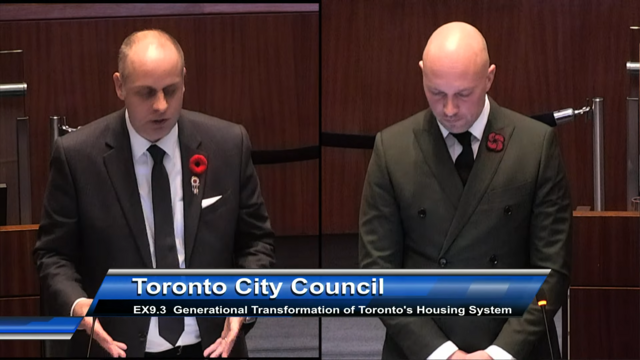



 nev
nev Tom 🇨🇦