
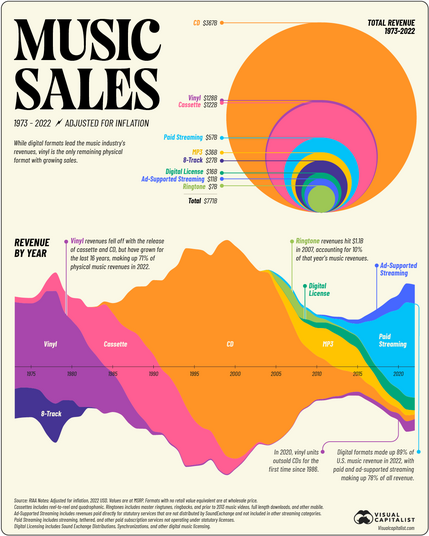
fascinating (and gorgeous!) chart showing the evolution of recorded-music revenue over the last 50 years

the first thing that jumps out at me is how much smaller the overall pie is post-streaming. the streaming services and major labels have successfully managed a) to dramatically devalue recorded music and b) to put a much larger percentage of it directly into their own pockets. it's one of the single biggest upward transfers of wealth in history — from artists to billionaire corporations
@hilljam It would be interesting to compare concert revenue over the same period, because the artists who can have turned that into a massive income source for themselves.
@jimbush i would be SO interested to see that chart! you are absolutely right, though — those of us who do music for a living have increasingly been forced out onto the road if we want to continue paying our bills. those of us who are able to tour, that is — not everyone can.
@hilljam @jimbush this, it's rubbish for disabled artists and taxing on able bodies - especially with COVID. Not to mention that disabled listeners (like me!) can't attend them safely. Live performances are not a replacement for recorded music.

@Rhube @jimbush you're so right about this, ro. it's at one level a fundamental issue of access and equity! 🖤

also, live isn't always possible from a creative or technical point of view. some artists are very much studio artists. forcing people to rely on live income marginalizes entire segments of creative work!

@hilljam @Rhube @jimbush
The ability to make money from touring is also being squeezed. For years venues have been taking bigger and bigger cuts of ticket/door money and even 50% + cuts on merchandise sales.

Add to that the tour agencies artists are forced to work with...

We need to move into the post-streaming era with something like a P2P artist-run service that completely cuts out labels and streaming platforms.

#music
#streaming

@maelduin13 @hilljam @Rhube @jimbush it's been ever thus....

"I am the entertainer
I bring to you my songs
I'd like to spend a day or two
I can't stay that long
Naw, I got to meet expenses
I got to stay in line
Gotta get those fees to the agencies
And I'd love to stay but there's bills to pay
So I just don't have the time" <Billy Joel>

@Dasy2k1 @maelduin13 @hilljam @jimbush you might be missing a BUNCH of points here...
@jimbush @hilljam live was always the main source of income for most artists able to do so. And well, that’s also being taken away by TicketMaster and friends.
@hilljam @aredridel I’d like to see a version of this chart adapted to revenue earned by artists, not total revenue
@samnabi @aredridel i believe it's basically the 📉 emoji 😂🖤

@hilljam @samnabi @aredridel I'm not sure it's all that simple, this report for UK gov suggests there's a bit more nuance around streaming reconfiguring who gets paid for what https://assets.publishing.service.gov.uk/media/614c760fd3bf7f719095b5ad/music-creators-earnings-report.pdf

(With the big caveat this just looks at 2000s and not historical earnings - which I would love to see but haven't anywhere)

@hilljam

Thank you for sharing this. Feels a little disorienting without a defined Y axis, but indeed pretty

@VoiceofDuum @hilljam

Yeah, this is a picture I'd use to explain to students what a graph is not.

No y-scale, weird wobbles for no apparent reason, and that dreadful stacked format that is generally difficult for people to interpret in non-misleading ways even when it doesn't float randomly around the x-axis.

Freaking gorgeous, though.

@hilljam about 60b of those cassette sales are because of me buying, wearing out and then buying tapes again all those years ago
@jason $1B alone from the cars greatest hits
@hilljam what I find amusing is how desperate this chart is to show value for vinyl.
@nailsthatglow can you say more? i read this chart as being a fairly dry assemblage of numbers, but perhaps i'm missing something!

@nailsthatglow @hilljam

I’m not sure why. Vinyl is purely a niche market, some of the record players on the market absolutely tear up peoples expensive vinyl (just as they always did) (people who aren’t audiophiles but just stupid people who think it’s cool to own vinyl) meanwhile I can fit on my phone with very good audio quality what used to take a whole room of shelving. I know which I prefer.

@hilljam everybody loves to hate on the streaming services for all the profit they make, even though most of them have yet to make any profit
@laurentoget @hilljam that is not the reason for the hate. The reason is that a pitifully small amount of the profit from sales (a distinct thing from the company's profit) goes to the artist. Your amusement comes from conflating the two distinct conceptions of profit.

@laurentoget @hilljam

Ah, that's the mystery of our age... All those tech giants have quasi monopoles, squeezing out competitors, paying the absolute minimum those actually doing the work, capturing the customers making it hard to leaving and decimating entire sectors that used to be thriving... And yet, don't make profits. (I'm thinking Spotify, but also the likes of Uber, Unity and many more)...

All the money goes in "fees" changed by the venture funds...

@Lily_and_frog @hilljam all the money actually goes to Intellectual Property Companies and Labels who hoard the rights to the 0.01% of music which receives most of the streaming revenues.

@hilljam funny, just yesterday I read a post about how CDs were the golden era - and look what a chunk they were!

Interestingly enough, I got a CD for the first time in ages this year (a request for my birthday) because I wanted the artist to be paid and I wanted to keep it as physical media. A small drop in the ocean, alas.

@Rhube @hilljam Yeah, it's probably not a coincidence that the format many people liked best was also the one that made the most profit.
@Rhube indeed. i still buy a lot of ambient and electronic records on cd, because we listen to them at bedtime and the bedroom stereo is cd-based!
@hilljam my friend had to order the CD from overseas - I hadn't realised when I asked for it. It's a reasonably popular American artist. I guess the market isn't there :(
@hilljam I'm wondering how much of the overall contraction in music sales during the cassette and mp3 eras are due to the easy availability of bootlegs/downloads.
@lisae it did contract in the mp3 era for the reasons you surmise — but you can see in the chart that the cassette era accompanied the single biggest growth era in the history of the industry!
@hilljam Yes, that's true, but the period where vinyl was starting to drop off and cassettes were growing, prior to CDs being introduced, there was a contraction. I remember that as the time when I spent my Sunday afternoons taping all my favourite songs from the top 40 on the radio 🤣
@lisae yes, 100% same. magical times 🥰
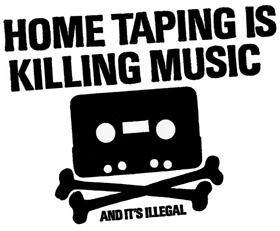
@hilljam @lisae And that was the time the major labels were trying to convince people that "home-taping is killing music." In fact, the opposite has happened: Mixtapes circulating in schools and colleges brought artists to people's attention in the first place and motivated people who liked them to buy their official releases.

@maytree @hilljam @lisae

For an album release this guy made more money from a donation link on piracy sites than he did from Spotify

https://youtu.be/L7EHRpnJICQ?si=GhP_BA1IM6pGXhCZ

Can Software Piracy Be Justified?

YouTube
@maelduin13 @hilljam @lisae Thanks, interesting example. But then he'll have made nowhere near the amount that major labels expect to make from Taylor Swift or any other big name on Spotify. But this guy is on Bandcamp, one of the few sites that might have had the potential to reduce parasitic middleman practices. Let's see how it fares now that it's been sold on for the second time within a year. #Enshittification ensues.

@lisae @hilljam

A lot. And that’s also the reason labels were able to gouge customers for CDs and CD rereleases initially. And that included not making CD singles available, so in some cases a 45 you’d buy for one song in the vinyl era would cost 16 dollars for the CD. So they ripped people off. And then torrent type digital downloads came along and that put a huge dent in that meal ticket. Eventually, they were forced to settle for digital downloads and streaming as main revenue sources.

@RodneyPetersonTalent @hilljam I do recall CD singles *existing*, but not necessarily being playable in whatever CD player you had. You're right, though, they were never widely available. Music really felt less accessible for a while there, and mainstream music was so overly manufactured. The studios really had everything the way they wanted it.

@lisae @hilljam

There were SOME CD singles. But for most hit songs that wasn’t the case. It got to the point where in December 1998 Billboard completely changed their Hot 100 chart to allow non singles to chart.

Before that, a hit had to be physically available as a single in some retail form to chart. This resulted in I believe 63 debuts on the Hot 100 that week if you compared it to their real published Hot 100 from the week before and not the published test chart from the previous week.

@hilljam @urbanbike How does one read this (bottom) graph?
@karlieeuh @urbanbike the x axis is years, which is labeled across the center. the y axis is total recorded music sales revenues, which aren't labeled. but, that number peaked in 1999 at $40B, and you can sort of interpret the rest from there in a relative sort of way
@hilljam @urbanbike but why is the bottom collapsing? where is the the y axis origin?

@hilljam this looks awesome. I would love to enphasize that corporations take a bigger share from the streaming revenue than they did from physical sales- because spotify is largely owned by the major labels. And with music as a service artists become much more replaceable- so they dont get to negotiate as much as they did back in the day. Its a bad time to be an artist.

Edit: spotify is not largely owned by major labels. It's another large company though.

@FlippoFlip @hilljam Spotify is not largely owned by the major record labels and never was. The highest stake they ever had in Spotify was 18%. This has dropped over time.

https://www.musicbusinessworldwide.com/heres-exactly-how-many-shares-the-major-labels-and-merlin-bought-in-spotify-and-what-we-think-those-stakes-are-worth-now/

Here’s exactly how many shares the major labels and Merlin bought in Spotify – and what those stakes are worth

Documents from 2008 reveal much about Spotify then – and now…

Music Business Worldwide
@kylotan @hilljam whoops. Thanks. My point remains valid though i think.

@FlippoFlip @hilljam The reasons majors take a bigger share from digital than physical is two-fold:
1) digital distribution costs are far lower, so less goes to retailers and distributors;
2) many records, especially older ones, are on old deals that pre-dated streaming and assign a smaller percentage to uses like this because nobody knew they'd become the main revenue source.

Many artists are fighting to fix point 2.

But for me, the bigger problem is the devaluation of music to $10/month.

@kylotan
The overall market value is much bigger than it was around napster time. Still, musicians make less. Someone is getting rich off the artist back.
@hilljam
@FlippoFlip @hilljam The market value is smaller now in real terms - that is shown in the graph at the start of this thread.
@kylotan
As i read it, it us smaller than the peak around 2000. It's about as big as 2006.
@hilljam
@FlippoFlip @hilljam Napster was 2000. That’s what ended the peak. It’s never fully recovered from that, and can’t as long as the tech industry holds all the cards.
@kylotan Napster peaked in 2001 and then shut down. So I'm not sure how it would cause the remaining decline after that.
@iaoth Napster itself didn't, but it opened the floodgates to a series of similar technologies - Limewire, Soulseek, Bittorrent, etc. Piracy was absolutely rife between 2000 and 2010.
How much does Spotify pay per stream? What you'll earn per song, and how to get paid more for your music

Spotify generally pays between $.003 and $.005 per stream, but how much you'll be paid differs based on your distribution contract.

Business Insider
@Hawkmoon @FlippoFlip @hilljam Never said it did :) Just saying that putting the problem down to major label ownership is untrue. The main problem is the way the tech industry was able to undervalue music; the way major labels treat their musicians is a big problem but not the root cause here.

@kylotan @FlippoFlip @hilljam

The tech industry behavior in no way absolves labels of their responsibility in milking musicians.

@Hawkmoon @kylotan @hilljam can we agree upon the fact that someone is earning a lot of money with music and it's not the artists?
If spotify or warner takes the rake is pretty irrelevant to me.