 Avid Seeker
In #Unix Programmer's Manual (1979), the `find` manual entry has a BUGS section listing "The syntax is painful." as a bug.
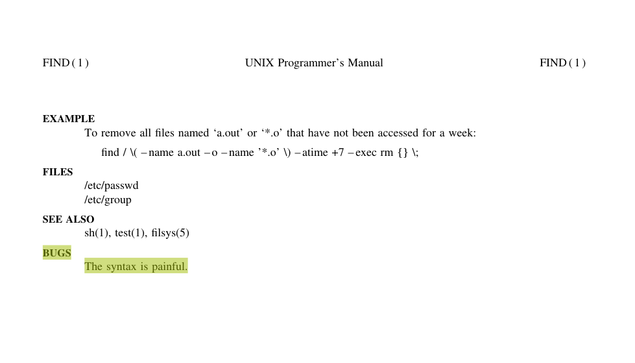
@avidseeker Yes. Yes, it is.
As an alternative to find(1), a lesser-known command called locate(1) was introduced in BSD Unix in the mid-80s. It uses a prebuilt, compressed database of pathnames to locate files by name.
I got familiar with it on a network of Apollo Domain/IX workstations. I set up cron jobs to run nightly searches on each host's filesystem and merge the results into a database of all the files on the LAN. That wasn't in the man page.
https://archive.org/details/login-feb83/page/n7/mode/2up?view=theater
@submicron @avidseeker The standard `locate(1)` program in Linux distros for a long time was `mlocate`, which had some performance problems as we reached more modern volume sizes and inode-tastic tree formats such as git repositories.
Fortunately `plocate` improves the performance back to the point where it's almost free to just try running `locate(1)` first and grepping out the paths you want.
 David Thomas
 Space Hobo