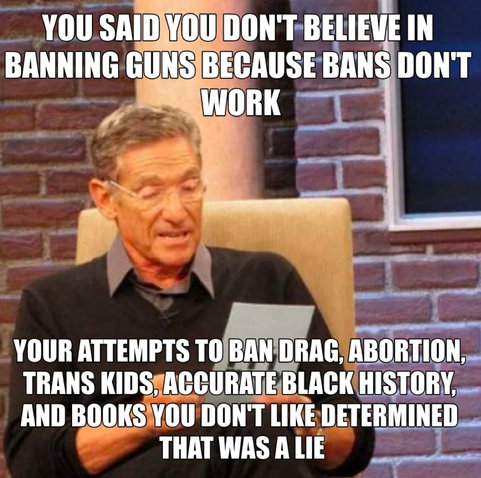
-Abortion: Ban it
-Marijuana: Ban it
-Drag shows: Ban it
-Immigration: Ban it
-Public Schools: Ban it
-Dialogue on racism: Ban it
-Books by Black or LGBTQ authors: Ban it
-Guns: BANS DON’T WORK YOU SNOWFLAKES
#Lewiston
@systemalias @QasimRashid as with every theory, it was constructed with boundaries. The free market theory was based on 3 principles:
- value can be expressed in money
- people make rational choices
- changes in demand can always be met
As long as these 3 principles are met, the free market can sort of work. Take for example things like bikes, pottery, books, etc. The 3 principles are mostly applicable and the market sort of works as intended.
It becomes problematic when we enter areas where:
- the value isn’t money
- people are no longer rational (either because of emotions or ignorance)
- changes in demand cannot easily be met
This is what happens when human lives are at stake (eg healthcare), the product is too complex to comprehend for most people (eg energy and water), or increasing supply is hard (eg education and the above 2 examples). In this case the principles are no longer met and therefore the theory becomes invalid (or at least should be treated as such until proven otherwise).
Applying free market theory in these situations is similar to using everyday physics at an atomic level; there are completely different rules at play, so the theory is more often wrong than right.

@Dave_von_S @systemalias@[email protected]
Cool. Show me how that theory fails on marijuana, justifying (under some goal) banning it.
First of all, I don’t think that banning that is a sensible (or even practical) idea, but that’s not the question.
The question is more if the free market philosophy would be applicable to these kind of substances. I don’t think it is, because it’s linked to a very large and complex ecosystem with many undesirable components and it’s impossible for the average consumer to make rational decisions.
This is typically a market that requires regulation before it can become a semi free market (similar to food). Which kind of regulation you choose (banning or assuring safety) depends on many other factors.
The crucial point is failure of the presumed rationality of an actor.
Plenty of research calls this to question universally.
It’s reasonable to infer then that regulation is the only viable path to a healthy or sustainable society, for many products. (Tobacco as a proven example.)
My original point actually wasn’t about theory. Political philosophy is deteriorating and hypocrisy is amplifying without acknowledgement.
@systemalias
Yeah, fair point. I should have taken your toot into the context you provided it.
I read it as ‘free markets are a failure’ but in hindsight you obviously meant ‘for these examples’. My bad.
To that effect then: a party moving stealthily to a new philosophy, especially with marketing like “MAGA”, underscores that the purpose of parties is to hold and maintain power.
This says a lot about the population and their supposed rationality too.
But I will reserve further analysis of that dynamic for another day.
@systemalias
Yeah I agree with that and that’s happening over here too (although to a lesser extent yet).
I also don’t think people in general are able to be rational about the future. Sure there are outcomes you might prefer, but we are unable to properly connect the dots on how to get there and what the impact of individual choices are. So (in general) we are sensitive to bias, gaslighting, etc.
The logic is to control people so they don’t rise up en masse as they should for many reasons.
But this is actually consistent. They don’t want to stop those things from happening, they want to punish people for doing them.
This is even more horrible, but I think it’s a necessary insight. They aren’t crazy, they honestly don’t believe the world can be better. They don’t think that you can get rid of guns, so bans just punish good people. Best explained by innuendostudios in the Alt-Right Playbook.