I got bored, so I decide to jot down my experiences of a rabbit hole I had some time ago. The topic is a piece of Chinese-Belgian history and collective memory. You're welcome to go down with me. Keywords:

#rant #rabbithole #Belgium #China #history #Kuleuven #Worldwar2 #Chiangkaishek #TVseries #bookpromotion #Xijinping #kingPhillipe
First, some context:
So, I came across an episode from The China History Podcast, titled “Qian Xiuling: The Belgian Schindler” and just by the sheer mention of my home country in the title, I clicked on it instantly (I know you would do too, fellow Belgians). The episode is basically an interview with a translator who talks about the book “Forget me” (忘记我) written by Xu Feng and published.
The episode made my jaw drop. “Forget me” recounts the story of Qian Xiuling (1912–2008) who studied at the University of Leuven in the 1930s, got a phd in chemistry, was settled in the remote Heubermont and later saved more than 100 Belgians from the execution by the nazis. Several times over the course of the war she went to Brussels to contact the military governor Von Falkenhausen whom she knew via her cousin Qian Zhuolun (who had trained with Von Falkenhaus in the army of Jiang Jieshi).
Now apart from some mistakes in the interview (“no, her alma mater is not in Brussels!”, “No, her alma mater was not called KU Leuven in the 1930s”), I enjoyed the episode and I wanted to know more about her, specifically how she was forgotten in the first place and how come we know about her since recently. The English book was not out yet and I didn’t want to wait for the Chinese book to come. So, I started to Google around to find archives, sources or people related to her story.
And here is where the rabbit hole begins. It led me to places I didn’t anticipate. This is what the rest of the thread will be about. So, strap in!

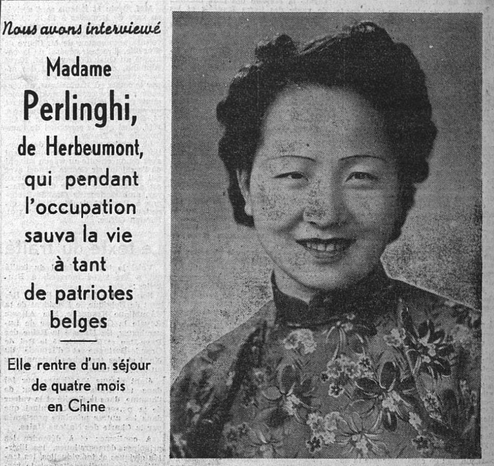
From what I could gather when it comes to historical sources, the deeds of Qian Xiuling during Nazi occupation were published in a French newspaper from the province Luxembourg (not country) on March 18, 1948, three years after the war, just after she had returned from a four month stay in China. The article on the front page and the fourth page is an interview with her.

https://www.belgicapress.be/pageview.php?adv=1&all_q=&any_q=&exact_q=&none_q=&from_d=1948-03-18&to_d=&per_lang=&per=&sig=JB421&lang=NL&per_type=0

KBR - Belgicapress

I put this source out there to remind the reader that the story of Qian Xiuling started out very local and that her story is only known within a few franco-Belgian communities. Yes, in later years, she received a royal medallion for her heroism but other than that I have nothing to indicate that her story went outside the Luxembourg province.
I tried to locate her in other Belgian newspapers (via the BelgicaPress database) but I only found earlier mentions of her maiden name (Tsien Siu Ling) in the 1930s when her exam results at Leuven were published.
As for Chinese coverage, I only remember she was mentioned in the Shun-pao when she left for Belgium as a self-sustaining student.
Now let’s flashforward to 2000s. Somehow, her story reached China.
Chinese author Zhang Yawen visited Qian Xiuling and wrote the book “A Chinese Woman at Gestapo Gunpoint“ (盖世太保枪口下的中国女人, 2002), which was adapted into a series (under the same name) funded by the China Women's Development Foundation. The series had some budget, considering it was filmed in Belgium (which means travel costs, filming permits, etc.) and was sixteen episodes which aired on the national broadcast in 2002.
The portrayal of the history in the book/series is… something. The book claims to be a true story yet the name of the character is Marie Jin (金玲) and, from what I have seen in the series, the timeline of her story isn't accurate at all.
In the series she has her doctorate in 1939, on the day of the German invasion of Belgium, (not 1935), and is still a single young woman. (She was married and had children by the time of the war. Heck, she was even pregnant when she visited the German general.).
TBF, artistic liberties are not uncommon and might be taken because of budgetary reasons or in favour of more compelling story-telling. However, it is clear from the get-go that the creators were set to tell a story that borders on myth-making and have no care for actual protrayal.
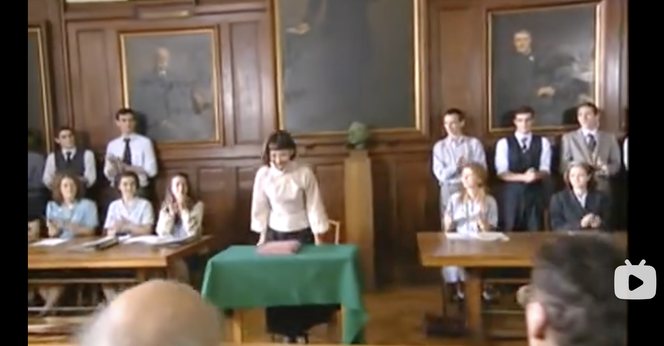
Let me exemplify this with episode 1. The series opens with the thesis defense of Marie Jin at the university of Leuven. She enters the room and talks (in Mandarin, of course) to her audience of Belgian classmates and professors. The narrative purpose of the scene is to flash out her characters (her dreams, how smart she is) as fast as possible.
There are infinite ways of doing this scene but one thing I want to focus on is the moment that  as part of her characterisation the professor (pro)claims that she is the first Chinese female student in the history of the university.
Now, is that true? Well, I happen to study the history of Chinese students in Belgium and… No, there were at least three women before the historical Qian Xiuling to my knowledge.

Admittedly, it is a small claim, but, why would this claim be made in the first place? What real benefit does this claim bring, honestly, other than to put her forward as a hero with extraordinary qualities, to assert her as a fish out of water?

(Which brings me to another question: Where are the other Chinese students? Where is her brother, at least? Did they commit the cardinal sin of not being heroic enough to be part of the story’s setting? What gives?!)

Anyway, it is fascinating to see that even though the creators wanted to bring the story to life with the best of intentions, they showed a lack of care for the actual experiences of whom they wanted to portray. And this disregard of genuine portrayal did not escape the notice of others.
In fact, the granddaughter of Qian Xiuling, Tatiana de Perlinghi, made a 2003 documentary (my grandma, a heroine?) about the series and probes the question of why there is such an emphasis on mythmaking of her grandmother at the expense of historical accuracy.
(Side-note: this documentary is made a long time ago, so I do not know whether the documentary maker still upholds the same views. Also, this is one perspective of a family member that is publicly available and it does not necessarily represent the view of every person close to Qian Xiuling. Keep in mind.)
The documentary has clips of Qian Xiuling herself (still alive at the time) expressing her disappointment with the book (”Marie Jin? Mother of Belgium?”), which makes me wonder whether she was ever consulted for the book/series, for she is, you know, the main subject of the series.
There are also other criticisms, such as the blatant omission of the connection of Von Falkenhaus with Jiang Jieshi. But I just recommend to watch this documentary if you’re interested.
You would think, “why bring up a book and series that are two decades old?” Well, 2015 happened, my friend: Xi Jinpin gifted the English translation of the book to King Philippe, and the Legend of Qian Xiuling came back into the spotlight. The book of Zhang Yawen got republished (good for her, being a writer is not easy, although it would be nice to assert it’s historical fiction), a few documentaries followed, and then… of course, a new Chinese book about Qian Xiuling came out in 2021
We’ve come full circle! It's time for “Forget me”
There was a book launch of the Dutch translation by the Chinese embassy in August 2022. I bought it when I passed through Belgium. The book is mostly about the experiences of the author researching as well as the story of Qian Xiuling. From what I’ve read, well, uhm… Look, it’s hard to do research on history that takes place in a country that you’re not familiar with and it’s harder if you don’t know who could help for your research. So… let’s say, his book does not bring new things to the table
One thing: there is a bizarre scene in the book in which the author looks for clues of Qian Xiuling at her alma mater (AKA my alma mater). If I remember correctly, he went through the halls of some chemistry building and found her portrait in some administrative office. There, some staff member went out of his way to explain how important she was to the university, as you do, naturally.
Now, it’s a first to learn that KU Leuven preserves portraits of students. I guess, it’s possible, but it is so unlikely. I tried to find the staff member with the suspicious English name on the website of KUL and no, no result, ladies and gentlemen! So, we have a mystery on our hands. If you’re KUL staff and have seen the portrait of Qian Xiuling, please let me take a pic and post it here 🙂
Final thoughts: in the grand scheme of things, this book could be a short-lived moment and just be seen as a diplomatic way to assert Sino-Belgian friendship. Sidenote: History will repeat this year when we Belgians celebrate 400 years Ferdinand Verbiest (Astronomer of the Kangxi emperor), after which a diplomatic visit will take place in the near future.
However, if we are only left with works of half-baked research, what are we actually accomplishing here? What discussions are we really having? This mythmaking really flattens the experiences of the ones in history and does not foster any deeper intercultural understanding.
What also pains me in this whole ordeal is the passivity from the Belgians themselves. Nobody goes out to engage with the work critically after the launch. In fact, I even haven’t read any Belgian “China-expert” talking about this pubicly. Maybe the event is minor, idk, but it’s a missed opportunity to reflect.