
It's hard for people to visualize removing tons or billions of tons of carbon dioxide (CO₂). I propose we talk about CO₂ removal (#CDR) like a time machine (e.g., this machine will take us back 5 minutes). For example:

Q: How far back in time does planting 100 million trees take us?

A: If one mature tree takes up an average of 25 kg of CO₂ per year, then 100 million trees will take up 2.5 MtCO₂. That's a time machine that takes us back 33 minutes and 6 seconds in a year. It's not a lot.
Another CO₂ removal (CDR) as time machine example:

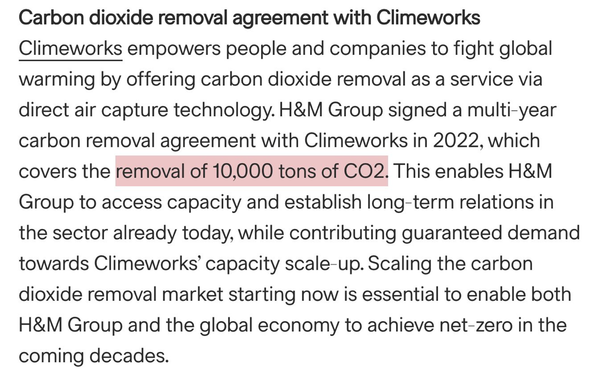
H&M, the second largest international clothing retailer, recently purchased 10,000 tonnes of CO₂ removal from Climeworks. 10,000 tonnes sounds like a lot, right, but it's a time machine that takes us back only 8 seconds. 😩

https://hmgroup.com/news/hm-group-further-invests-in-the-decarbonisation-of-its-value-chain/

H&M Group further invests in the decarbonisation of its value chain - H&M Group

Working towards its ambition to achieve net-zero by 2040, H&M Group joined the COP27 in Egypt to build momentum for collaborative action and share about the company’s progress and challenges.

H&M Group

My #CDR friends on twitter got mad at me for pointing out that the four regional Direct Air Capture (#DAC) Hubs under the Inflation Reduction Act (#IRA) specify a minimum CO₂ removal capacity of 50,000 tonnes/year.

Hence, each DAC Hub is a #time #machine that takes us back only about 40 seconds a year!

It's important to point this out because some people think CDR is a replacement for #decarbonization and that can never be the case.

https://www.energy.gov/oced/four-regional-clean-direct-air-capture-hubs

Four Regional Clean Direct Air Capture Hubs

Four Regional Clean Direct Air Capture Hubs

Energy.gov
@davidho if it only manages to reduce such a small amount, what sense does it make to pursue it now? why not wait until the system becomes more impactful? Honest question.

@mdione @davidho if you do the math on direct air capture based purely on the thermodynamics of extracting co2 from air you'd need something like >5% of the world energy production to make a dent at reasonable timescales, assuming perfect efficiency with 0 losses

it's just not practical without some entirely different approach *and* real decarbonization