 ᔅᑕᕐᐗᓪ
ᔅᑕᕐᐗᓪwe are all stardust
no but really
I mean except for the hydrogen in you. that came from the dawn of time itself
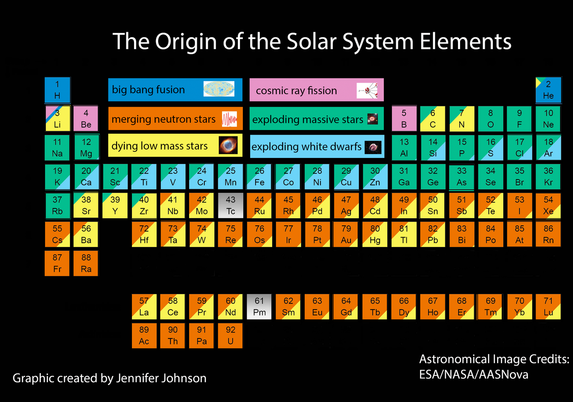
you are 10% hydrogen by mass. all of it is leftovers from the raw energy of the explosive first moment of the universe
the very same hydrogen in the water in your blood, that hydrogen. all of it formed in the immediate first seconds of creation. it took nearly 400,000 years for it to cool down enough to become an actual gas as opposed to a dense hot plasma, and literally the entirety of time more to finally end up in the water you drank today
we have not really had much time with this information, specifically we hadn't observed a neutron star collision until august of 2017.
we are getting far better and more precise at doing astronomy and as we get lucky and observe more we begin to understand the processes that brought us to where we are now, and its absurd, it is an absurd history and it's phenomenal
the very stars themselves died so we may live
it's rad and it's beautiful and fuck if that doesn't make me feel things
The gravitational wave background was just discovered, on june 28th of this year
it is TWICE as noisy as we first predicted
we don't know why
we are figuring it out
as our instruments become better and we build more gravitational wave detectors we will be able to better triangulate the origins of these waves in the sky, and eventually we may be able to filter out all of the noise from more recent black hole mergers and be able to listen to the primordial reverberations of the big bang itself still rippling through all of spacetime. we will be able to peer back deeper into time than ever before, and finally begin to answer some profound questions about the first moment of creation
It SHOULDN'T work, logically there's no part about gravitational wave astronomy that makes any sense. Surely if you're IN space, you wouldn't be able to build any sort of contraption that can detect it bending since the contraption itself would bend imperceptibly with space, and YET
we answered a pretty big question just TODAY. Anti-matter experimentally interacts with gravity in exactly the same way as matter. https://www.nature.com/articles/s41586-023-06527-1

and like you're probably like "oh, antihydrogen falls just like everything else, big whoop" but like this is a huge thing. because. we don't know why anything exists
in the first moment of creation, not JUST hydrogen (protons) but also electrons and in equal amounts positrons and anti-protons were ALSO created by this quantum clusterfuck of a bunch of energy desperately trying to state change down into anything that made a lick of sense
all of this energy turning into matter like the particles being created by a particle accelerator when you throw a proton at another proton with the force of a softball going 80 milles an hour--all that kinetic energy has to turn into SOMETHING so the universe just spawns a shitload of weird particles, nearly all of which just exist for just an instant before they spontaneously decay because most of them aren't even quite stable
an interesting part about this process is that matter and antimatter are created equally in the collisions, this is in fact, how we made the anti-hydrogen in the first place.
the big bang created equal amounts of matter and antimatter, all of which should have annihilated. and indeed that's what happened: all of which did, except for a VERY small remainder.
for every 10 billion particles of antimatter that were created, 10,000,000,001 particles of matter were created.
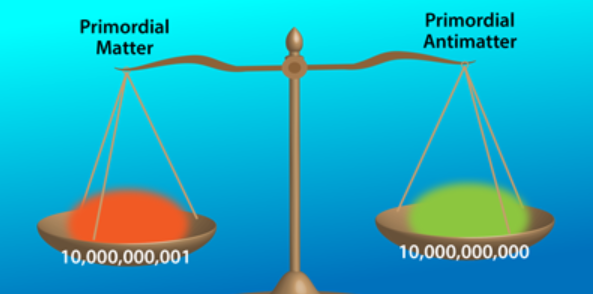
every single atom is that remainder.
the question is: why was there an imbalance
What caused the material universe to well, exist? We don't know. Perhaps antimatter interacts sliiiiiightly differently with the laws of physics than matter does. If it experienced gravity in a slightly different manner that could possibly tell us one such asymmetry, but no such luck
so the question remains: why does anything exist at all when it Should have exploded
 Roger Crew✅❌☑🗸❎✖✓✔
"Perhaps antimatter interacts sliiiiiightly differently with the laws of physics than matter does"
There's no "perhaps" about it. There *are* (very slight) asymmetries and they've been observed since the 1950s in particle accelerator experiments
 sdgathman
@starwall Images show "sound" waves on the surface of CMB. "When the morning stars sang together."
This could prevent 100% mixing. Are we *sure* there are no anti-matter galaxies? The only way to tell is by annihilation at the boundaries of regions of each. But maybe the anti-matter is well separated - beyond observable boundaries even.
This could prevent 100% mixing. Are we *sure* there are no anti-matter galaxies? The only way to tell is by annihilation at the boundaries of regions of each. But maybe the anti-matter is well separated - beyond observable boundaries even.
 xian
xian Butternuts 🦆
 Jasper 🍉
@starwall protons weren't created, since their constitutuent quarks would be unbound on that energy.
I reckon we don't know if equal amount of matter and antimatter was created at the start of our universe, theory may say so, but we don't know if the theory is correct in that regime.
Probably relevant that gravitational waves were detected using careful observation pulsar timings, detecting far longer wavelengths than the LIGO and other laser interferometry observatories.
the theory ALWAYS said -- ever since Dirac came up with it in the 1920s -- that antimatter has positive mass.
But yes, confirmation is nice.
 IAG
IAG@starwall when I first saw this I thought "well of course antimatter is affected by gravity in the same way as regular matter because otherwise the spontaneously generated particle-antiparticle pairs wouldn't annihilate each other" but I didn't think about the ramifications of "well then why is there any unanihillated matter"
 endrift 🏳️⚧️
@starwall I remember wondering about this years ago and assuming that antimatter had positive mass but wasn't sure--and upon looking it up, they hadn't actually managed to prove it yet! I saw an Ars Technica article about this come across my RSS reader recently, and was...honestly relieved to hear that they had finally settled it in more or less the expected way, even if antimatter having negative mass would have been extremely exciting for a bunch of reasons (I'm looking at you, Alcubierre drives)
@endrift well I think this experiment disproves it, they have normal mass and thus experience gravity as expected as a result. no exotic matter yet, I'm afraid.
 Hugh Ferguson
it's true that you can't measure gravity directly (*), but what you *can* do is measure *tides* (variations in gravity). Oil companies do this all the time (surveying for pockets of different mass density deep below the earth's surface that might be things they can drill to)
and that's what gravity waves are, i.e., they're really tide waves.
(*) if you're inside a freely falling elevator in a completely uniform gravitational field, you will be completely weightless -- impossible to tell the difference between that and being out in the middle of interstellar space (Equivalence Principle). But actual Earth gravity won't be uniform; it'll be slightly stronger nearer the floor than at the ceiling,... *that* you can measure)
 Kenneth
 Khleedril
@starwall
Gauss showed us that curvature is absolute and can be measured inside the space.
Gauss showed us that curvature is absolute and can be measured inside the space.
@starwall honestly the sole concept of detecting gravitational waves using pulsars is so unbearably cool
@fdrc_ff it is in fact extremely clever and cool
@starwall WE WILL FIND KOLOB
@starwall I'm interested in taking the data from multiple directional gravity detectors (not necessarily waves) in real time to create a 3D model. I got the idea from sci-fi novels by Michael McCloskey (where this replaces vision and hearing as a natural sense in an alien species).
@starwall This is what about astronomy in general and cosmology in particular. New instrumentalities scarfing up data of which our models had. No. Clue.
 Pēteris Krišjānis
@starwall that is so metal and emo at the same time. It is not poetry, that is literally what happened with all matter in the universe.
I am reading this and like, fuck, Bible as origin story cannot top this.
I am reading this and like, fuck, Bible as origin story cannot top this.
 The Doctor
@starwall Can I quote you on that?