
So here's what Unity says the new pricing policy is, today (assuming it doesn't change again next week, like it did last week, and the week before).

https://blog.unity.com/news/open-letter-on-runtime-fee

Critical thoughts:

1. The fact that the new fees *only apply to future versions* is the critical change here, and probably(?) avoids a lawsuit. This *will* have interesting ecosystem effects since many people will now want to stick on 2022.3 LTS indefinitely. Possibly, libraries will latch to 2022.3 and never update.

An open letter to our community | Unity Blog

An open letter from Marc Whitten to the Unity community in September 2023. 

Unity Blog

2. The new policy is a bit confusing, though easier to understand than last week's. They now claim [over $1m revenue] they will charge *the lower of* 2.5% revshare, OR a charge per "number of new people engaging with your game" that they "calculate" based on your "self-reported data".

This "new installs" number is still untrustworthy gibberish. But now you can ignore it. The new "price" is 2.5% of revenue, possibly reduced arbitrarily.

Now the question is: Is this better or worse than Unreal?

(2, continued) Unity's new 2.5% revshare is lower than Unreal's 5%. But *Unreal doesn't charge a per-seat fee*.

A per-seat fee *plus* a revshare is sour tasting. Per-seat fees are really inconvenient for small operations where some or all of your devs may only use Unity part time. And those per-seat fees are (by my math) 5x higher than they were in 2021.

Overall, New Unity *probably* costs less than Unreal, *usually*. But awkwardly, any cases Unity costs more will be at the lower revenue end.

3. My gut is that if *this open letter's policies" were what Unity had announced to begin with, people would have been *annoyed*, as they were with the 2021 changes, but you wouldn't have seen a community collapse or mass exodus. However, I do not think this open letter will halt the mass exodus. The core problem is that *Unity can no longer be trusted*. You can consider the new 2024 prices acceptable. But now what you really have to worry about is how they will change in 2026.

(This thread has been edited to correct confusion about Unity's version numbering scheme, as corrected by Jonbro; 2023 LTS will be released in 2024 and therefore the new fees will apply.

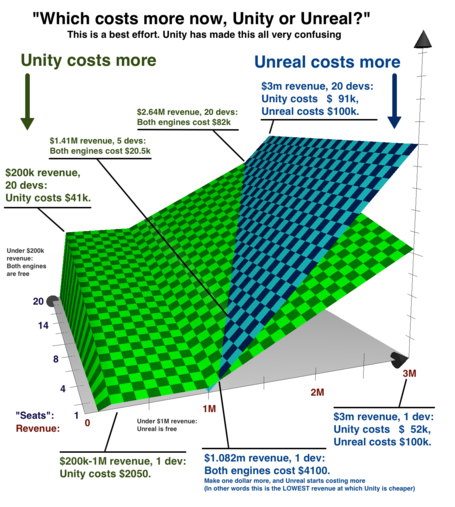
Possibly, I will post a version of this thread on Cohost later, just so that I can actually sit down and make a two-dimensional graph of at what combinations of developer count and revenue Unity now costs more than Unreal. I bet it's going to be a *fascinatingly* baffling graph.)

Okay, here's the Cohost version of the above thread, featuring the below diagram. https://cohost.org/mcc/post/2935303-unity-corporate-self

My takeaway from the diagram:
- Geepers, this is complicated! It's kinda hard to predict now if Unity is a good deal or not!
- If you are a small dev making between $200k and $2.5M, Unity is basically a bad deal compared to Unreal now. You have to be making either more or less than that for Unity to make sense finance-wise.

@mcc My takeaway: godot's graph is looking nice and simple! 
@vv I don't mention Godot for a simple reason: For mobile/PC, Godot costs zero. But for *consoles*, Unity/Unreal can actually cost *less* than they do on PC… and on consoles, the price of Godot is *unknown*. There are several entities you can license a console-compatible version of Godot from, and the price, and quality level, of those console Godot forks is unknown to me.
@mcc @vv are there legal or technical reasons for Godot not having native support for consoles? (Technical include “no contributors with the necessary know-how”.)
@oblomov @mcc I believe it's mostly legal. Most if not all of the console agreements are proprietary/confidential and so it's not really possible to just hit "deploy".
@vv @oblomov It is very difficult to produce open source software for consoles since the APIs are covered by NDA , so it is assumed any software targeting those APIs must only be distributed to people who already signed the NDA. Most collaboration and distribution systems for OSS support this poorly.
@mcc @vv thank you both for the details (and the link)