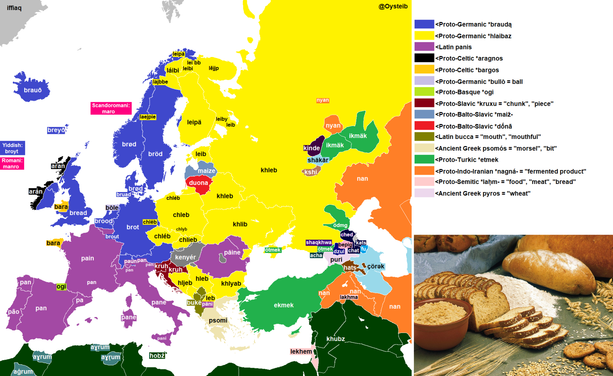
The word for bread in various languages.

Proto-Germanic seems to have had two words for bread, one becoming the present Germanic blue words, the other borrowed into Uralic and Slavic languages and becoming the yellow ones.

One theory is that *braudą was the word for bread with yeast. It is related to the verb "to brew [beer]".

The yellow word survives in English "loaf" and Norwegian "leiv" (piece of bread) and "loff".
#etymologidag #language #languages #linguistics

Apparently, Slavic, Finnic and Sami languages all borrowed the word from Germanic independently of one another (but Eastern Sami variants are borrowed from Finnish).

Armenian 'hats' _may_ be related to Latin 'panis'. Welsh and Breton 'bara' is (distantly) related to English 'barley'.

Frisian 'bôle' is familiar to Norwegians, as we also have 'bolle' for a small round piece of bread, often (but not always) sweet. The same origin as French 'boulanger'.

@oysteib
Nan bread is bread-bread? 🤯
@eclogiter Possibly, but this gets a bit complicated - nan bread as we know it is Indian isn't it? In Persian, apparently, all bread is different types of 'nan', but I don't know if that is the case in Hindi and other Indian languages, or if 'nan' there is only the type we would call 'nan'. Anyone else know?
@oysteib one of my favourite etymologies is that of companion
@oysteib Reading the history of bread (in Pallant's book, Sourdough Culture for one), it seems bakers took the foam from brewing beer to make bread. Apparently, the beer yeast rose better and faster than the sourdough cultures, and changed the way bread was baked across Europe.

@oysteib as I lived in Thailand I was always on the lookout for the rare shared root words.

pang (ปัง) for bread is one of my favourites.

@oysteib Lefsa er vel òg eit leiv-ord.
@oysteib og Og OG: engelsk «lord» er òg eit leiv-ord
@oysteib omg Nyan Cat is a bread cat and that makes so much sense now