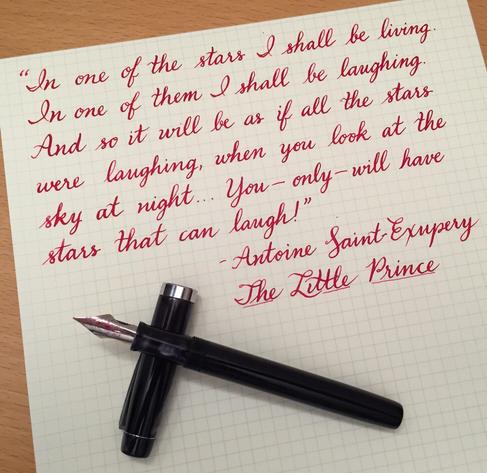
My #handwriting and #FountainPen story, in response to @MsHearthWitch and other folks who have asked:

As a kid I learned Zaner-Bloser cursive teaching script[1] in U.S. elementary school and then proceeded to never use it again. (Ballpoint and pencil just aren’t really suited for cursive.) I switched permanently to print, then oblique italic in early adulthood, which is still my daily handwriting.

1/

[1] Overview of U.S. teaching scripts: https://www.howjoyful.com/lettering-cursive/
Lettering Cursive: Intro to American Cursive & Script alphabets

In this ultimate guide to lettering cursive, I will share everything you need to know about cursive and script lettering + FREE worksheets!

HowJoyful

When I started using fountain pens, I quickly figured out that cursive actually makes sense with fountain pens. So I looked at a few guides, at first I didn’t really know what I was looking for and just experimented. I looked at a bunch of the classic U.S.[2], English [3], and German[4] cursives and kind of picked what I liked.

2/

[2] US cursives: https://loopsandtails.com/cursive/
[3] English round hand: https://www.google.com/books/edition/The_Universal_Penman_Etc/lHQdZONVcIkC
[4] German old teaching script: https://commons.wikimedia.org/wiki/File:Lateinische_Ausgangsschrift_1953_plain.svg#/media/Datei:Lateinische_Ausgangsschrift_1953_plain.svg

Cursive Archive - Loops & Tails

Loops & Tails

So I guess in the end this is a round hand derivative with mostly Zaner-Bloser as a base, combined with some Spencerian[5] and Palmer[6] capitals.

3/3

[5] Spencerian at Loops and Tails: https://loopsandtails.com/spencerian/
[6] Palmer Method: https://palmermethod.com/

Spencerian Archive - Loops & Tails

Loops & Tails

@paradoxmo Just wanted to say: thank you for posting this.

After many years of writing more and more unrecognizably, I just recently started to make an effort to develop a nice handwriting (with a fountain pen) and am still looking for a cursive writing style to aim for.

@FrankSonntag it might be worth checking out some sample pages of The Art of Cursive Penmanship by Michael Sull, I didn’t use this but I know a lot of people have used it with good results. It teaches an American cursive similar to Zaner-Bloser. https://www.amazon.com/Art-Cursive-Penmanship-Personal-Handwriting/dp/1510730524
Amazon.com

@paradoxmo @yentaru this is so helpful! My cursive has always been … “ unique” so there’s always room for improvement!
@paradoxmo I'm curious as to why you say that ballpoint and pencil aren't suited to cursive writing. I've used both all my life for cursive, though I almost exclusively use fountain pens, now. I, too, learned Zaner-Bloser in elementary school. We even had the special ergonomic Zaner-Bloser mechanical pencils.Later in life, I retrained myself to write Palmer Method, as my mother was taught in her school days.

@gcvsa re: why ballpoints are bad for cursive, there’s a whole article about it in The Atlantic[1] from a few years ago. The gist of it is that because ballpoints and pencils require you to press into the page, it’s more natural to write in separate strokes and motions because as soon as you let up the pressure, you get a thinner line or no line.

1/

[1] https://www.theatlantic.com/technology/archive/2015/08/ballpoint-pens-object-lesson-history-handwriting/402205/
if it’s cut off, switch your browser to reader mode and it should load the entire thing.

How the Ballpoint Pen Killed Cursive

Thicker ink meant it didn't smudge as easily as its predecessor, the fountain pen—but it also made writing by hand more physically demanding.

The Atlantic

This need to exert pressure downward is not helpful for cursive as you have to keep the pen moving horizontally as well as push it down. It doesn’t lend itself to one uninterrupted stroke because as soon as you do nothing, the stroke stops. So it’s much more natural to use pressure to initiate strokes on each letter because this keeps the ink or mark consistently dark.

2/

With a fountain pen or dip pen, your stroke continues if you pause your hand motion and do nothing. So it’s quite natural to write continuously in one stroke. It doesn’t require exerting pressure downward, so all you have to worry about is moving the pen forward. This makes connecting several letters together in one stroke the more effortless thing to do.

With ballpoints, linking letters in one stroke requires extra effort, so many people stop doing it and switch to an unconnected hand.

3/3

@paradoxmo I mean, I've read that article before, but I've been using fountain pens for about 45 years and ballpoints for at least as long, and I've never had any trouble writing in cursive with a ballpoint. A ballpoint is actually my second favorite type of pen after a fountain pen. I loathe rollerballs and gel pens.
@paradoxmo I commonly use a Bic Cristal for taking notes when there might be long pauses that would cause my fountain pens to dry up. I also have a very expensive Graf von Faber-Castell rhodium Guilloche rollerball whose insert I've replaced with a blue Schmidt 2010M ballpoint refill that is designed for rollerball bodies. Back when we still had to sign credit card receipts, that was my fancy going out to dinner pen. I gave a bunch of them to my wedding party.
@paradoxmo @MsHearthWitch That's a really great style!