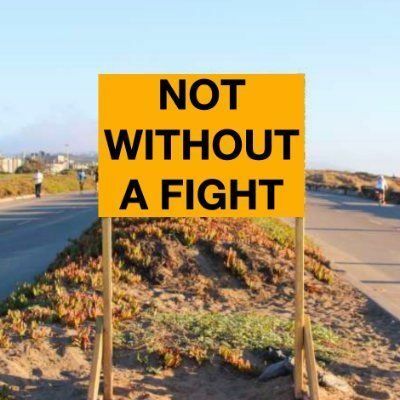
A week ago, a driver turning right at 4th/King killed for a four year old. Today at the vigil organized by WalkSF and other non-profits, SFMTA said it would take 3 weeks to do a “quick build” to make the intersection safer. That's too long to wait. So we did our own quick build tonight and closed one of the turn lanes
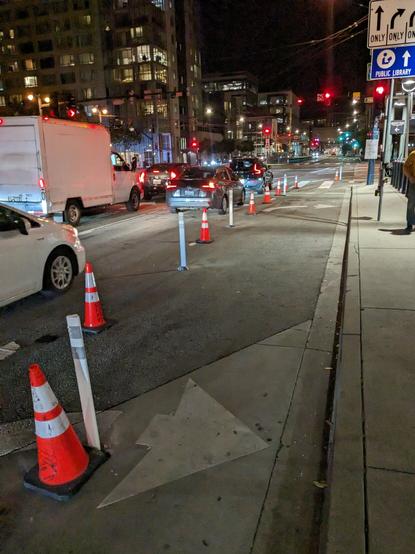
@SafeStreetRebel if I may, what about the extra turning lane is considered to be so dangerous?
@cooopsspace @SafeStreetRebel
Inside turning lane car blocks visibility for the outer turning lane driver. This would have been obvious to the traffic engineer that designed the intersection.

@jessta @cooopsspace @SafeStreetRebel

Also, if cars fully turn before a crossing, they intersect with pedestrians at a right angle.

But if the turning lane is right next to a zebra crossing, cars turn on top of it. This means crossing pedestrians are not always visible through the windshield and drivers have to actively use mirrors or turn their head. They might be fully hidden behind one of the cars pillars or other passengers.

@Flo_Rian @jessta @SafeStreetRebel Australian here so I don't totally know the right on red rules, is there even one here? Wouldn't forcing everyone to stop reduce the risk of a serious accident?
@cooopsspace @Flo_Rian @jessta @SafeStreetRebel
In most of the States, right on red (and left, more info below) is legal in all fifty states and territories, though some local governments restrict it either in part or entirely based on density. With *two* exceptions, there must be a sign posted that you cannot turn right on red. Those two are NYC and DC, which have right on red banned by default. About ten states prohibit it when you (1/2)

@cooopsspace @Flo_Rian @jessta @SafeStreetRebel
have a red arrow. Left on red is allowed in some scenarios, primarily intersecting one-way streets, with eight states and DC being the exception. Wikipedia’s “Turn on red” article covers a lot of the specifics, but in general, turns at red lights are standard practice in the States.

Traffic engineers have been putting too much emphasis on cars for too long, at the pedestrian’s expense (2/2)