

@ai6yr @ai6yr what do you do to measure the antenna efficiency- VSWR? How did it do?

Curious to the directionality too.
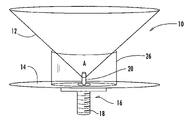
@JohnLMacFarlane @ai6yr I ran an MFJ analyzer on this, as well as a NanoVNA. It's <2.0 SWR on 70cm and 2m, and it is <4.0 SWR on 15m (where it transmits). SWR is too high to transmit on 20m but it receives fine. My suspicion is that the large metallic surface has it acting a lot like a discone.
@JohnLMacFarlane @ai6yr Just searching now there is an "inverted feed discone" which is owned by Harris Corp. https://patents.google.com/patent/US7286095
US7286095B2 - Inverted feed discone antenna and related methods - Google Patents

The discone antenna includes a conical antenna element, having an apex, and a disc antenna element adjacent the apex of the conical antenna element. An inverted antenna feed structure, such as a flanged coaxial connector or coaxial cable, is connected to the disc and conical antenna elements and extends outwardly from the disc antenna element on a side thereof opposite the apex of the conical antenna element. The discone antenna with such an inverted feed structure facilitates an inverted positioning, for example, on vehicles, rooftops and/or control towers, etc., that will increase the bandwidth pattern in the direction of the potential target.
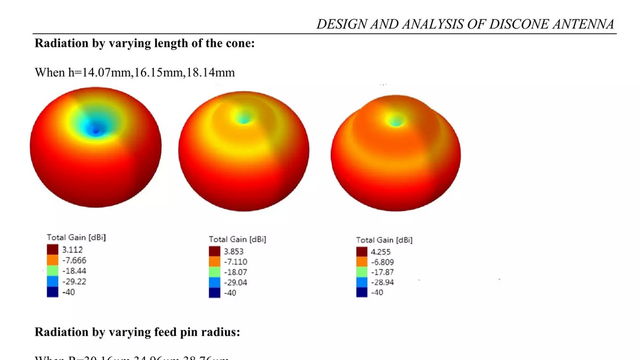
@JohnLMacFarlane @ai6yr Looks like discones are pretty omnidirectional, with gain outward depending on the "length of the cone"
@ai6yr @ai6yr I would imagine that’s changing the tuning of the antenna at the same time.
@ai6yr @ai6yr The antenna modelling software is pretty good these days, have you tried modelling it? Might give you some ideas.
@JohnLMacFarlane @ai6yr Yeah, maybe throw some approximation of that into EZNEC and see what it spits out