 Mauro Silva Jr 🏳️🌈
"We contend that evolutionary psychology now provides predictions and powerful ways to interpret findings about the differences and changes in human cultural preferences (e.g., for romance158, 159, e.g., for horror160)"

Exploratory preferences explain the human fascination for imaginary worlds in fictional stories | Scientific Reports
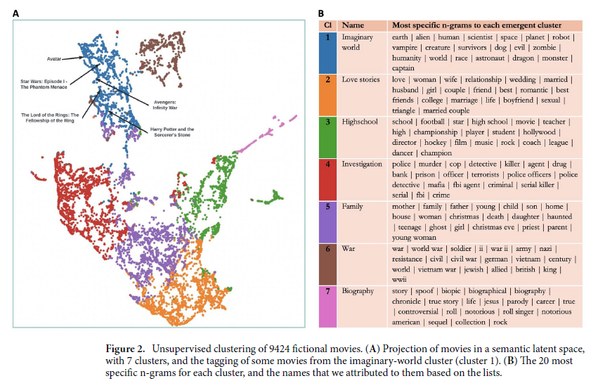
Imaginary worlds are present and often central in many of the most culturally successful modern narrative fictions, be it in novels (e.g., Harry Potter), movies (e.g., Star Wars), video games (e.g., The Legend of Zelda), graphic novels (e.g., One Piece) and TV series (e.g., Game of Thrones). We propose that imaginary worlds are popular because they activate exploratory preferences that evolved to help us navigate the real world and find new fitness-relevant information. Therefore, we hypothesize that the attraction to imaginary worlds is intrinsically linked to the desire to explore novel environments and that both are influenced by the same underlying factors. Notably, the inter-individual and cross-cultural variability of the preference for imaginary worlds should follow the inter-individual and cross-cultural variability of exploratory preferences (with the personality trait Openness-to-experience, age, sex, and ecological conditions). We test these predictions with both experimental and computational methods. For experimental tests, we run a pre-registered online experiment about movie preferences (N = 230). For computational tests, we leverage two large cultural datasets, namely the Internet Movie Database (N = 9424 movies) and the Movie Personality Dataset (N = 3.5 million participants), and use machine-learning algorithms (i.e., random forest and topic modeling). In all, consistent with how the human preference for spatial exploration adaptively varies, we provide empirical evidence that imaginary worlds appeal more to more explorative people, people higher in Openness-to-experience, younger individuals, males, and individuals living in more affluent environments. We discuss the implications of these findings for our understanding of the cultural evolution of narrative fiction and, more broadly, the evolution of human exploratory preferences.