Just above Messier 8 is another star-forming region called Messier 20 (Trifid Nebula). The first time I took pictures of this nebula (two years ago), all I got was the open star cluster and none of the nebulae. This is also an unusual item because it's actually four different objects: an emission nebula, a reflection nebula, a dark nebula and an open star cluster.

The reddish part of Messier 20 is the emission nebulae, caused by the ultraviolet light of nearby stars. Emission nebulae are 1/3
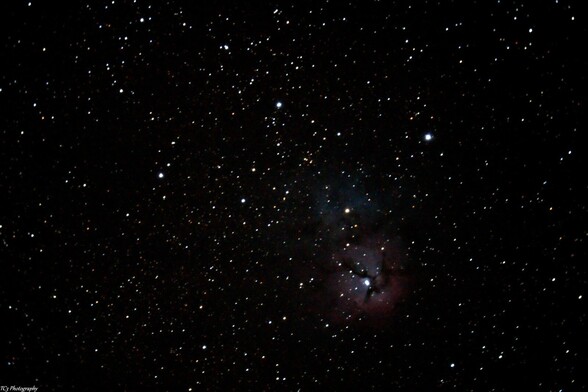
clouds of extremely hot hydrogen gas and usually regions where new stars are being formed. The light from these stars illuminates the surrounding clouds, ionizing photons in large portions of the clouds.

The blueish areas are the reflection nebulae. Unlike emission nebulae, which emit spectral line radiation from ionized hydrogen, reflection nebulae consist mostly of clouds of interstellar dust and do not emit any light of their own, but simply reflect the light of nearby stars. 2/3

The dark nebula, cataloged as Barnard 85, are the dark lines that appear to separate the nebulae into sections. Dark nebula consists of dust clouds that absorb and block light from the bright objects behind them. 3/3