 Jesse
Jesse"Voting with your feet" is a backstop not a first resort. The first resort should be democratic decision making. We should not accept instances where the users don't collectively have ultimate authority over policy and defederation decisions.
As long as each instance is a (hopefully benevolent) dictatorship, you can't really say this isn't feudalism. As long as users are in charge, you can't really say it is. That's the difference.
That was an atrocious construction but you know what I mean.
We need to start another fedi pact for democratic governance. And a complimentary user pact not to join another instance that is not a signatory.
 Kyle Thayer
@misc do you know of any descriptions or guides or recommendations for community run instances?
(Also, I think individually run personal instances should be exempt)
@kylethayer The ones I know of are cosocial.ca and social.coop. My understanding is that hachyderm.io, while not fully user governed, takes care to be transparent with its rules and decision making process. I’m not aware of a guide, but I think that would be good. Certainly single user instances should be exempt - I’d even think very small ones that are effectively consensus driven. This are definitely standards that would need to evolve.
@misc Ok, this is a thread of my first pass of what a #FediGovernancePact might look like.
Anyone feel free to copy/change anything if you think there is something useful here. And if people like this (or something like it) let's try to figure out how to share and get more input (and community buy-in) on this:
#FediGovernancePact (post 1)
Goals:
- community governance of Fedi projects and instances
- make the Fediverse more welcoming
@misc #FediGovernancePact (post 2)
Why these goals?
- Community governance: having individually-run projects/instances leads to a feudalistic system, where the "benevolent dictators" duke it out over legitimate or petty conflicts. Users on those systems/servers have little say in these conflicts and may be forced to migrate servers (and only some things migrate). Also, this puts an unfair burden on the lone "benevolent dictator" to act perfectly always.
@misc #FediGovernancePact (post 3)
- make the Fediverse more welcoming: There are groups of people who have found the Fediverse unwelcoming, such as Black users, journalists, non-technical background users. We want to make this a more welcoming place for them. (note: we do **NOT** want to be welcoming to racism, transphobia, harassment, etc.). (further reading in next post):
@misc #FediGovernancePact (post 4)
- The Whiteness of Mastodon: https://techpolicy.press/the-whiteness-of-mastodon/
- Black Twitter, quoting, and white views of toxicity on Mastodon: https://privacy.thenexus.today/black-twitter-quoting-and-white-toxicity-on-mastodon/
- The Affordance Loop: https://erinkissane.com/the-affordance-loop
- Mastodon is easy and fun except when it isn’t: https://erinkissane.com/mastodon-is-easy-and-fun-except-when-it-isnt
- Some history: https://privacy.thenexus.today/mastodon-a-partial-history/#dogpiling-weaponized-content-warning-discourse-and-a-fig-leaf-for-mundane-white-supremacy
- The Whiteness of Mastodon: https://techpolicy.press/the-whiteness-of-mastodon/
- Black Twitter, quoting, and white views of toxicity on Mastodon: https://privacy.thenexus.today/black-twitter-quoting-and-white-toxicity-on-mastodon/
- The Affordance Loop: https://erinkissane.com/the-affordance-loop
- Mastodon is easy and fun except when it isn’t: https://erinkissane.com/mastodon-is-easy-and-fun-except-when-it-isnt
- Some history: https://privacy.thenexus.today/mastodon-a-partial-history/#dogpiling-weaponized-content-warning-discourse-and-a-fig-leaf-for-mundane-white-supremacy

@misc #FediGovernancePact (post 5)
How:
- To join the Pact, all instances/projects over a certain size should be community run (e.g., democracy, transparent foundation)
- TODO: define governance models
- Additionally, joining the pact means making efforts to include historically unwelcomed communities in governance (E.g., Black users, non-tech users, etc.) and keep up with the concerns of those groups.
- Make a way for users to see what servers have agreed to (and are following) the Pact
@misc #FediGovernancePact (post 6)
Examples of community governance I've seen people mention (un-vetted):
- https://cosocial.ca/
- https://hachyderm.io/
- https://digitalcourage.social/
- https://social.coop/
- https://kolectiva.social/
(Please tell me if you know of more examples, or if any of these examples are problematic and I should delete them from the list)

@misc #FediGovernancePact (post 7, final post)
This is just my first pass at thinking through a #FediGovernancePact. Feel free to copy this, modify it, and make it your own. I don't feel any need or desire to own this (it should be community owned if the Fedi community wants it!). I just want to help get the ball rolling toward better community governance.
 Jon
Jon@kylethayer @misc Thanks for kicking off this discussion, and apologies for the delayed response.
In terms of the #FediGovernancePact goals, let's start with #2: "make the Fediverse more welcoming". It's not clear to me how a pact of community-governed instances would make the fedivese more welcoming. Which of the issues discussed "Mastodon is easy and fun except when it isn’t" or "Whiteness of Mastodon" do you see a pact as addressing?
Goal #1 ("community governance of Fedi projects and instances") seems to reflect an assumption that more "community governance" in today's overwhelmingly white fediverse, with endemic HOA racism, is inherently a good thing. Is it? Are there examples of BIPOC people suggesting that a pact of community-governed instances would be a good course for the fediverse?
Or, look at the ongoing discussion about BBC as a test case. At least in my feed, most trans people (although certainly not all!) see BBC's history of publishing transphobic post and platforming transphobic people and groups as grounds for defederation. Most cis people (although certainly not all) see BBC's presence here as a good thing and think that defederation is a mistake. So if that's an accurate representation of people's positions in general, it's likely that "community governance" on a mostly-cis instance is likely to lead to a policy that most trans people see as anti-trans.
Of course it's possible that the cis people could listen to and prioritize trans perspectives. Unfortunately, that's not likely to be the case in today's fediverse. Look at community governenace examples like social.coop's loomio discussion about Threads or the equivalent #CoSocialMeta hashtag (both on instances you cited as good examples). There's virtually no reference to the risk to trans and queer people from the anti-LGBTQ hate groups that Meta's giving free reign to. And to tie it back to my initial point, there's also not any reference to concerns some Black people have expressed about Threads -- I've got a few exampels with links here, right after "perspectives aren't monolithic".
EDIT: Nivenly's just-announced community discussion of #Haidra is another example in progress; some initial thoughts here.
Don't get me wrong, BDFL is a very problematic model for open-source projects, and I think it's important for admins to get input from their communities. So it's certainly useful to think about different forms of community governance and the role it can play. But the discussions need to foreground anti-racism and other aspects of intersectional anti-oppression. And if you're talking about potential mechanisms for today's fediverse, it needs to take the realities of today's fediverse into account.
In terms of the #FediGovernancePact goals, let's start with #2: "make the Fediverse more welcoming". It's not clear to me how a pact of community-governed instances would make the fedivese more welcoming. Which of the issues discussed "Mastodon is easy and fun except when it isn’t" or "Whiteness of Mastodon" do you see a pact as addressing?
Goal #1 ("community governance of Fedi projects and instances") seems to reflect an assumption that more "community governance" in today's overwhelmingly white fediverse, with endemic HOA racism, is inherently a good thing. Is it? Are there examples of BIPOC people suggesting that a pact of community-governed instances would be a good course for the fediverse?
Or, look at the ongoing discussion about BBC as a test case. At least in my feed, most trans people (although certainly not all!) see BBC's history of publishing transphobic post and platforming transphobic people and groups as grounds for defederation. Most cis people (although certainly not all) see BBC's presence here as a good thing and think that defederation is a mistake. So if that's an accurate representation of people's positions in general, it's likely that "community governance" on a mostly-cis instance is likely to lead to a policy that most trans people see as anti-trans.
Of course it's possible that the cis people could listen to and prioritize trans perspectives. Unfortunately, that's not likely to be the case in today's fediverse. Look at community governenace examples like social.coop's loomio discussion about Threads or the equivalent #CoSocialMeta hashtag (both on instances you cited as good examples). There's virtually no reference to the risk to trans and queer people from the anti-LGBTQ hate groups that Meta's giving free reign to. And to tie it back to my initial point, there's also not any reference to concerns some Black people have expressed about Threads -- I've got a few exampels with links here, right after "perspectives aren't monolithic".
EDIT: Nivenly's just-announced community discussion of #Haidra is another example in progress; some initial thoughts here.
Don't get me wrong, BDFL is a very problematic model for open-source projects, and I think it's important for admins to get input from their communities. So it's certainly useful to think about different forms of community governance and the role it can play. But the discussions need to foreground anti-racism and other aspects of intersectional anti-oppression. And if you're talking about potential mechanisms for today's fediverse, it needs to take the realities of today's fediverse into account.
@jdp23 @kylethayer Thanks for this thoughtful response. I have some thoughts but I'm gonna follow your example and marinate on it a bit before I get back to you. ;)
@jdp23 @kylethayer Ok, as promised, my thoughts. This is going to be a long thread, so I’m going to untag you both and make the rest of this unlisted.
I agree with you both that it’s vital to view these questions of governance through the lens of intersectionality, and to center the well being of people who are marginalized and oppressed in our society. Not just as an aside, or as window dressing, but as integral to our thinking and work. (1/14?)
“Perspectives aren’t monolithic” indeed, and we should be careful about speaking broadly on behalf of groups, especially ones that we don’t belong to. And also, about the assumptions we make in general… (2/14)
Before going on, I want to mention something or it’s gonna bother me: I’m mixed race. Also …not sure I consider myself totally cis, exactly? I realize people see me as a white dude for the most part, so I’m rolling with it for the purpose of this discussion. It’s true enough, in the ways most salient here. And yet, when I perceive that mirrored back at me, it feels a bit like erasure, and… doesn’t feel great! IDK, no request here, & not sure what to do, other than name it. Anyway, onward! (3/14)
BIPOC, trans folks, women, disabled people… are whole people. They’re not just their oppressions, and their interests go beyond not being harassed. Yes, their safety should be our top priority. But we also have to think about how to make the fediverse more congenial in general. Because tbh, in my extremely limited unscientific anecdotal observation, when I’ve seen people in these groups grow weary of the fedi, it often hasn’t been primarily because of targeted harassment. (4/14)
At this point, in my provisional mental model (*extremely* subject to change) there are two main reasons the fediverse doesn’t look like the rest of the world, and that it pushes away people who don’t look like it does presently. One is lack of safety. But the other is an insular, alienating culture. (I would put “HOA racism” somewhere in between those two poles.) (5/14)
I think a lot of people get a sense here, immediately upon arrival, that they are expected to know some things, and are at risk of getting in trouble if they don’t. Stuff like established customs about CWs and alt text has been much discussed. But I would also include technical jargon that gets thrown around casually. And various cliques and feuds that could screw you up if you inadvertently choose the wrong instance or form friendships over the wrong fault line. (6/14)
Those frustrations and alienations — the kind of stuff Erin Kissane has been writing about — they pile up, and eventually a lot of people just leave. Who is more likely to leave? The people who are most alienated. Who is more likely to stay? People who feel most at home here, or who are ideologically committed. What does that mean in practice? The fediverse keeps looking like it does. Segregation through passive aggression. (7/14)
Backing up, I want to be clear that we’re discussing (at least) two distinct ideas here. Even though they’re related, it’s important to keep track. One: a community governance model for instances. And two: the idea of a “pact” between instances, and a companion “pledge” to only join instances in that pact. (8/14)
Re: the first. Tyranny of the majority is a real thing, but imo that does not mean we give up on democracy. Democracy does not equal simple majority rule. In “real world” governance, many methods have been used to protect minority rights and representation. To name a few: enshrining rights in a constitution, the “progressive stack”, proportional representation, consensus-based decision making, and guaranteed seats for underrepresented groups on representative bodies. (9/14)
I’m under no illusions about democracy as a panacea. Certainly not for oppression or “drama”, both of which have been rampant in democratic groups I’ve been part of. Even with the provisions I listed, it’s far from perfect. But I also believe that the only way we will get to the just world we want is if we build it together. I think that democracy is a necessary but not sufficient part of how we get there. Not everywhere, not always… but in general, more is better than less. (10/14)
About the idea of a “pact”. Just like with the original Fedipact, what I was proposing would be completely voluntary. I absolutely think there is an vital place in the fediverse for instances that are not communally governed, especially ones that are governed by people with identities that are underrepresented on the fedi and oppressed in society. (11/14)
That said, I now regret using the word “pact”. I think what I have in mind is different from the spirit of the fedipact. Real talk: despite some protestations to the contrary, the fedipact was never purely about self determination. It’s also about pressuring the whole fediverse to adopt a certain policy. That’s fine, but it’s not what I’m after. I hope to see more democracy in the fediverse, but to me that’s about promoting the idea and demonstrating interest, not applying pressure. (12/14)
I would like to associate myself with Erin’s call here https://erinkissane.com/notes-from-a-mastodon-migration. We need better tools to help people make informed choices of their instance, and I would like to see these tools include governance structure as a criterion for deciding. (13/14)
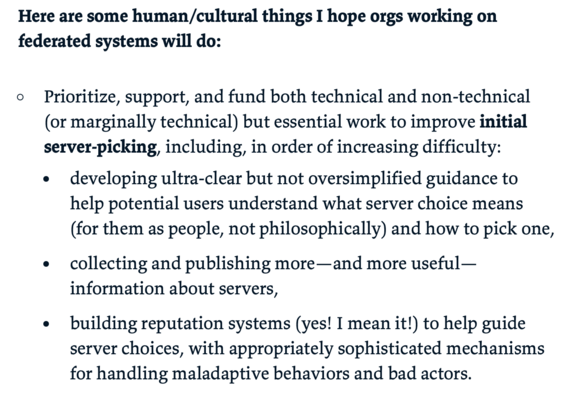
In conclusion, I believe the fedi offers space for many forms of governance, and more diversity in those forms is better. There should be *more people* with marginalized identities running instances, not fewer. But I would like to see more than a handful of self governed instances too, so that people have options, and more people find their way to active participation in building this thing. I think that will be very positive for this ecosystem, and for building a better, more just world. (fin)
Thanks @misc for the thoughtful response. And extra thanks for highlighting your own positionality ... as somebody who's often perceived as cis I can certainly relate to the complexities caused by people making assumptions!
It sounds like we're in agreement on many things, so let's start with those to double-check. I'll break it into two categories. The first is on the fediverse's welcomingness in general:
-- the fediverse is unwelcoming to new people in many ways, and the net effect of that is to reinforce the current demographics
-- marginalized people don't primarily leave the fediverse becasue of targeted harassment (although issues related to safety are one of the factors in why the demographics are the way they are)
-- when people show up there are a lot of norms they're not aware of, some of which there have been intense disagreements about for years, so it's easy to say something that unexpectedly gets you a lot of feedback, frequently delivered in very unhelpful ways.
-- there isn't any community-accessible way of knowing which instances don't federate or institutional memory about why, which makes it very hard for people (especially but not only new people) to understand the dynamics
-- the initial server-picking experience is a big part of the unwelcomingness; as Erin suggests, and people have been sayingn for years, step 1 is to develop better guidance for people choosing initial servers
And specifically on governance:
-- there are approaches to community governance that can avoid the tyranny of the majority
-- the fediverse will have a diversity of governance models and that's a good thing
-- agreements between like-minded instances could be a very valuable complement to today's structure and mechanisms. @zkat's thoughts about caracoles and @ophiocephalic's thoughts on fedifams are two other examples of this.
-- it would be great if there were more community-governed instances on the fediverse that are welcoming and inclusive to people of all races, genders, etc. And it would be great if there were more instances like that on the fediverse no matter how they're governed!
Do these all seem like accurate statements of your positions? If so, then yes, we're in agreement on all of those!
@kylethayer
It sounds like we're in agreement on many things, so let's start with those to double-check. I'll break it into two categories. The first is on the fediverse's welcomingness in general:
-- the fediverse is unwelcoming to new people in many ways, and the net effect of that is to reinforce the current demographics
-- marginalized people don't primarily leave the fediverse becasue of targeted harassment (although issues related to safety are one of the factors in why the demographics are the way they are)
-- when people show up there are a lot of norms they're not aware of, some of which there have been intense disagreements about for years, so it's easy to say something that unexpectedly gets you a lot of feedback, frequently delivered in very unhelpful ways.
-- there isn't any community-accessible way of knowing which instances don't federate or institutional memory about why, which makes it very hard for people (especially but not only new people) to understand the dynamics
-- the initial server-picking experience is a big part of the unwelcomingness; as Erin suggests, and people have been sayingn for years, step 1 is to develop better guidance for people choosing initial servers
And specifically on governance:
-- there are approaches to community governance that can avoid the tyranny of the majority
-- the fediverse will have a diversity of governance models and that's a good thing
-- agreements between like-minded instances could be a very valuable complement to today's structure and mechanisms. @zkat's thoughts about caracoles and @ophiocephalic's thoughts on fedifams are two other examples of this.
-- it would be great if there were more community-governed instances on the fediverse that are welcoming and inclusive to people of all races, genders, etc. And it would be great if there were more instances like that on the fediverse no matter how they're governed!
Do these all seem like accurate statements of your positions? If so, then yes, we're in agreement on all of those!
@kylethayer
Kat Marchán 🐈 (@[email protected])
tl;dr: a system of federation where, instead of federating automatically, federation had to happen intentionally between communities. To lighten the load of potentially having to federate with small instances one-by-one, I propose a system called "caracoles": you essentially ask to join concentric federations of instances that have all agreed to federate with each other, with smaller caracoles able to vote to federate with entire other caracoles. These can be disjoint groups: you can A can federate with B either through their membership in Caracol 1 or Caracol 2. If A's caracol decides to defed B, they still have access through Caracol 2, unless they opt to leave Caracol 2, or Caracol 2 defeds B as well. Individual instances would also be able to defed individual caracoles and instances, ofc, since they're essentially their own caracoles (of membership size 1). But the critical thing here is: all federation would need to be *opt-in*. Consent is important, and this would put it at the forefront while still having a mechanism for efficient mass-federation. It does mean that microinstances would have to ask to join a larger caracol before they have access to the rest of the fedi, though--but I think this won't be much of a problem in practice, and it'll turn out that this will also make it very easy to mass-defed caracoles made up of Pleroma channers. Think of it as a reverse blocklist ;) The funnest part about this: I *think* this can be implemented not as a full ActivityPub server, but just as third-party software that munges settings for any AP server that supports a mechanism like AUTHORIZED_FETCH. Just run a tiny server on the side, and it'll maintain the list of authorized instances in the caracoles you belong to, and you can otherwise keep using Mastodon, Akkoma, Firefish, whatever (you just need to have a "module" for supporting specific software's way of doing this) /cc @[email protected] @[email protected]
 ophiocephalic 🐍
@jdp23 @zkat @misc @kylethayer
Thanks Jon for the callout and link back to the fedifam post!
One point on Jesse's thread which I think needs addressing. The fedipact has nothing to do with pressuring anyone. The prospect is indeed all about self-determination, and specifically, of a collective nature. Claiming it as coercive is simply wrong
@ophiocephalic @jdp23 @zkat @kylethayer I had a feeling that would be controversial, and I'm sorry I didn't put more nuance. I believe that's how you view it, but I don't believe that view is universal. And even if it was, once something like that is launched, it takes on meaning and connotations beyond its creators' intents. So I was mostly copping to awareness that it's become seen as a more confrontational action than anything I'm endorsing.
 Dale Reardon
@misc @ophiocephalic @jdp23 @zkat @kylethayer To me it becomes coercive & very high pressure when instances advocate / push for defederating from instances that don't defederate from Threads - that is, if you don't adopt my rules then we don't want to deal with you in any way at all
@dalereardon That's not the only way to look at it though. When mastodon.social federates with Threads, that will potentially create risks for instances that federate with mastodon.social even if they block Threads -- there's a simple example here. So it's very reasonable for other instances to say "if you're doing something that may put people on our instance (or their data) at risk we're going to prioritize their safety and defederate from you."
And @ophiocephalic, @vantablack was explicit about her purpose in creating the #FediPact. From https://fedipact.online/why
"the purpose of The Pact is to embolden instances to commit to blocking project92/barcelona/threads. a lotta peeps were already talking bout preemptively blocking it since the march leaks, me included. and the idea popped into my head that maybe if we had like, y'know, a thingy peeps could sign to show their support for it... it might weaken that argument that it's like pointless or whatever, and might make that choice easier to make"
And it very much succeeded at that! Of course she was also clear that this wasn't why others signed the Pact, and many people pushing for defederating Threads (whether or not they signed the pact) articulated a whole range of reasons. For example in Consent and the fediverse @onepict says
"By supporting the fedipact we are signalling that we don't consent to interacting with a known abusive actor who revels in their power."
@misc it would be interesting to see some of the descriptions that framed it as coervice. Maybe they were reacting to statements that were phrased in a coercive way, which would also be interesting to see. But it wouldn't surprise me if they were projecting something into it that wasn't really there. This happens a lot -- @welshpixie's Toxic Manosphere of Fedi links out to an example where an instance admin asserting a boundary as a "bully", and @oliphant's Defederating Universeodon has an example where a different instance admin describes defederation as "abuse". So it's quite possible that people initially describing the FediPact as "coercion" were similarly mischaracterizing it, and then others just repeated that description without checking it.
@zkat @kylethayer
And @ophiocephalic, @vantablack was explicit about her purpose in creating the #FediPact. From https://fedipact.online/why
"the purpose of The Pact is to embolden instances to commit to blocking project92/barcelona/threads. a lotta peeps were already talking bout preemptively blocking it since the march leaks, me included. and the idea popped into my head that maybe if we had like, y'know, a thingy peeps could sign to show their support for it... it might weaken that argument that it's like pointless or whatever, and might make that choice easier to make"
And it very much succeeded at that! Of course she was also clear that this wasn't why others signed the Pact, and many people pushing for defederating Threads (whether or not they signed the pact) articulated a whole range of reasons. For example in Consent and the fediverse @onepict says
"By supporting the fedipact we are signalling that we don't consent to interacting with a known abusive actor who revels in their power."
@misc it would be interesting to see some of the descriptions that framed it as coervice. Maybe they were reacting to statements that were phrased in a coercive way, which would also be interesting to see. But it wouldn't surprise me if they were projecting something into it that wasn't really there. This happens a lot -- @welshpixie's Toxic Manosphere of Fedi links out to an example where an instance admin asserting a boundary as a "bully", and @oliphant's Defederating Universeodon has an example where a different instance admin describes defederation as "abuse". So it's quite possible that people initially describing the FediPact as "coercion" were similarly mischaracterizing it, and then others just repeated that description without checking it.
@zkat @kylethayer

 Esther Payne
@jdp23 @vantablack @oliphant @welshpixie @zkat @ophiocephalic @misc @kylethayer @dalereardon
I can understand why it would seem cohersive, it's often easier for folks to go with the flow.
Whereas when someone is pushing against that loudly and clearly, it can seem cohersive and agressive.
What you may want to consider is how did the members of the fedipact get here, to the pact?
How did it get to the state where we had to be loud enough for others to hear?
@jdp23 @vantablack @oliphant @welshpixie @zkat @ophiocephalic @misc @kylethayer @dalereardon
Perhaps the reason why it felt cohersive, is because some folks haven't had their agency or right to exist in a community space in peace bulldozed though.
The fedimens of the pact want to protect their community. It's not about the rest of us. It's their communities their choice.
Have you ever felt the need to raise that voice to push back? Consider why and if you were being cohersive.
@onepict @jdp23 @vantablack @[email protected] @welshpixie @zkat @ophiocephalic @kylethayer @dalereardon I'd like to disavow any use of the word "coercive" to describe the fedipact. At this point, this all seems to be in response to something I've written that I now retract. I can try to explain what I was thinking but that's always a dicey proposition that can lead to more miscommunication.
@misc @jdp23 @vantablack @oliphant @welshpixie @zkat @ophiocephalic @kylethayer @dalereardon that's cool, my response was mainly to Dale.
To be be clear I'm not criticising and I apologise if I am being aggressive.
I feel that a lot of the criticism of the fedipact was based on that feeling of cohersion being expressed. Those are feelings to be examined by all of us. Communities online, need to be human and community focused first.
@misc @jdp23 @vantablack @oliphant @welshpixie @zkat @ophiocephalic @kylethayer @dalereardon its natural for us techs to focus on scale, onboarding and growth.
But the harder part is the community and safety factor.
Which I think is partly why there are two camps. Scaling and onboarding needs to consider more factors than how to do it.
It should be how do we do it safely and steadily. Some of us prefer smaller communities, some larger.