 Church of Jeff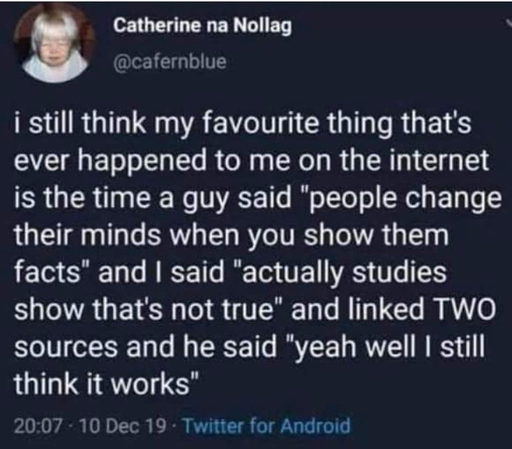
 Daarin
@jeffowski How do you spell Q E D?
 亖小姐
亖小姐@jeffowski
Hahaha 🤣😂😂🤣🤣🤣🤣
Hahaha 🤣😂😂🤣🤣🤣🤣
 DigitalRob
@jeffowski BEST.STORY.EVER
 Dave Rand
@jeffowski But the majority of evidence shows that people DO change their minds when you show them facts...

Partisans’ receptivity to persuasive messaging is undiminished by countervailing party leader cues - Nature Human Behaviour
In a study examining 24 US policy issues and 48 persuasive information treatments, the authors find no evidence that US partisans’ receptivity to persuasive information is diminished by countervailing cues from favoured party leaders.
 Noah Gibbs
@Drand @jeffowski Is that what that study is saying? I'm having trouble telling what it's claiming.
Like, it's claiming the party leader cue is *stronger* than the persuasive argument, but also that party leader cues don't have an effect on the persuasive argument.
I imagine it means something specific, but man it's not clear exactly what.
Maybe that you can mostly just add the two? But then it's not saying "people change their mind when you show them facts."
I mean, sort of. But then it's saying "facts are important, but still not as important (roughly magnitude 0.33 vs 0.48) as their preferred current authority."
Or maybe it's making some different claim. Again, I'm having a lot of trouble telling, which makes it hard to agree, disagree, or usefully check their data.
@codefolio @jeffowski Here's a hopefully more accessible summary of the paper https://thehill.com/opinion/campaign/3961818-have-we-become-too-partisan-to-be-swayed-you-might-be-surprised/

Okay. Those sound more like "the two factors add together, one doesn't diminish the other, even though it's higher in magnitude and so still overwhelms it."
So then perhaps it's "people change their opinions when presented with facts, but you'll need to hope they're not reminded of their party leader's support?"
@codefolio @jeffowski I'd say it's "many things affect what people believe, including facts". The take of "people ignore facts" is wrong, bc it implies facts don't do anything. They do something - but so do lots of other factors.
You might also find this book by Alex Coppock interesting https://isps.yale.edu/news/blog/2022/11/persuasion-in-parallel-alexander-coppocks-new-book-argues-in-favor-of-effective
Hm. That, too, is an interesting interview. It also seems a lot like persuading people by giving them facts or persuasion doesn't work terribly well -- at least, according to that interview, after about ten days.
But for most interesting topics, we have a significantly longer horizon than that.
Just generally, it's kind of hard to read the specific things he's saying and still agree with his conclusion in that interview.
@codefolio @jeffowski and here's another popular press overview
Why Do People Fall for Fake News? https://www.nytimes.com/2019/01/19/opinion/sunday/fake-news.html?smid=nytcore-android-share
Why Do People Fall for Fake News? https://www.nytimes.com/2019/01/19/opinion/sunday/fake-news.html?smid=nytcore-android-share

@Drand -- You're the meme dude...
@jeffowski the whole "facts don't change people's minds" idea was really sexy and popular last decade but has been thoroughly debunked. This is a main focus of my research - check out many of these papers https://docs.google.com/document/u/0/d/1k2D4zVqkSHB1M9wpXtAe3UzbeE0RPpD_E2UpaPf6Lds/mobilebasic
 David Zaslavsky
@jeffowski Would you consider adding alt text? I would love to boost this but without alt text it's kind of pointless to anyone who doesn't see the image.
 Cenobyte
 atomicangel
@jeffowski that’s the definition of irony, to the fullest.
 Alex Knapp
@jeffowski I laughed at the joke but also - those studies failed to replicate and subsequent research has uncovered how to present facts persuasively and successfully so....