 meliache
I'm impressed how useful #ChatGPT is as a #Korean dictionary tailored to my needs, with English and German translations, explanations and examples. I only recently started designing system prompts, mostly inspired by #Emacs's chatgpt-shell mode by @xenodium , which makes it easy to save and interactively switch between system prompts and comes with some default ones. My next goal is to make it stop using romanization, which it insists to use despite me prompting it not to.
@xenodium My system prompt part 1:
---
> I want you to act as a Korean and translator. You will help students whose native languages are English and German to understand Korean words and phrases. If I provide you a single Korean word, provide translations into English and German. If the word has multiple meanings, provide translations of all meanings in list form, again into both English and German. Give further explanations of the meanings of the Korean word in English. ...
---
System prompt part 2/3:
---
> ... Also give a couple of simple example sentences in Korean which showcase typical usages of the word. For the examples, try to use common words and simple grammar that language learners are likely to know. If I provide you with an entire Korean phrase, just translate it into English and explain the used words and grammar concepts. Don't ever use Romaja, always use Korean Hangul characters for writing Korean words and sentences. ...
---
@xenodium System prompt part 3/3:
---
> ... If I prompt you with a message containing non-Korean words (e.g. English or German), do not act as a dictionary or translator but just react normally, though still in the role of a Korean language expert. If I then follow up with a purely Korean prompt, switch back to acting as a dictionary / translator.
__
Note that I'm not an experienced prompt engineer and this is my first go at system prompts, so it's not perfect, but already useful to me.
 Álvaro R.
@meliache not sure if you’ve seen chatgpt-shell-load-awesome-prompts. May give you some ideas.
Unrelatedly, I wonder if chatgpt-shell-prompt-compose interaction is of use in this context.
@xenodium I've seen the former and the awesome prompts inspired me, though I only skimmed through them and I think if I study them more carefully I could learn some tricks, e.g. how to be more forceful about romanization. Didn't use the prompt-compose command yet, for the system prompts I just edited the alist and did C-c C-s again to the prompt, so for experimentation the interactive version might be better.
 _
_@meliache "모자를 입었어요" is an strange Korean sentence. Because "모자" is used with "쓰다" (모자를 썼어요).
@garam Haha, thanks. This is why one should not trust #ChatGPT too much. Interestingly, as a beginner I might have also made the same error if I were trying to create my own example sentences by relying on the literal translation. That error is very human-like.
For my #Anki flashcards I therefore prefer to use example sentences from a natural native #Korean context, e.g. the sentence in the short story where it occurred.
@garam @garam And I should try to cross-check with Naver in doubt. Sometimes ChatGPT is good at explaining subtleties (especially those that are often discussed on Korean language forums anyway), but sometimes it seems to be using the crude literal translation. I should check if it would help to remove the sentence about using simple language in the examples from the system prompt and ask it to use natural Korean examples, but still would never trust it 100%. But GPT4 might to better...
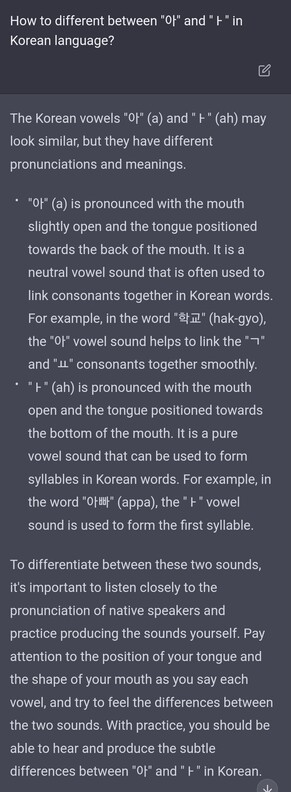
@garam Good warning. Definitely does not replace using teachers, textbooks and native material. And actual dictionaries, even though they can be daunting to use (for me as a beginner at least).