 mhoye
mhoyeI felt this in my teeth.
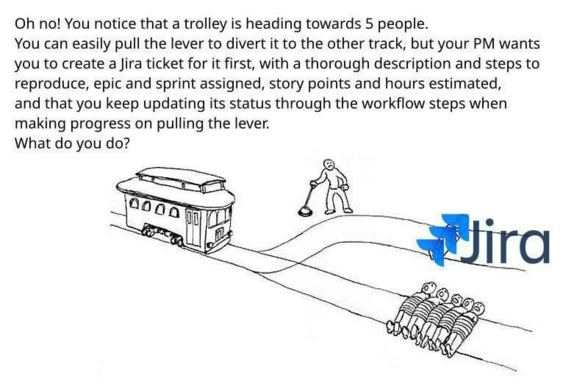
@bsmedberg Every project needs issue trackers, but describing Jira as an issue tracker is like describing McDonald's as a restaurant. It's a organizational culture and language least-common-denominator normalization tool whose endpoint happens to resemble an issue tracker.
A well-functioning issue tracker is a core part of making an org visible and legible to itself; adopting a tool that forces every part of an org to speak the same operational language is the lowest-trust path to that goal.
@oliver @sjstoelting This reminds me a conversation I had 20 years ago with a certain VP that hated DBs with a passion. A really, deep hatred I might add. He suggested storing data in plists (property lists) and index them separately. I wish I was joking, but sure as heck I’m not. That pushed me to write one of the first SQLite wrappers in Objetive-C in early 2002.
The man is brilliant, trust me, but this serious suggestion threw me for a loop.
True story.
@titociuro @oliver PostgreSQL has an extension for this: hstore
https://www.postgresql.org/docs/current/hstore.html
Developing failures that other people had already solved is stupid.
@titociuro @oliver A bit more fun facts:
The first .net provider hasn't been M$ SQL Server, it's been PostgreSQL.
And there is a foreign data wrapper to read from and write to Sqlite: https://github.com/pgspider/sqlite_fdw
@titociuro @oliver It's very well documented. PostgreSQL has a thing called CommitFest https://wiki.postgresql.org/wiki/CommitFest_Checklist?ref=timescale-blog
A list of previous and coming CommitFests can be found here: https://wiki.postgresql.org/wiki/CommitFest_Checklist?ref=timescale-blog
This is for new features. Bug fixes are done on email lists.
@titociuro @oliver @sjstoelting There is no such thing, as far as I'm aware. People work on something, or they don't.
Companies might prioritize this internally, and have people work on this, using their internal tools. Which may or may not end up in upstream.
 Benjamin Smedberg
 Stefanie Janine Stölting
 Oliver Maksimović
 Tito Ciuro

 Andreas Scherbaum