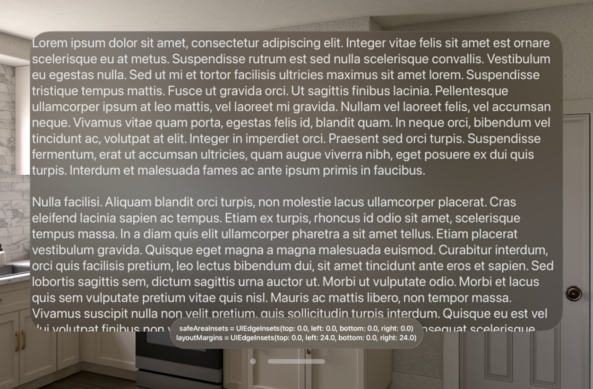
Ornaments don't affect the safe area insets or layout margins of their associated views on visionOS. This seems odd to me. What's the best way to inset a scroll view to ensure the content can become fully visible then?
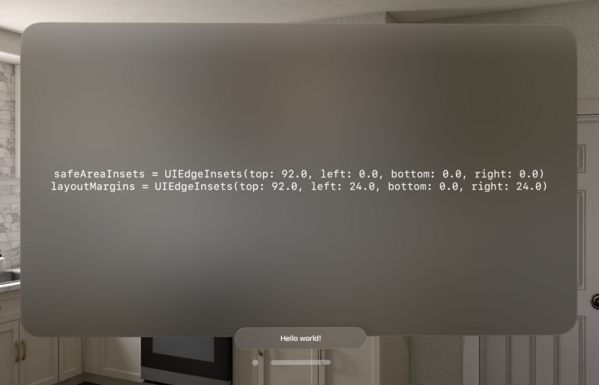
Filed this as FB12777426 with an example project. The feedback and example project can also be found here: https://github.com/simonbs/AppleFeedback/tree/main/FB12777426
AppleFeedback/FB12777426 at main · simonbs/AppleFeedback

💬 Sample projects submitted to Apple Feedback. Contribute to simonbs/AppleFeedback development by creating an account on GitHub.

GitHub
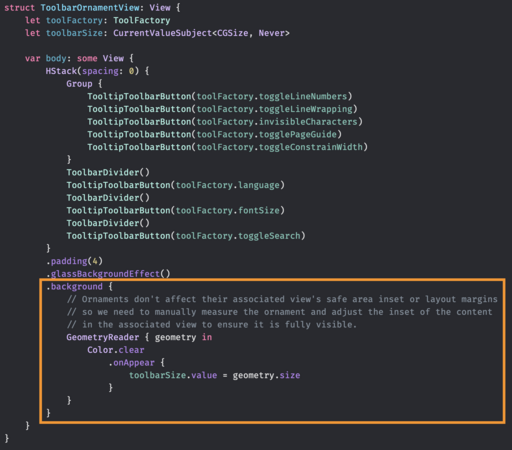
Best workaround seems to be measuring the ornament and updating the UIScrollView's content insets manually. It works but it isn't pretty.

Recipe for measuring a view in SwiftUI:

1. Add a background or overlay to your view.
2. Add a GeometryReader to that background or overlay.
3. Add an empty view, for example a clear color, to that GeometryReader.
4. Listen for changes to the geometry passed to you by the GeometryReader.

Sure, we may understand the code but how did we end up here? Surely this isn’t intuitive to anyone.

(Sorry for being old and grumpy)

@simonbs SwiftUI Views have a cycle where a parent proposes a size, the child picks a size and the parent positions the child. With a GeometryReader the available size can only be passed down meaning it would part of that same cycle. With PreferenceKey we can pass information like the size back up. This may cause another cycle where the proposal and child are recalculated. If you’re not careful it can cause many or infinite cycles and performance issues. This may be why they didn’t make it easy.
@ryanlintott @simonbs yes, I got performance issues in iVote where I needed to build “custom table” with row action functionality. Was able to optimize it, but man, it took me a long time to fix every little inefficiency
@ryanlintott @simonbs and there are still thing to be improved in that code but time is scarce