So I find VC Zurn's rationale for rejecting the AMC settlement fascinating:
https://courts.delaware.gov/Opinions/Download.aspx?id=350440
Essentially, the common shareholders sued, the settlement (a non opt out class) requires issuing more common, which necessarily dilutes the APEs. The parties tried to sneak into the settlement -
- that not only would claims of common SHs be extinguished, but also the claims common SHs had with respect specifically to their APE holdings, if they held both.
That was a bridge too far, for what I read as two distinct reasons.
The first is something like a due process argument about the class action context. Any claims arising from the APEs were too different from claims of the common, and -
- the class reps were not appointed as APE representatives. Which makes some sense. Aside from how the claims in the complaint, etc, did not concern harm to the APEs -
- every bit of the settlement that benefitted the common also harmed the APEs. Common SHs might be differently situated with respect to their APE shares, though - some would hold more, some less, and it would be unfair to treat them as the same.
This part of her opinion drew on other class cert decisions, and I am not an expert but her reasoning seemed sound.
The second rationale, though, was more interesting.
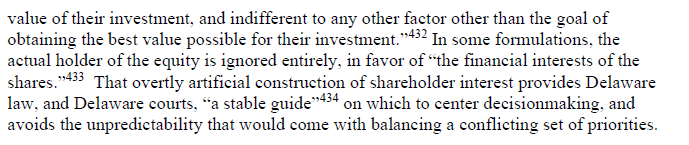
That rationale was that the offenses of AMC were not against the common shareholders in their personal capacities. They were offenses against the shares, abstractly. The class reps were not representing a class of shareHOLDERS so much as they were representing a class of SHARES.
The APEs were different shares; even if held by same investor, they represented a different set of rights, also attached to the shares and not to the people who actually hold them.
Under this logic, the common shareholders cannot settle away APE rights because the common shareholders in their specific capacity as common shareholders have no power to represent APEs - even if they personally hold APEs.
That idea - where the rights of the shares are abstracted away from the actual for real investors who hold them, to the point where the actual desires of the investors have no role to play -

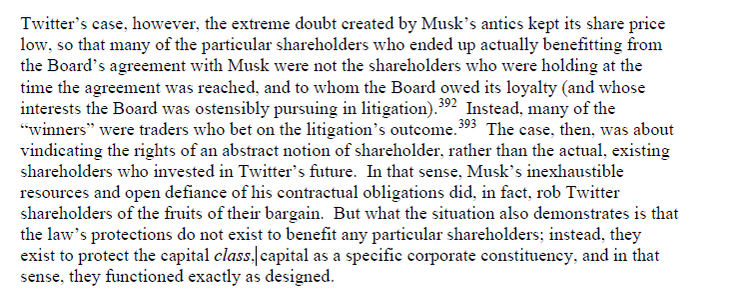
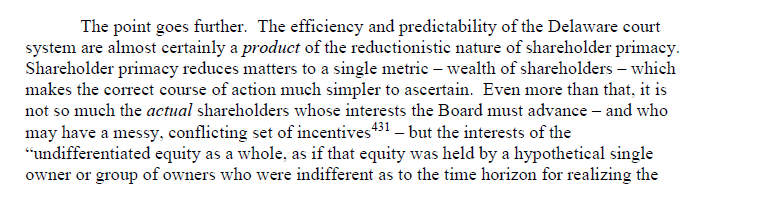
has been a sub rosa underpinning in corporate case law for a while, but has recently become more overt. Which is something, by the way, I discuss in that paper about Twitter/Musk I keep plugging:
https://papers.ssrn.com/sol3/papers.cfm?abstract_id=4442029

@annmlipton I still kick myself for not putting a good chunk of money into Twitter shares when the price was well below the Musk deal price, but I was pretty certain Twitter was going to be able to force him to follow through on the deal. Funny to think that would have made me more of an “intended” fiduciary than the long-term investors on some level…
@drfancypantsesq Yeah I mean what's so interesting about that dispute is that it encapsulated a lot of the themes in corporate law but, like, threw them into relief so you could really see them.
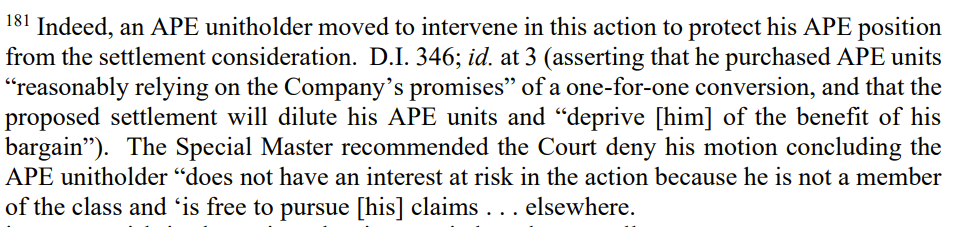
@annmlipton This stood out to me, because presumably it's the reason they tried to sneak the APE release into the settlement. In a footnote it was noted that an APE holder unhappy about the settlement consideration could pursue claims elsewhere...but how would that work in practice? Would such a claim potentially delay conversion, hence why the company is scared of it? The company and AA have often claimed the units are equivalent, which sits poorly with a conversion settlement specific to AMC.

@AttractiveNuisance Ape holders have no interest in delaying conversion. So Ape holders might I guess sue for monetary damages if they feel misled or something.

But the settlement didn't cover all Ape holders, just the ones who also held common.

That said, I haven't been monitoring closely but I gather this was thrown in at the last minute and not thought out well by the parties - defendants always want to make releases as broad as possible but they overshot.

@annmlipton Got it - it totally makes sense that APE holders angry about being diluted (by the settlement consideration relating to AMC shares only) might prefer to sue for monetary damages rather causing a delay in conversion. It just seems so weird to me that AMC holders complained and got some settlement consideration at the expense of APE holders, and then APE holders might complain about the consideration and get monetary damages, which necessarily must come at the expense of AMC holders.
@AttractiveNuisance not necessarily. If Apes sue they could get monetary damages from the directors and officers who orchestrated the scheme and not the company. Or from their insurance. I mean I don't necessarily expect a suit but that could be the theory.
@annmlipton Thanks again for your commentary - it turned out that the $APE complaint really did end up happening.
https://www.docketalarm.com/cases/Delaware_State_Court_of_Chancery/2023-0835/Simons_v._AMC_Entertainment_Holdings_Inc/92351725/
Simons v. AMC Entertainment Holdings, Inc., 2023-0835, No. 92351725 (Del. Ch. Aug. 15, 2023)

On july 21, 2023, the delaware court of chancery rejected the settlement of the class action lawsuit because it contained a release that was excessively ...

Docket Alarm