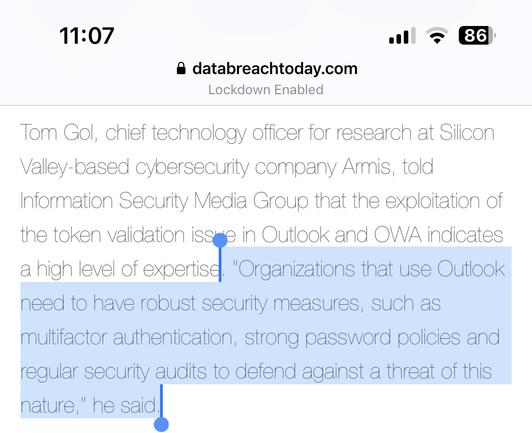
They used Outlook Web App - runs the Exchange Server codebase btw - to craft tokens to bypass auth.
There's some clever wording in blog around only impacting OWA. OWA is a part of Microsoft 365 and Exchange Online.
The problem was discovered by the US Government and reported to Microsoft. https://edition.cnn.com/2023/07/12/politics/china-based-hackers-us-government-email-intl-hnk/index.html
This one looks like a huge mistake, a consumer MSA key (managed end to end by Microsoft - there's no external logs) was able to forge any Azure AD key.
It's only become public it appears as the US Government told Microsoft, which forces public disclosure.
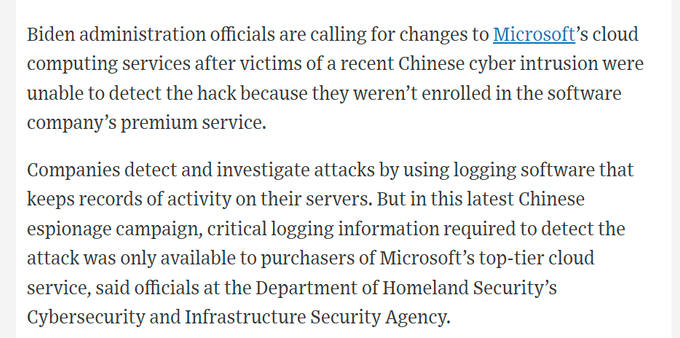
CISA's advisory on the Microsoft 365 compromise is wayyyyyyyyyyy better than the Microsoft advisory - contains actionable hunting and logging information. Kinda nuts that the US Government are providing better information about Microsoft than Microsoft.
Okay - I found a victim org.
The situation for them is 😬
MS are going to have to release more info, methinks.. or I crank out the blog writing.
Really good Washington Post piece on the breach of Microsoft 365’s email service.
- hackers accessed customer emails for a month
- Microsoft didn’t notice
- USG had to tell them
- The access to generate tokens very likely came from MS being hacked and not realising
Talked to another impacted victim org in the Microsoft 365 hack, they basically got no actionable info from MS. Basically ‘lol you got hacked’ with wordsmithing and padding. 👀😬
I think I’m going to post hunting queries for this with an MS Paint logo.
🎶 regulation 🎶
I agree with CISA here (and have publicly for years) - security access logs for customers own services shouldn't be locked behind E5 per user licensing.
Yes, it will cost Microsoft money in upsell. They're more profitable than a large portion of the UK economy; they can afford it.
I should also point out the reason Microsoft was able to tell orgs specifically that they'd be targeted even when they didn't have E5 is MS already store the logs anyway.
“We don’t have any evidence that the actor exploited a 0day." say Microsoft. Their first blog on this says “exploit” - so are MS saying they don’t patch vulnerabilities in their cloud? 🤔
Their latest blog also says “This was made possible by a validation error in Microsoft code” - which is a vulnerability. Which is a 0day as it was under exploitation before Microsoft knew of it existing.
Microsoft lying to media and customers is not a good look.
All it took was Exchange Online in GCC and GCC High getting breached
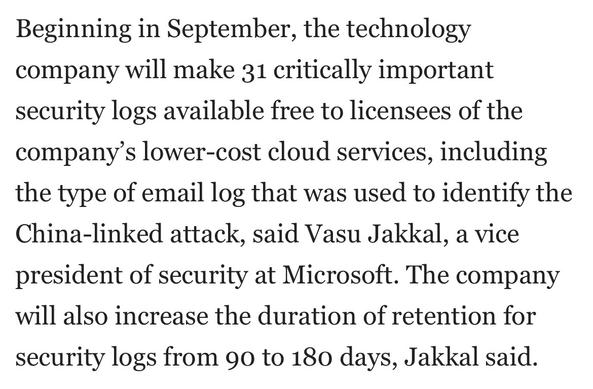
Non-E5 users to get some security log availability finally.
More details about the Microsoft 365 Exchange Online breach in this article.
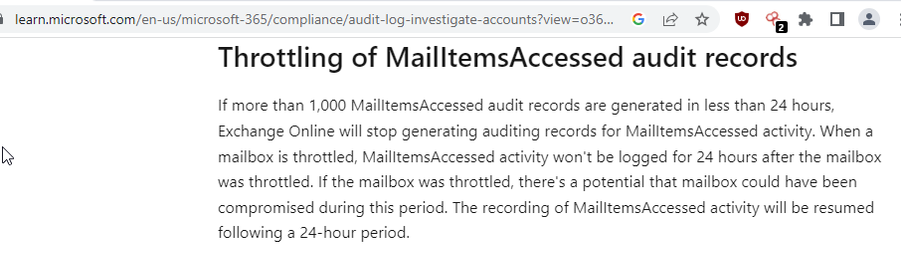
Although not stated, orgs are struggling to understand the scope of the breach due to audit log limits on MailItemsAccessed - it stops recording after 1k items. https://www.wsj.com/articles/u-s-ambassador-to-china-hacked-in-china-linked-spying-operation-f03de3e4
Just to loop this thread into this thread - I took a look at the attack path used in the M365 customer data breach.
A key part of the attack chain was documented by Microsoft at BlackHat in 2019.
Attached: 2 images Been looking at Microsoft 365 email breach some more - it looks like Microsoft were aware of issues in same token validation space in Exchange Online 4 years ago. MS did a talk at BlackHat about it, after somebody external pointed out an invalid token allowed any email box to be accessed via consumer Outlook.com. They fixed that issue - but still allowed any valid MS token to access any email, so the threat actor stole one of the MSA certs. Talk: https://www.youtube.com/watch?v=KN6e1mqcB9s
Wiz have an in-depth look at what they think happened at Microsoft over the Microsoft 365 breach.
They nail a new detail - one of the 'acquired' signing keys expired in 2021, but apparently it was still valid in Microsoft's cloud services. https://www.wiz.io/blog/storm-0558-compromised-microsoft-key-enables-authentication-of-countless-micr
Our investigation of the security incident disclosed by Microsoft and CISA and attributed to Chinese threat actor Storm-0558, found that this incident seems to have a broader scope than originally assumed. Organizations using Microsoft and Azure services should take steps to assess potential impact.