"Some argue that rapidly scaling back #FossilFuel production would leave billions of pounds of “stranded assets”, [and] would impoverish the public through a fall in the value of #savings and #PensionFunds.

The study found that in high-income countries two-thirds of the financial losses would be borne by the most affluent 10%.

Just 3.5% of financial losses from #StrandedAssets would affect the poorest half of Americans & could easily be compensated for by government."

https://www.theguardian.com/environment/2023/jun/22/fossil-fuel-assets-loss-study

Loss of fossil fuel assets would not impoverish general public, study finds

Research allays fears that rapid scaling back of production would hit people’s savings and pensions hard

The Guardian

Finally, the discussion turns to WHO stands to gain or lose by a clean #EnergyTransition.

The owners of #FossilFuel company shares (that is, the affluent and the powerful) stand to lose.

Everyone stands to gain from the stable #climate, the clean air and water.

And the people who are now the most "disadvantaged" (read: whose needs are ignored) have the *most* to gain from cleaning up our energy sources.

THIS is the roadblock to the energy transition.

https://www.theguardian.com/environment/2023/jun/22/fossil-fuel-assets-loss-study
Loss of fossil fuel assets would not impoverish general public, study finds

Research allays fears that rapid scaling back of production would hit people’s savings and pensions hard

The Guardian

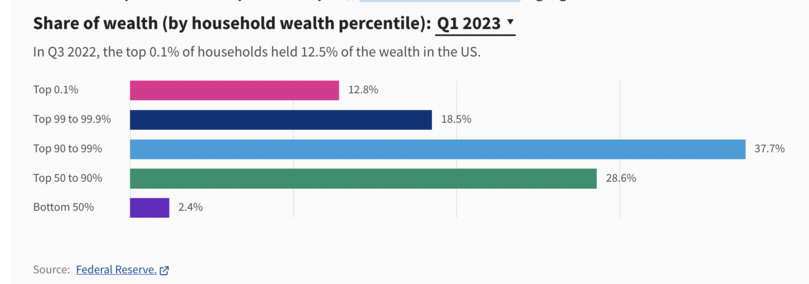
The study ^^ found that in high-income countries two-thirds of the financial losses from #StrandedAssets would be borne by the most affluent 10%.

This is simply because the most affluent 10% have two thirds of the wealth.

Data below from USAFacts
https://usafacts.org/topics/wealth-savings/

US Wealth & Savings Statistics and Data Trends: household wealth, wealth distribution, and more

Find statistics and data trends about wealth and savings in the US. This includes median household net worth, the distribution of overall wealth in the US, homeownership rates, and savings rates.

USAFacts

We need to emphasize this at every turn: We live in a fossil fueled #austerity now, and can have a clean-energy powered #abundance (borrowing from Rebecca Solnit here).

An abundance of clean air.
An abundance of jobs.
An abundance of community.
Vast savings on health care costs and other averted climate damages.

Let's go!

https://www.motherjones.com/environment/2023/04/electrify-everything-scope-data/

What "electrify everything" actually looks like

Get ready for a US building spree not seen in generations.

Mother Jones
@CelloMomOnCars Maybe we shouldn't electrify everything -- as in, why not make better non-motorized products? Like push-mowers, line drying, etc. I had a friend in Vermont who lived off the grid. If you wanted to watch TV, you had to peddle a stationary bike hooked up to a generator. We should be doing more of this type of thing, imho.

@DoomsdaysCW

As much as I agree with you (we use a push mower and sun-drying, have no tv, and locally mostly ride a bike -- and love all this), effecting these changes on a massive scale requires a culture change.

Getting everyone to ditch their car and take the bus or the bike takes culture change.

Culture change takes a long time. Can we pull that off in the time required?

My town's bike committee has been there for six decades and all we got is a bunch of sharrows.

@CelloMomOnCars

But, by and large, a bus is not an option, presuming there even is a bus, if one can't walk the mile/km to the bus stop. And bikes aren't even an option for some/many of us. I'm just saying that bikes and buses are only part of the solution.

@DoomsdaysCW @largess

@johnb48 @DoomsdaysCW @largess

That's what I mean though:
Putting in a real bus network, including last-mile provisions, takes culture change. "What, we have to spend money on poor people?"

No, once there is a real viable network, everyone will take the bus, not only poor people.

And that will make the streets more pleasant to those who must drive.

It's interesting to me how bringing up bus and bike gets interpreted as proposing a ban on cars. It's unfounded fear (and some projection).