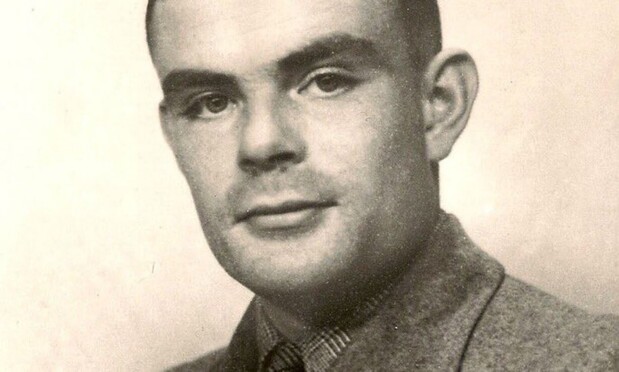
Mathematician, computer scientist, and WWII code breaker Alan Turing, who established the theoretical foundation for just about every modern computing device, was born #OTD in 1912. His work helped make it possible for you to read this.

The British government prosecuted him for being gay, a monstrous act that eventually led to Turing’s death by suicide. Then they waited over 60 years before issuing a pardon.

Image: The Guardian
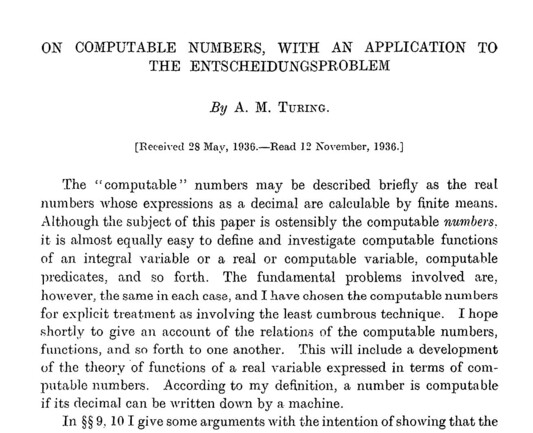
In 1936 Turing wrote "On Computable Numbers, with an Application to the Entscheidungsproblem," in which he addresses Hilbert's decidability problem, proves that the Halting Problem is unsolvable, and lays out the modern definition of computability.

Ref: https://londmathsoc.onlinelibrary.wiley.com/doi/abs/10.1112/plms/s2-42.1.230

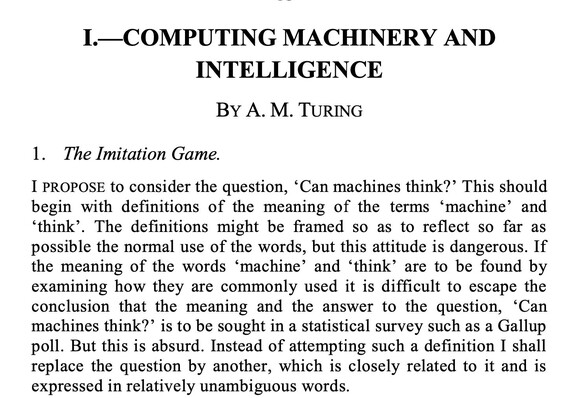
Given the proliferation of bots on social media, and of LLMs [sweeps arm in revealing gesture] basically everywhere else, Turing's paper "Computing Machinery and Intelligence" may be of more current interest.

In this paper he proposes the "imitation game" for scrutinizing a machine's ability to emulate human intelligence. We now call it the Turing Test.

Ref: https://academic.oup.com/mind/article/LIX/236/433/986238?login=false

I.—COMPUTING MACHINERY AND INTELLIGENCE

I propose to consider the question, ‘Can machines think?’ This should begin with definitions of the meaning of the terms ‘machine’ and ‘think’. The definit

OUP Academic

Really, the test proposes to gauge a machine's ability to emulate a human trying to *deceive* another human.

This is perhaps even more relevant to the current moment, to the ways LLMS and related technologies are impacting social media, spam and email solicitations, legal filings citing unusual case law, and a zillion other things. You may have heard some things recently!

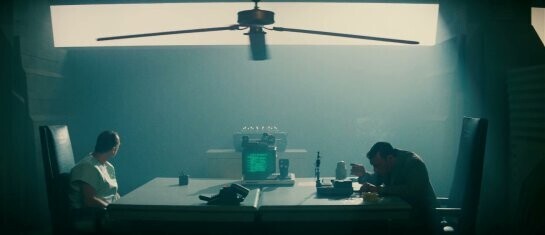
Turing initially describes the imitation game in terms of a man (A), a woman (B), and an interrogator.

The man and woman are in one room, the interrogator in another. The interrogator passes them questions and receives replies labeled "X" or "Y."

The interrogator's goal is to correctly assign "X is A and Y is B" or vice-versa. The man's goal is to trick the interrogator into making the wrong assignment. The woman's goal is to help the interrogator.

The Turing Test is now usually phrased in terms of a person and a machine, with the machine trying to convince the interrogator that it is a person, and the person trying to help the interrogator make the correct identification.

In informal usage, the Turing Test has come to refer to a person trying to decide, on the basis of replies to conversational questions or some sort of test, whether or not they are speaking to a machine or another person.

A few years ago I wrote about this on another social media site. When I used the word "assignment" it immediately triggered an avalanche of replies from multiple bots asking if I needed any help writing essays or completing assignments. Rates negotiable, results guaranteed to fool even the savviest human reader.

In 1952, the British government prosecuted Turing for what it termed "gross indecency."

He was gay, which to them was a crime. To avoid prison he was forced to submit to chemical castration. A few years later he took his own life by ingesting cyanide.

Turing’s codebreaking work at Bletchley Park during WWII had been critical to the war effort and saved tens of thousands of lives, maybe more. The British government repaid him with demonization and persecution.

To be clear, absolutely no one deserves this treatment. A person's right to live as themselves, free of persecution, isn't conditional on their contributions to war efforts or society or whatever.

In December of 2013, 59 years after his death and 61 years after his chemical torture by the state, Alan Turing received a royal pardon for a something that should never have been a crime in the first place.

https://www.bbc.com/news/technology-25495315

Royal pardon for codebreaker Alan Turing

Computer pioneer and codebreaker Alan Turing is given a posthumous royal pardon for his 1952 conviction for homosexuality.

BBC News

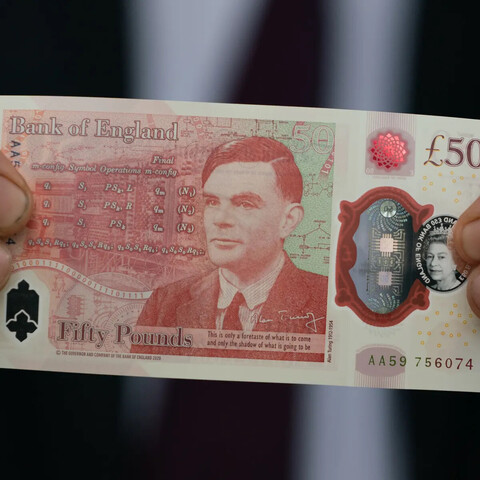
Then, two years ago today, a government that hounded Alan Turing to his death and waited over a half-century to pardon him, began circulating bank notes bearing his image.

Image: The Guardian

https://www.reuters.com/world/uk/new-british-50-pound-note-with-ww2-codebreaker-turing-enters-circulation-2021-06-22/

New British 50 pound note with WW2 codebreaker Turing enters circulation

A new 50 pound ($70) banknote featuring the mathematician and computer scientist Alan Turing enters circulation in Britain on Wednesday, three months after the Bank of England first unveiled the <a href="https://www.bankofengland.co.uk/banknotes/polymer-50-pound-note" target="_blank">design</a>. <a href="/business/bank-england-unveils-new-banknote-celebrating-ww2-code-breaker-turing-2021-03-25/"> read more </a>

Reuters
@mcnees
They put Alan Turing on the £50 note to make sure that poor people never see his portrayal and wonder who this guy was and what he contributed.
@TSAguilar46 @mcnees
The only people who see £50 notes are tradesmen.
You ever get a fifty out of an ATM?
@Jodami
"You ever get a fifty out of an ATM?"
Silly question. The only time you're likely to use an ATM is to take out £50 to pay the tradesman 😉.
@TSAguilar46 @mcnees
@mcnees for others reading this, there's an Easter egg on the note, there's a binary code on a line going into his shoulder, convert it to decimal 👍

@davespice @mcnees

Ob01000111100000111101111
= 0x23c1ef
= 2343407
= 11²×107×181

Trying it little-endian, I get
0x7bc1e2 = 8110562
(November 8, 562?)

It's not valid UTF8 in either direction (assuming adding a leading 0 to get it to 24 bits was what was intended but evidently not...)

okay, I'll bite; what's this supposed to be?

@davespice @mcnees

sure helps to find the version of the image that *doesn't* have somebody's thumb covering the first two bits (10)

Ob1001000111100000111101111
= 0x123c1ef
= 2343407 + 2^24
= 19120623

https://www.bankofengland.co.uk/-/media/boe/images/banknotes/50/polymer/polymer-50-specimen-back.jpg

@wrog @davespice @mcnees iso date order (my favorite) but not the UK standard, right?
@wrog @mcnees I wonder if the finger is covering some digits, check also the specimen images on here https://www.bankofengland.co.uk/banknotes/polymer-50-pound-note
£50 note

We first issued our £50 in 2021 - it features the scientist Alan Turing.

@mcnees There are a lot of small Turing Easter eggs built into the note design, thanks partly to input from the Bank itself.