
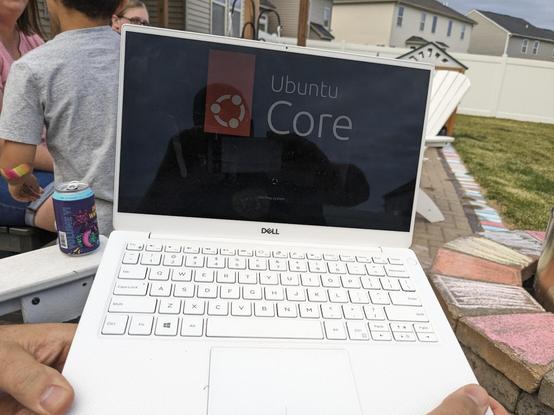
I've got some awesome news for #linux folks today! @kenvandine dropped by my house on his way to Mackinac island and I got the full tour of #ubuntu core desktop. The TLDR is. It is not just good, it's looking _great_, and the better news is that it's the same model.

Which by the way, is available as a public image, people just haven't found it and realized you can splat it onto a disk. Everything I will talk about in this thread is all public, no secrets. Here's the lowdown:

The terminal experience is the same model as say distrobox, but it's built on lxc as you'd expect. The terminal is brand new, built using Flutter, and it looks native, I thought it was gtk.

There's a gui with the logos of each distro when you click it, with the ubuntu logo being the larger default, and then after setup the terminal just takes you there, similar to distrobox.

Here's boot on an xps 13:

The entire gnome session is sandboxed, and apps talk to the things in your CLI via the snap plugs (or whatever they call it, sorry my terminology might be wrong).

This session has no "classic" mode, but the classic vscode runs fine and can connect to the lxc container for dev work.

The desktop sessions can run on top of the base system, which will be based on core LTSes, so 22, 24, 26, and then the desktop can run on a channel so you can run different versions of GNOME let's say.

And then sessions like KDE, etc and be on the same system and they also run in a sandboxed environment, so the entire desktop itself is like this.

Most of the old apps you hate won't be coming with, they'll be replaced with flutter versions, so no more old update manager.

No gnome software, they are rolling with the community made snap store thing.

Resource usage is better than with classic ubuntu by a measurable amount, and you can tell on observation almost immediately, it's not as jank as usual.

@jorge I think snaps would work great as building blocks for a immutable system but I don't think they are good as Flatpaks for desktop apps. I would like to see Canonical giving up snaps as a front-end solution and specializing it for backend and services letting Flatpak for the desktop apps.

@evasb They're not going to give up on that.

And the whole "but it's fine for servers and services" won't work as it's not suitable for that (despite what they tell you).

@jorge I don't like snaps at all. I like to argue that they are "fine" for backend just to be diplomatic.

It is kinda sad having this pretend half-closed universal packaging being pushed by the arguably most important distro on the desktop while Flatpak is a much better solution.

@evasb We're going to get the fruits of their portal contributions, and the hard part is getting apps to care about zero trust models.

For example, visual studio code will still not work right when it's sandboxed (that's why it's a classic snap), and the flatpak has the same challenges. Fixing the IDEs would make them work on both, and they have to integrate with portals anyway.

Sure, it's not my personal choice either but shrug, it's OSS.

@jorge Yeah, I read recently that snaps adopted portals too some time ago. At least it is something very important to share between the projects.

@evasb I ramble on about "the cloud native linux desktop model" and people roll their eyes. Here's an exact example:

In Kubernetes each part of the stack has an interface. Two of them are: A container network interface (CNI), a container storage interface (CSI).

Those interfaces are part of kubernetes and maintained upstream, in order to play you have to follow those guidelines as they are codified in open source governance and an understood standard.

@evasb There are tons of CNI plugins you can use, some open, some not. Same with CSI.

Different consumption models, everything from your the worst nightmare to your ideal thing can use these interfaces.

So while I prefer all open stuff, it ends up, if you have a plug for vendors to connect to stuff that is maintained as an open standard, they can make money using kubernetes. And in order to be successful you have to care about the health of kubernetes.

@evasb Repeat this for just about every component in the stack.

Canonical has chosen a model where they feel they can add value, and while people might not like it (I don't), they have to talk to portals ... this is what @ramcq and I were talking about 2 years ago at LAS when we mean that Portals are the missing desktop API.

@evasb @ramcq The way to keep Canonical honest, is to hold them to that portal standard. So far they have been doing that.

And we have to accept that they want to choose this road, it's their money to spend.

So the way we do this (IMO) is to push for the portal standards and whatnot to be run in a similar fashion as it works in cloud. aka portals should have the same level of rigour governance-wise as you would expect in a cloud native project.

@evasb @ramcq They don't return our calls. We don't even get invites, no cool parties for us.

So if we want the best realistic outcome, we need to prioritize getting app developers paid and Flathub is right here in front of us.

So the next time someone nitpicks about some dumb Flatpak issue, it better be more important than fucking paying open source developers.

@evasb @ramcq Otherwise another vendor gets that money, and sure, I like competition.

But we ain't out here trying to take some app store level cut, we need enough to keep the infra humming and sponsors like Fastly donate their infra to help make that experience better.

@evasb @ramcq So that's how I'm looking at this. So now that the diplomatic version is out of the way:

@evasb @ramcq I intend to compete in the following ways:

Support Flathub any way you can. Money, time, whatever. Encourage people to stop arguing about packages, the real race is to get devs paid.

Fedora needs to hear loud and clear that people want this because they've been making this and have had it for years now.

@jorge @ramcq

Hope Flathub have the payment system and the model ready soon. I agree this is the real race.

@evasb @ramcq It's close. We need people to bring hugops to the folks running Flathub. And they need our support, people are working hard.

More help would be nice, help us get the word out so that people can dive in if they want!

@evasb @ramcq

I will prioritize building a community around a cloud native terminal: https://github.com/orgs/ublue-os/discussions/156

And I'm going to keep working on https://github.com/projectbluefin/ as my interpretation of the Ubuntu spirit because I've had all of this for a long time and it will at least be as good as this. So it'll be a net good for Linux.

Project Exo: Ideas for a cloud-native terminal Β· ublue-os Β· Discussion #156

(This is labelled as a concept, which is an inprogress idea or proposal, it is not resourced or scoped so mostly just a collection of ideas. Over time it might move to a proposal) Hey everyone, I'v...

GitHub

@evasb @ramcq

Plus, I got to hang out with an old friend and we geeked out about Linux.

And whatever poisonous shit people post in response to all of this new info check this out:

@jorge @evasb @ramcq @kenvandine @kenvandine great meeting you arranged with Jorge!!! Made up an amazing thread, and I am currently deep into the #OpenPrinting Snaps, especially the #CUPS #Snap (most are switched to #core22 now) so that a distro where everything just works has printing just work, too! @seb128 has also already given me the link to the images for testing. I hope I will be able to demo Ubuntu Core Desktop in India on my Conference I am organizing there in September ...

@jorge @ramcq Flathub as a storefront is very important. It would help many people do what they like most.

We need to normalize the sale of binaries, enable people to make, if possible, a living selling their FOSS software.