Reminder that the only safe dummy domains to use are:

- example.com
- example.net
- example.org

And nowadays there's also a safe dummy TLD: .example

These are safe because they are reserved by IANA as as special-use domain names for documentation purposes on direction of IETF in RFC 2606 and RFC 6761.

Any other domain can be registered and as such should _never_ be used as a dummy domain for documentation or as eg. an example in default configs.

See: https://en.wikipedia.org/wiki/Example.com

example.com - Wikipedia

Removed “example.edu” from the list + submitted a correction to the Wikipedia page as “example.edu” is not mandated in the IETF RFC:s, see:

- https://datatracker.ietf.org/doc/html/rfc2606#section-3
- https://datatracker.ietf.org/doc/html/rfc6761#section-6.5

The “example.edu” appears to be in the same league as “example.se” and others – a class of second
level domains that a TLD owner itself has voluntarily chosen to reserve for documentation purposes, which is different from the other three which are directed by IETF.

RFC 2606: Reserved Top Level DNS Names

To reduce the likelihood of conflict and confusion, a few top level domain names are reserved for use in private testing, as examples in documentation, and the like. In addition, a few second level domain names reserved for use as examples are documented. This document specifies an Internet Best Current Practices for the Internet Community, and requests discussion and suggestions for improvements.

IETF Datatracker
@voxpelli Dang I was hoping there would be an example.example
@Datenegassie Since the entire .example TLD is safe to use, you can for sure use example.example in your docs 😅 https://en.wikipedia.org/wiki/.example
.example - Wikipedia

@voxpelli It is also worth to mention that IPv4 documentation network blocks are 192.0.2.0/24, 198.51.100.0/24, and 203.0.113.0/24. IPv6 documentation network block is 2001:DB8::/32. See RFC 5737 and RFC 3849
@milosz fun fact! There are documentation ranges for MAC addresses as well!
https://www.rfc-editor.org/rfc/rfc7042.html#section-2.1.2
I was years into my career before I stumbled across that while doing a side project.
RFC 7042: IANA Considerations and IETF Protocol and Documentation Usage for IEEE 802 Parameters

@hugo Wow, amazing! Thanks for sharing this.
@voxpelli There's also .invalid and .test TLDs, the former for an invalid domain and the latter for testing.
@voxpelli Let’s take example.com for example… 😁
@voxpelli @pluhmen i will start using example.example !
@voxpelli sometimes registries reserve example domains too! Like eksempel.dk which is really useful since example.com feels out of place in a Danish blog post.
Eksempel Domæne

@voxpelli Well, for a presentation I needed a dummy domain for a fictional "secure email" provider.

Every fantasy domain that I could come up with did actually exist. I ended up with an emoji-style "🔒mail.com" - but then, this may also be registered…

@katzenberger “🔒mail.example”?
@voxpelli Yep, TIL from you that TLD exists. Thx!

@voxpelli Funny story, I worked for a company called Canadian Bank Note and they used *.cbn as an internal TLD.

It was super fun when Christian Broadcast Network bought and released the now public *.cbn TLD.

@Routhinator Oh no 😂

We used to use *.dev as an internal TLD back when I worked with PHP and Apache and needed virtual hosts, but that changed when Google bought that and made it a public TLD.

There has been some work on getting *.internal reserved for such uses: https://github.com/wkumari/draft-wkumari-dnsop-internal/issues/6

Status · Issue #6 · wkumari/draft-wkumari-dnsop-internal

@wkumari Great initiative! 🥇 Just curious, what's the status of this RFC? What has the response from IETF been? @jeffbarr @jeffbarg sorry for the ping 😄 In short, this RFC suggests making .internal...

GitHub

@voxpelli I tried to use "dummy" in some code for work, and I was told that it was an insensitive term. I changed it to "placeholder".

https://media.tenor.com/ERa47gPVan8AAAAC/the-more-you-know.gif

@steve If used to describe a person, sure, but else not I think: https://www.merriam-webster.com/dictionary/dummy

Also:

- ”placeholder": a person or thing that occupies the position or place of another person or thing
- ”dummy”: an imitation, copy, or likeness of something used as a substitute

I would say that ”dummy" would often be better replaced with ”fake" if one were to replace it:

- ”fake”: not true, real, or genuine

Eg: "crash dummy" vs ”crash placeholder” vs ”crash fake”

Definition of DUMMY

Definition of 'dummy' by Merriam-Webster

@voxpelli I agree with you. I'm just recounting an experience I had with my place of business. In the case I was using it, placeholder worked just as well.
@steve Yeah, I have had similar experiences when I eg. tried to use a blacklist / whitelist, especially struggling as a non-native speaker
@voxpelli At my company, we are instructed not to use the word "execute" as in "execute a program" because executing an instruction is THE SAME as executing a person. Tangentially, we also can't use "encryption" but instead we have to say "security".

@steve Yikes, I guess its similar to eg. https://alexjs.com/

I like the spirit of promoting considerate writing, but I don't like it when its spreading fear, uncertainty and doubt in a way that risks silencing more than it helps.

alex: Catch insensitive, inconsiderate writing

Whether your own or someone else’s writing, alex helps you find gender favouring, polarising, race related, religion inconsiderate, or other unequal phrasing.

alex
@voxpelli IIS have reserved example.se. If needed for some reason.
@brother Yeah, I noticed that as well later on, along with a few others domains: https://data.internetstiftelsen.se/barred_domains_list.txt
Your Name Here - Domain Name Concierge Services, Coming Soon.

Professional Full Service Concierge for Secure Domain Name Transactions - Leasing, Acquisitions, Co-Branding and Revshares.

Whois yournamehere.com

Whois Lookup for yournamehere.com

@voxpelli @stux I liked how the Mail Administration Guide (from the 80’s) sendmail main.cf file provided a sample machine as “CS.Podunk.EDU”

For anyone looking, podunk.ai is available (surprised OpenAI, MS Bing, or Google Bard didn’t snatch that up).

@voxpelli Totally! I am missing an example TLD using IDN though :( (for use in unit tests etc)
@voxpelli
Haven't the NFT ones all freed up?
@encthenet

@dexter
Just because they are unused today doesn't mean they won't be reused again tomorrow.

There is also the equivalent for IP addresses as well.

@voxpelli

@encthenet @dexter @voxpelli

When I need multiple domains for a book, I register them. Readers have trouble internalizing setups using example.net vs example.org, but two wildly different domains stand out.

(Really, I pick some of my domains that don't have the service I'm writing about and that feel right, but the point is: they are registered.)

@mwl @encthenet @dexter @voxpelli I also feel like using only example.<blah> domains can get confusing. Depending on the context in docs I sometimes also use "<something>.home.arpa" (RFC 8375) or "<something>.test" (RFC 6761). Now that people are more comfortable with alternate TLDs, the .test reserved TLD examples don't look as strange as they used to.
@jimp @mwl @encthenet @dexter @voxpelli you can use subdomains of those too: alpha.example.com, beta.example.com.
@kw217 @mwl @encthenet @dexter @voxpelli subdomains are good for examples inside an example org but if you're trying to document an example setup between two unrelated entities then using subdomains (or even example.com vs .net) make it ambiguous. Whereas using exampleco.test and widgetsllc.test makes it much more clear they are distinct.
@jimp Should be exampleco.example though, the .test ones are intended to test the DNS system, not for documentation
@voxpelli You are absolutely correct, but even though it's better in theory I've found using .example more awkward in practice, same with .invalid.
@jimp I myself opt for “example.com” for as many places as possible
@jimp @mwl @encthenet @dexter @voxpelli That's true. Then you have to fall back on domains you own or trust. At work I use contoso.com and fabrikam.com which are owned by Microsoft for that purpose.
@kw217 @mwl @encthenet @dexter @voxpelli I'd be too afraid someone would forget to (or decide not to) renew those and they end up hosting malware. One of many reasons I stick with the reserved names and networks laid out in RFCs.
@voxpelli Speaking from experience if you have a silly fake domain you use for examples: register it. At a past job we didn't and someone (probably an ex-employee) did. Not a great time.
@voxpelli I see a lot of people in #infosec using evil.com, and I'm afraid that one day it will actually turn evil.
@voxpelli
Someone registered example.ie so don't ever use that one either.
The .IE Domain Registry also delegated nic.ie - the registrant was already using NIC on their logo so it was allowed.
.invalid - Wikipedia

@jnfingerle There are some other exceptions yes, but generally for documentation purposes
@voxpelli
So, you agree that "any other domain can be registered" is incorrect?

@jnfingerle I did a correction to my main post now, the example.edu should not have been there, Wikipedia tricked me to thinking it was part of the IETF RFC.

My focus was on the second level domains of ordinary TLD:s, not on special TLD:s.

Also:

- All .invalid domains are explicitly by definition invalid
- .test domains are intended to test DNS related code

So for any ordinary use those two wouldn’t qualify anyhow.

See: https://datatracker.ietf.org/doc/html/rfc2606#section-2

RFC 2606: Reserved Top Level DNS Names

To reduce the likelihood of conflict and confusion, a few top level domain names are reserved for use in private testing, as examples in documentation, and the like. In addition, a few second level domain names reserved for use as examples are documented. This document specifies an Internet Best Current Practices for the Internet Community, and requests discussion and suggestions for improvements.

IETF Datatracker
@voxpelli
I fully support your main message. I only find there's value in not over-simplifying the truth into the realm of the factually incorrect. No absolute value, of course, but "most other" instead of "any other" would have been the same basic message *and* true at the same time.
@voxpelli Cool, I had completely forgotten that the .example TLD exists.
The said RFC 2606 https://datatracker.ietf.org/doc/html/rfc2606 is probably the shortest RFC I’ve ever seen 🤓
RFC 2606: Reserved Top Level DNS Names

To reduce the likelihood of conflict and confusion, a few top level domain names are reserved for use in private testing, as examples in documentation, and the like. In addition, a few second level domain names reserved for use as examples are documented. This document specifies an Internet Best Current Practices for the Internet Community, and requests discussion and suggestions for improvements.

IETF Datatracker
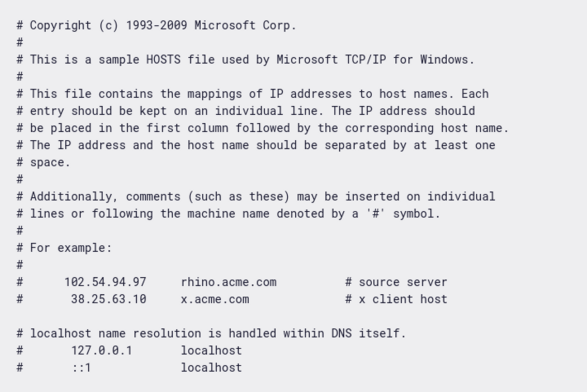
@voxpelli Yes please. Microsoft still uses my domain name in their hosts.txt file because decades ago they didn't know about RFC2606 and they are too stubborn to fix it.
@voxpelli I sometimes use .invalid domains
@voxpelli I remember such relief figuring out that was safe to use in docs, back in the day
@avirr Yeah, same here, and when @utochin reminded me that not everyone have figured it out yet (which is quite obvious of course) that made me want to share it so that even more people could feel that relief and - um - a few more people than I anticipated felt a relief and wanted to boost 😅

@voxpelli See also: Google acquiring .dev and building Chrome to explicitly ignore your system's DNS settings and /etc/hosts lookup.

That… is part of why I refuse to use Chrome. I will not have my DNS or other network traffic hijacked by an advertising company known to share data with third-parties.

@voxpelli I wrote a doc on this. Not only for domains, but also IP addresses and phone numbers.

https://gist.github.com/atoponce/4c94e964e0953c95c3d1e67454fbb7e7

Best practices for examples in documentation

Best practices for examples in documentation. GitHub Gist: instantly share code, notes, and snippets.

Gist
@atoponce @voxpelli "While the area codes 600, 622, 633, and 644 are identified as "non-geographic", they are assigned to Canada." 🤯
@raboof @voxpelli "Non-geographic use in Canada".

@raboof @voxpelli Looks like I can add area codes 677 and 688 also as Canadian non-geographic area codes.

https://en.wikipedia.org/wiki/Area_code_600

Area code 600 - Wikipedia