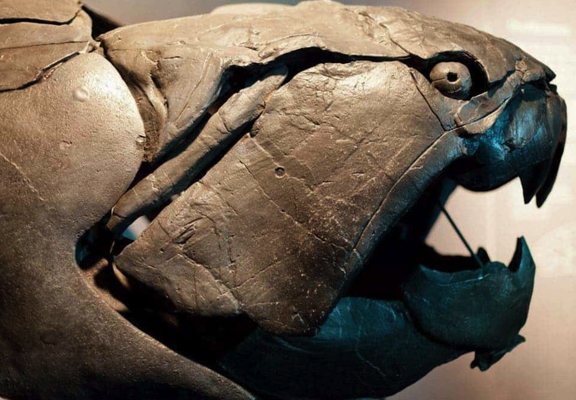
So, I've been looking for a solution to the question: Why did vertebrates fail to flourish on Myrmecos?

I think I have the answer: No Armored Fishes.

If there were no armored fish then the Eurypterids would have continued to be apex predators longer. Some might have filled the hunting niche of early tetrapods. Arthropods were already on land, but you get a second wave.

The land gets built up with arthropods and fish are trapped in the seas!

https://worldbuilding.stackexchange.com/questions/247287/a-planet-without-vertebrates-mostly-restrictions-apply

A planet *without vertebrates. (*mostly, restrictions apply)

I'm thinking about the evolutionary history of life on a world very similar to earth in many ways, carbon based life, life began in the seas, creatures like cephalopods, and arthropods, evolve. But,

Worldbuilding Stack Exchange

And in this universe earth is the exception. Not only is earth far away from all of the other living planets it's one of the few with land vertebrates.

The armored fish driving tetrapods on to land was a kind of ripple in the intended pattern. It threw everything off!

And just looking at The Dunk-- it is kind of unnatural, don't you think?

This also means that the ants will keep describing humans as "intelligent life from the sea" -- even as we keep explaining that everything came from the sea and it was a long time ago...

To them having a backbone means you are adapted to living in the water.

I'm adding "Evolution of Ant" to my list of things to draw.

It would be like one of those old-school natural history museum murals. Starting with single-celled life in the tidal pools of early Myrmecos, then the first multicellular life, then the first sea arthropods, then a momentous moment when a little crab creature first steps on land! Then the early insects, primitive solitary wasps with the glimmers of consciousness, eusocial insects discovering fire ... and at last ants!

Hmm it occurs to me reading about the history of human aviation and all of those people longing "to fly" might make ants very uncomfortable.

The ants have never had much fascination with flight. (Space is another matter.) Any queen or drone can fly. It's considered a sign of maturity to pull one's wings off and get on with life.

Flying has primitive, and also vaguely sexual connotations so all the documentaries about people like the Wright Brothers just make Humans sound hopelessly horny.

@futurebird And that's incorrect how?

@futurebird I would have thought that from the ants' perspective, human preoccupation with flight would strike them as sort of tragic, in that humans never got to experience the sexual freedom of adolescence, and clearly spent the rest of their lives longing for escape from premature adulthood.

Humans don't get to choose when to pull off their wings, adulthood is thrust upon them whether they feel ready or not. I think in that the ants would read that human existence is much less free than ants' existence, where humans are slaves to their strange and inexorable biology, and live lives of suffering therefore.

@siderea

But most ants never fly.

And it's kind of a boundary pushing thing when queens and drones decide to keep their wings.

Though I do like the idea of ants looking at paintings of angels and thinking "What a lovely nuptial flight"

@futurebird I am very pleased with the idea of space ants having a natural history museum and also thinking humans are horny because we make airplanes.
@futurebird is there an ant version of the “inevitable evolutionary progress” meme that runs from ape through slouching to upright human? Like shedding legs until they reach the obviously optimal count of 6, or something?

@futurebird

"The human body's design spec is: a spacesuit for a fish."

(Ken MacLeod, "The Cassini Division")

@futurebird

I love it.

Seabags with endoskeletons are clearly "not from around here" to air-breathing arthropods

Same as we would describe a molluscae land-dweller as "cthulhoid" even if they'd been land-walkers for millions of years