Spoiler alert: I intend to start blogging about #EastNorse language history. Not only #VikingAge or #runic or Medieval #OldDanish and #OldSwedish, but also older #ProtoNordic and digressions into modern dialects, #Elfdalian and Fenno-Swedish. Hang on and boost if you think your followers are interested.
My blogs will feature some elements from my existing research, This includes #umlaut, including the spread of #rounding, and #breaking.
#EastNorse and #Gutnish, perhaps #Övdalian, have a different story to tell here and may contribute a lot to the reconstruction of how the process originally proceeded.
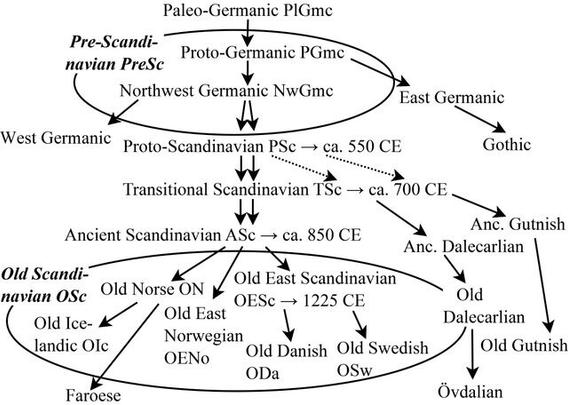
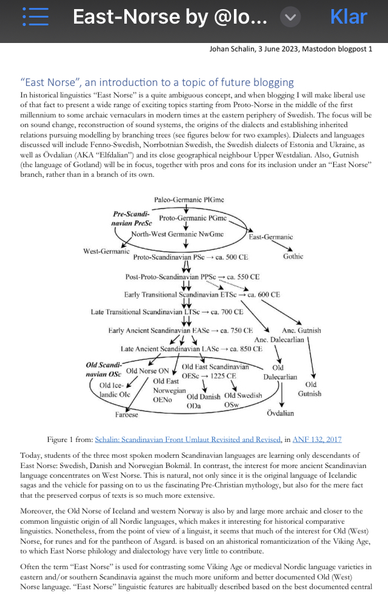
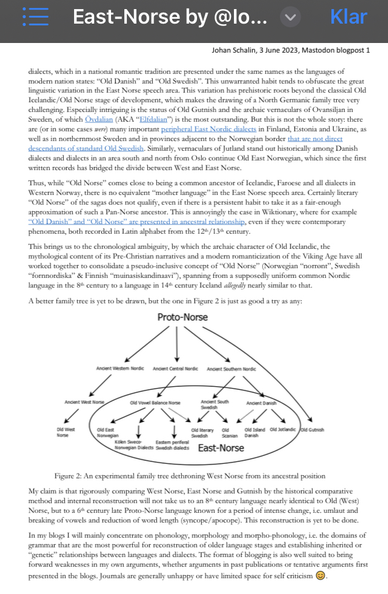
I attach my first introductory blog on #EastNorse, depicting coming topics.
I will discuss periferal Swedish dialects that originate from a more archaic East Norse than #OldSwedish. I will also by rigorously comparing #WestNorse, #EastNorse and #Gutnish show that they do not derive from 8th century language similar to #OldWestNorse, but a 6th century late #ProtoNorse.
As it seems, that Mastodon does not support PDFs, so I will have to reconsider my format of any future blogs.
My first posting is on #FennoSwedish. In parallel in this chain you find two spontaneous samples from #Pargas between Turku and the Åland Islands.
Old traits common in Finland:
-Neuter & non-referential pronoun ”he” ’it’, also compounded ”hehe” ’it-that’ & ”hete” ’it-there’ -Small words with initial d- in Swedish begin with t- in dialect: ”teh” =”där” ’there’; ”To” =”Du” ’you’; ’tåte” =”dylik-där” ’such there’.
-Short stressed CV-syllables ”sama” ’same’.
-Retained diphthong ”göutar” ’boys’
Before taking on harder subjects, let’s debunk a myth circulating in Finland and Sweden: No! The dialect in #Närpes or #Närpesiska is not the ”oldest” #FennoSwedish dialect! And moreover, it has remarkably little in common with “Swedish spoken in Stockholm in the 1500s” (see link). The myth is fuelled by the impression that “incomprehensible”=“archaic”. In fact Närpesiska is incomprehensible mainly for the opposite reason: it is full of phonological innovations. https://svenska.yle.fi/a/7-1281219
Fredrik Lindström: Närpesiska liknar stockholmska - så som man talade på 1500-talet (Från 2018)

Åbodialekten liknar 1800-talets stockholmska.

Among dialect scholars in Finland some want to name the dialect of #Kronoby as the most archaic. As a researcher specialised in #vocalism I willingly subscribe to that: unlike #Närpes (and unlike #Icelandic) no secondary diphthongisation and better preserved #OldNorse syllable quantity. Unlike some #FennoSwedish dialects a distinction is maintained between öi (vf. #WestNorse ey) and öu (cf. West Norse au) https://kronomagasinet.wordpress.com/om-krombi/
Om Krombi

På den här sidan hittar ni lite information om Kronoby och Kronobydialekten. Vill du bidra? Kontakta oss genom att skriva en kommentar i Postlådan eller genom att skicka e-post direkt till krombidi…

Kronomagasinet.com
By and large #WestNorse preserves more of #ProtoGermanic than #EastNorse. An exception is the verbal stem gā/*ga- ’go’, which in #OldSwedish was used in the present tense and at times in the infinitive. Else its inflection was suppleted by forms of the verb ”ganga”.
In West Norse ”gá” is attested very sparsely indeed, and instead ”ganga” is used throughout the paradigm.
In past research there was an idea that gā could have been borrowed from #LowGerman, but today this is not deemed probable. 🧵👇🏻
@iohannan ah, so that's why going from Sweden to Norway feels like travelling back in time.