
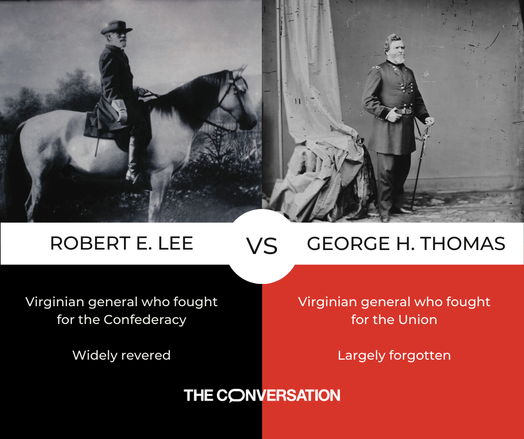
Two Southerners serving in the U.S. Army in 1861 made different choices when the Civil War began.

Robert E. Lee has been looked on as a source of pride by White Southerners.

But perhaps, according to historian Christopher Einolf, a better source of pride today would be Maj. Gen. George H. Thomas โ€“ another Virginian, who honored his oath to defend the Constitution.
https://theconversation.com/us-army-maj-gen-george-h-thomas-journey-from-enslaver-to-union-officer-to-civil-rights-defender-205950

#History #BlackHistory #Histodons @histodons

US Army Maj. Gen. George H. Thomas' journey from enslaver to Union officer to civil rights defender

A Southerner, Maj. Gen. George H. Thomas was a racist enslaver before the Civil War. But he fought for the Union because he prioritized his oath to defend the Constitution over state interests.

The Conversation
@TheConversationUS @histodons george thomas was a slave owner just like lee why not cancel him too
@ekknappenberger @TheConversationUS @histodons Not committing treason in defense of slavery goes a long way. Unlike Lee, Thomas honored his oath to his country and the Army and instead fought to preserve the Union and destroy slavery, even if it meant giving up the people his family had enslaved.
@tequila0341 @TheConversationUS @histodons this kind of rhetoric is ultimately unhelpful. "treason" "oath" and even "country" need contextualizing here
@tequila0341 @TheConversationUS @histodons you cant for example say that george thomas was against slavery because he stayed in the union army in 1861. not when slavery was abolished only in part in 1863 and wholly later than that.

@tequila0341 @TheConversationUS @histodons and some of the most prominent voices for negro social equality were actually confederate soldiers: see eg G W Cabel (1844-1925).

I hope it is clear that the actual history cannot be reduced to such black-and-white rhetoric

@ekknappenberger @TheConversationUS @histodons Except most of the groups inflicting mass violence on black Americans in the post-CW South were made up of Confederate veterans, who were overwhelmingly determined to resist any attempt to emancipate or empower black Americans.
@ekknappenberger @TheConversationUS @histodons what about staying in the Union army post 1863 and post 1865, as well as fighting to exterminate the Confederate regime whose entire purpose was the preservation of slavery and the destruction of the Union?
@tequila0341 @TheConversationUS @histodons it's anachronistic to say that George Thomas was fighting for abolition when he stayed in the army in 1861 -- my whole point is that things were more complicated than just "slavery or abolition" -- which wasnt even clear in 1863, let alone in 1861
@ekknappenberger @TheConversationUS @histodons it was extremely clear especially post 1863, and even more so post 1865.
@[email protected] @TheConversationUS @histodons that's not when Thomas made the decision to stay in the Union army, though. It was not clear in 1861 that the Union was fighting for abolition