
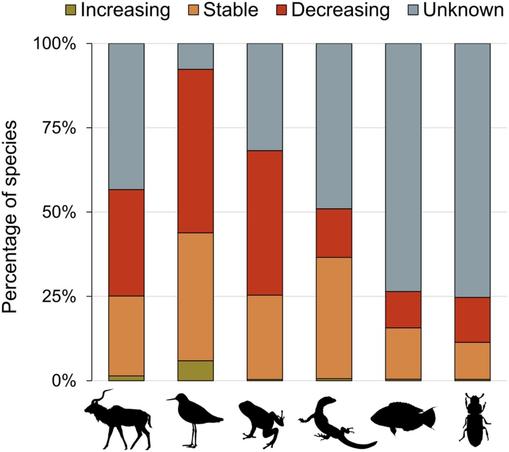
The remarkable diversity of life on our planet is in grave danger, with research indicating that nearly *half* of all animal species are currently in decline...
___________________________

Over the past several decades, it has become clear that global biodiversity has been declining due to human activities including conversion of habitat, use of pesticides and herbicides, and more recently, climate change. It is not known how many species are extinct due to such activities, but scientists have been trying to track species at highest risk of disappearing.

Now a trio of macro-biologists and life scientists has determined that the modern "sixth mass extinction" event is going to be even worse than prior research has shown.

They found that 48% of species have declining populations, and just 3% have rising populations. They also found evidence showing that 33% of species currently classified as non-threatened are actually spiraling toward extinction.

The team concludes that the planet is approaching a mass extinction event far graver than prior research has suggested.
___________________________

FULL ARTICLE -- https://phys.org/news/2023-05-anthropocene-sixth-mass-extinction-event.html

#Environment #Climate #ClimateChange #ClimateCrisis #ClimateEmergency #Biodiversity #Extinction
Anthropocene 'sixth mass extinction' event predicted to be worse than previously thought

A trio of macro-biologists and life scientists, two with Queen's University Belfast and the third with Czech University of Life Sciences Prague, has found that the modern "sixth mass extinction" event is going to be even worse than prior research has shown.

@breadandcircuses

Since this article mentions "Anthropocene" I thought it would be a good time to boost this piece again to clarify were the real blame lies:

https://news.climate.columbia.edu/2022/09/21/how-colonialism-spawned-and-continues-to-exacerbate-the-climate-crisis/

"To date, researchers have mentioned the Anthropocene Epoch as the latest geological period in more than 1,300 scientific papers. While the scientific community has been debating over which year the Anthropocene Epoch began, several Indigenous and Black scholars have shot back against the term.

"The problem, some scholars say, is that the term assumes the climate crisis is caused by universal human nature, rather than the actions of a minority of colonialists, capitalists, and patriarchs. And the implication that the Earth was stable until around 1950, when the ‘Anthropocene’ supposedly began, denies the history of people who have been exploited by those systems for centuries.

"Indigenous scholars have further addressed how the term stands for colonialist ideologies that sever the deep ties and interconnections between humans, plants, animals, and the soil.

“Instead of treating the Earth like a precious entity that gives us life, Western colonial legacies operate within a paradigm that assumes they can extract its natural resources as much as they want, and the Earth will regenerate itself,” said Hadeel Assali, a lecturer and postdoctoral scholar at the Center for Science and Society, a Columbia Climate School affiliate."

#capitalism #colonialism #biodiversity #ClimateCrisis

How Colonialism Spawned and Continues to Exacerbate the Climate Crisis

Colonialism was motivated by the promise of plundering the environment and subjugating populations. Its legacy makes it far more challenging to address the climate crisis and implement equitable solutions.

State of the Planet

@RD4Anarchy @breadandcircuses

Often use of the term ‘anthropocene’ reinforces western exceptionalism and feeds the ‘noble savage’ myth. American landscapes were deeply and profoundly shaped by human activity before the arrival of europeans, in both sustainable and unsustainable ways.

@DavidM_yeg @breadandcircuses @mybarkingdogs

"The current biodiversity crisis is often depicted as a struggle to preserve untouched habitats. Here, we combine global maps of human populations and land use over the past 12,000 y with current biodiversity data to show that nearly three quarters of terrestrial nature has long been shaped by diverse histories of human habitation and use by Indigenous and traditional peoples. With rare exceptions, current biodiversity losses are caused not by human conversion or degradation of untouched ecosystems, but rather by the appropriation, colonization, and intensification of use in lands inhabited and used by prior societies. Global land use history confirms that empowering the environmental stewardship of Indigenous peoples and local communities will be critical to conserving biodiversity across the planet.

"Archaeological and paleoecological evidence shows that by 10,000 BCE, all human societies employed varying degrees of ecologically transformative land use practices, including burning, hunting, species propagation, domestication, cultivation, and others that have left long-term legacies across the terrestrial biosphere. Yet, a lingering paradigm among natural scientists, conservationists, and policymakers is that human transformation of terrestrial nature is mostly recent and inherently destructive. Here, we use the most up-to-date, spatially explicit global reconstruction of historical human populations and land use to show that this paradigm is likely wrong. Even 12,000 y ago, nearly three quarters of Earth’s land was inhabited and therefore shaped by human societies, including more than 95% of temperate and 90% of tropical woodlands. Lands now characterized as “natural,” “intact,” and “wild” generally exhibit long histories of use, as do protected areas and Indigenous lands, and current global patterns of vertebrate species richness and key biodiversity areas are more strongly associated with past patterns of land use than with present ones in regional landscapes now characterized as natural. The current biodiversity crisis can seldom be explained by the loss of uninhabited wildlands, resulting instead from the appropriation, colonization, and intensifying use of the biodiverse cultural landscapes long shaped and sustained by prior societies. Recognizing this deep cultural connection with biodiversity will therefore be essential to resolve the crisis."

https://www.pnas.org/doi/10.1073/pnas.2023483118