 Hynek Schlawack
Wow, #Firefox injecting Mozilla VPN ads into web pages… the Chrome team stares jealously over. The question is always: what clueless middle manager thought this could be a good idea? A move that betrays virtually everything Firefox fans value!?
 James Bennett
@hynek Looking through the related bugs and links, my read is that it was supposed to be one of those "what's new in..." type things that only shows under certain circumstances, but it relied on a buggy API to decide when to show itself, and so started popping up kind of at random.
And then people decided to apply the least charitable possible interpretation (Mozilla is DELIBERATELY MALICIOUSLY INJECTING UNBLOCKABLE ADS in EVERY WEBSITE!!!ZOMGWTFBBQ!!!!!!!!!!), and now will never ever be talked out of that interpretation. It's the same old "If Mozilla screws up 1 time out of 100000, people treat it as a worse thing than Google screwing up 99999 times out of 100000" problem that's always existed.
(obligatory disclaimer: I no longer work for Mozilla, haven't for years, didn't work on the browser when I did, have no inside info, am speaking for myself and giving my own personal opinions, not official stances of Firefox or Mozilla)
@ubernostrum I really don't think that makes it any better and the fact they're peddling VPN snake oil now is the cherry on the cake
@hynek Well, this is kind of what I was getting at -- you already decided that this must be an evil/bad thing, so it doesn't matter if there's a mundane explanation, because you're not really open to having your mind changed about it.
That said, I've read the docs on it and it seems to be as clear as I think mass-market end-user docs *can* be on what a VPN can and can't do and when it might or might not be useful.
I used to run my own VPN to use when I was traveling and didn't want to have to trust random wifi, for example, and that's a use case they hit in the docs. If I still had that use case, I might throw a few bucks at them to solve it for me.
@ubernostrum I have not. The thing is I find thirsty “what's new” pop ups that interrupt me while surfing already super obnoxious and it only gets worse from there (→ ad → VPN). And yes, if you build a brand on a certain type of trust and then betray it, of course the damage is bigger than if you’re YOLO the whole time. Apple also gets lambasted for every tiny misstep.
@hynek I don't really see how this is a betrayal of any particular kind of trust.
Did Mozilla promise you they'd never offer a VPN service? That they'd never offer any paid services or products? That they'd never tell you what's new in a latest version? That they'd never tell you about what things they're doing, or what non-browser things they're doing?
@ubernostrum if you don't see a VPN ad the pops up while you're surfing a private(!) server as a perceived betrayal of trust, then we have no common ground in this discussion.
I 100% understand where you're coming from, but it makes no difference. If THIS is you claim, you CAN’T under ANY circumstances inject (VPN!) ads. The reasons why it happened anyway just don't matter. It's like planes mustn’t crash. If they crash due to you negligence, you're fucked (c.f. 737 MAX).
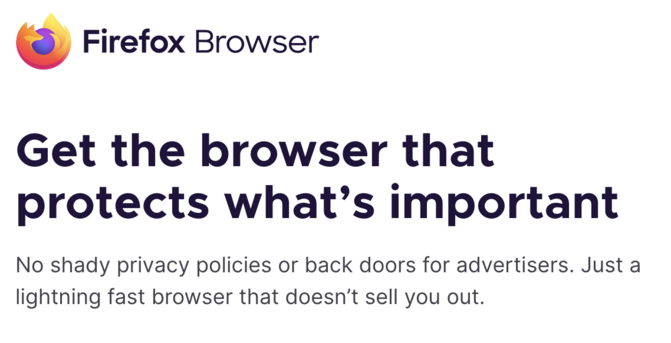
@hynek I think offering a VPN is not inherently an evil thing, and I think letting people know they're offering a thing is not inherently evil.
But even if I didn't think that, I would still try not to jump to the harshest and nastiest and most rage-driven possible conclusions, the way you are doing here.
So I wouldn't try to force a description of this as injecting ads, for example -- it's very clear that's not what they were trying to do, and no matter how angry I might be, they deserve an attempt at my understanding.
But like I said originally, it's very clear that you are not really open to having your mind changed on this, so I'm just going to drop out and mute the conversation.
 שי ברגר
  Shai Berger
I think offering a VPN, and placing ads more generally, are not inherently evil. But AFAIK Firefox had, for years, a "what's new" tab open besides whatever else you were doing, and that's a proper place for such things -- never in your way; you'll see it at a time when you're not in the middle of other things. Opening a modal ad, forcing a user to stop what they're doing, is wrong -- I cannot imagine any circumstances where it would be acceptable.