 Julia Evans
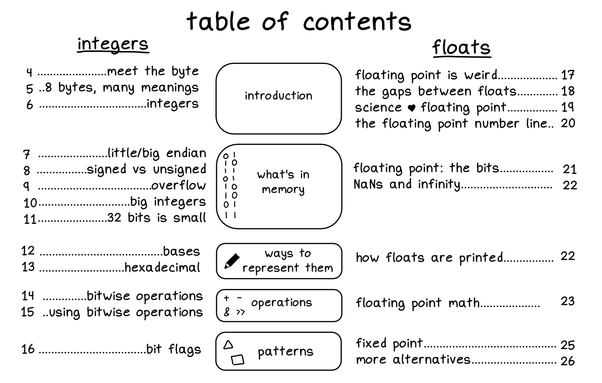
getting closer to finalizing the table of contents for this zine on how integers and floating point numbers work
@b0rk Makes xi wonder what would happen if we taught kids binary math before base 10 math.
Xi know we would have to deal with little-digitian vs. thumb-digitian systems.
@b0rk I find it useful from time-to-time to remind myself that the machine is just a machine; it reliably translates input patterns to output patterns following a configurable set of rules, and that's all it does.
Any meaning whatsoever in those patterns is imbued by human observation.
Smalltalk has Rational Numbers.
Yep; arbitrary fractions.
Pretty Cool!!!
.
(But, honestly, business mostly wants decimal fractions with a "sane" number of digits to the right of the decimal point.)
@b0rk Hey, if you can explain the floating point trickery of Quake's FISR algorithm, I'm fairly certain you'd win a Nobel.
But there may be alien technology involved in that mysterious constant. 😜
 wakejagr
 ShadSterling
 Jaycie
 Mark Tomczak
 Sebastian Gfeller
 Jeff Grigg
 johncarneyau
 Rev. GothAlice
 aaronsingline