
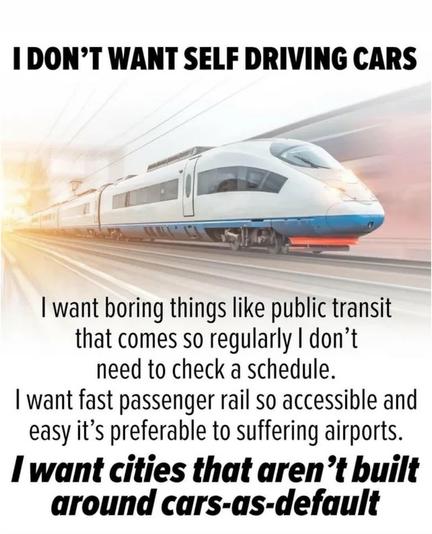
Is this too much to ask? Evidently it is. 😕

#Environment #Climate #ClimateChange #ClimateCrisis
#ClimateAction #WarOnCars #BanCars
@breadandcircuses Not everyone lives in a city. All those millions of people in towns and villages will always need private transport of some kind, unless one would rather try to forcibly depopulate the countryside like some modern-day version of the Highland Clearances.

@hughster @breadandcircuses Did you know that most of the old-time USA was built on the back of trains & rails?

Those thing were abandoned or torn up during the 20th century to make the automobile industry happy. They literally bought rail operations to shut them down.

@lispi314 It wasn't some auto industry conspiracy: cars became omnipresent and trains less used because cars were much more convenient and flexible than trains, serving every location in the country point to point. It happened in pretty much every economically developed country in the world, even though the US went further than most in reshaping development around it.

Trying to deny this is pointless and doesn't help us solve the problems of car dependency and traffic in cities and large towns.

@hughster @lispi314
I believe an additional factor was the price of hauling freight by truck was less than by train. By truck you can go where the roads go. By train you have to go where they go, then still have to haul freight from there to the customer.
@jeber Railroads introduced TOFC/COFC in the '60s. I was directly involved in engineering systems and methods. The trucking lobby fought it. Until we started buying everything from China, transported via containers, the COFC concept was doa in America not because it was inferior but because politics, both local and national, fought it. We literally welded containers to truck chassis because nobody would use them.
When is the last time you saw a trailer on flatcar? Long haul trucks are stupid.
@hughster
There absolutely was a combination of auto and gas industry behind the decommissioning of interurban railways and trolley systems in cities. Yes, autos presented big advantages & would have taken over a lot of personal transportation, but killing the rail systems sealed the deal. Case in point: the Chicago, Aurora & Elgin railroad went out of business when its track into Chicago that fed directly to the Loop elevated system was eliminated by the building of the Eisenhower expressway.
@dbc3 Sure, but I think we're talking about US-specific circumstances here, though, rather than the overall reason cars took over across the world. Other countries with well-developed rail networks didn't experience this, particularly in Europe. The UK had incredible rail coverage until the 60s, when it closed a great amount of the network because people had simply been shifting to road transport en masse over the previous few decades—both for freight and passenger services.

@hughster
@lispi314
@breadandcircuses

You may be talking world-wide.
I was responding to the OP:

"Did you know that most of the old-time USA was built on the back of trains & rails?"

Had intelligent long-range planning been used rather that corporate greed, the interstate highway system would have incorporated high speed rail as a basic design requirement for the major coast to coast routes like I-80, I-70 & north-south like I-95, I-5

@dbc3 The OP was a meme saying "I don't want self-driving cars", tagged with "#/BanCars" and "#/WarOnCars". That's what I initially responded to.

@hughster
The vagaries of thread spaghetti.

I was responding to: "@lispi314 It wasn't some auto industry conspiracy"

@hughster @lispi314 The construction of the Interstate Highway System, begun in 1956, also contributed to the convenience of the automobile over train travel. It definitely cut down on travel time to get from point A to point B. For instance, the time it takes to get from Milwaukee to Chicago is about 90-minute drive from I-94 E to the Loop. The scenic route takes 3 hours, 12 minutes.

@SharonGibson3 @hughster An investment of course that would have had overall much better returns if instead it had been made out of railways.

And that they were operated by the state rather than purely by profit-based organizations, as that has also predictably led to disaster almost everywhere it has been tried. With Japan as a notable exception that got around that through strict & active regulation.

@hughster It was pretty obvious to anyone who bothered to run the numbers or even just *look* at the time that this was going to be the eventual outcome.

Overlooking that was directly influenced by propaganda such as the one analyzed in this video: https://www.youtube.com/watch?v=n94-_yE4IeU

If you pay close attention, you'll note that even the propaganda piece's narrator (not just the video content) mentions some of the problems that will cause and makes exactly no suggestion for how to fix it.

Would You Fall for It? [ST08]

YouTube
@lispi314 I've seen this already. This too is US-centric and only explains how the US became markedly more car-centric and blighted its cities so much more significantly than other developed nations; it doesn't account for why cars were universally popular throughout all developed nations in the first place where none of this propaganda was seen. And the simple reason for that is that cars were generally a positive thing for people and everybody wanted one.

@hughster I think "follow the leader" accounted for a *lot* of it (also, fancy expensive luxury you can put on display, I don't get it but idiots sure love their luxury social displays). It certainly explains a large part of why Canada also ruined itself doing the same.

"The Americans" are doing it and rich so it must work right? No, they're idiots and we'll fall with them if we follow them into their idiocy. Nevertheless the pattern keeps repeating.

@lispi314 It really didn't. Cars were developed and manufactured across multiple countries from the late 19th century onwards completely independently from each other. Innovations in modern road infrastructure too were pioneered by different countries, e.g. traffic lights in the UK and freeways in Italy.
https://en.wikipedia.org/wiki/History_of_the_automobile
History of the automobile - Wikipedia

@lispi314 If you follow Not Just Bikes' videos on roads in the Netherlands and other European countries, you'll see that the road styles and urban development patterns are markedly different from North America here despite there being a heck of a lot of cars and roads. Your experience of cars and urban development around them is pretty markedly unique to you.