New paper!
Cytoelectric Coupling: Electric fields sculpt neural activity and “tune” the brain’s infrastructure.

Brain waves carry info and alter the brain on the molecular level. This tunes the cytoskeleton, optimizing network function.

Work by Dimitris Pinotsis.
https://doi.org/10.1016/j.pneurobio.2023.102465

@ekmiller I’ve said it before and I’ll say it again: spikes will turn out to be explanatory epiphenomena as substrate-independent electrical activity will be the explananda for cognition
@dbarack @ekmiller
Fascinating! Did you write it down somewhere citable? (and if not, nudge).
@NicoleCRust @ekmiller Not yet… though there might be a sentence I snuck in the Nature Rev Neuro article. But it’s a half-written chapter of my interminably work-in-progress book! I really should get it out there as a perspective piece of something

@dbarack @NicoleCRust @ekmiller

Hi David -- interesting! I always read your paper with Krakauer as saying that the our explananda for cognition are our internal representations and the transformations we perform over them (a mental level description), with substrate-independent electrical activity as the most fruitful explanans on a neural level (rather than circuits).

But here I think you're saying that the explanatory target is electrical activity itself, which normally sits at the neural level. Could you clarify? Or just tell me to wait for your book chapter ;-)

@sandervanbree @NicoleCRust @ekmiller Great question. I'm a reductionist--in fact, I'm worse: I'm an identity theorist. I think that mental representations will be type identical to physical types. What types? Those are the physical-substrate-independent electrical activities. So the mental level description = a physical level description (despite being substrate-independent! You have to target the right physical level, and you still get substrate independence). And, the explanatory target (the explanandum) is the cognitive phenomena, not the electrical activity (which is the explanans, what does the explaining), but I take it that that is what you meant.

Now, explanation might be intensional. I can explain that the cat is on the mat without explaining that Granny's favorite critter is on the mat (to provide a Fodor-inspired example). Note though that this is intensionality for the explanandum. There is also intensionality for the explanans. I can explain that the cat is on the mat (the explanandum) because the door was left open, or because Cousin went out to play. These are also distinct. In the first case, the explananda are not the same, and explanans cited to explain the one may not explain the other. In the second case, the explanans are not the same, and they might explain different explananda. (1/2)

@sandervanbree @NicoleCRust @ekmiller
So, to be annoyingly philosophical, it depends on what you mean by "our explananda for cognition are our internal representations". The explananda for cognition is intelligent behavior (or near enough). The explanans are physical things--those are the internal representations (namely, spaces of electrical activity). Applying the foregoing, the electrical activity and the mental representations are type identical explanans that explain the explanandum of intelligent behavior, but they might explain different explananda as well.

I think this is actually important. A lot of explanans (such as neural electrical activity) are type identical to other explanans (such as mental representations) but simply aren't suited to some explanations that their identical counterparts are suited to. Referring to biological neural electrical activity qua biological activity won't help explain the cognitive phenomena evident in artificial neural networks, for example, even if referring to that biological neural activity qua mental representations might just do.

Also, because of the intensionality of explanation, you can give an explanation of spaces of electrical activity without giving an explanation of mental representations (or vice versa). But note, the explanans for cognition are our internal representations, whether neural or mental; when the explananda are those representations, the explanatory target has changed. (2/2)

@dbarack @NicoleCRust @ekmiller

Thank you for taking the time to write out this wealth of information. I think I get what you're saying: intelligent behavior is the explanandum, and substrate-independent e-fields are the explanans, and so too are internal representations because they are actually type-identical to those fields. But their distinction is nevertheless important because in other explanatory contexts it might not be the case that the e-fields and internal representations can be exchanged for each other, which we see for instance if we move to the explanatory context of ANN behavior. Clickidy?

Another question that interests me -- and I know it interests you too -- is whether manifolds are real objects. It was either a talk or a tweet where you made a passing comment that you think they are, and it seems not too far off from the point you're making today. I always think of manifolds as good old descriptions only -- which of course may well figure in scientific explanations. Will questions of realism be covered in your book also? I hope it will.

@sandervanbree @NicoleCRust @ekmiller Clickidy!
Not sure questions of realism will make it into my monograph but it is certainly a topic I’m interested in.

@NicoleCRust @dbarack @ekmiller

Here are two more (older) data points on the causal effects of weak electric fields ...

on spikes:
https://www.jneurosci.org/content/30/45/15067

and network activity:
https://www.jneurosci.org/content/27/11/3030

Low-Intensity Electrical Stimulation Affects Network Dynamics by Modulating Population Rate and Spike Timing

Clinical effects of transcranial electrical stimulation with weak currents are remarkable considering the low amplitude of the electric fields acting on the brain. Elucidating the processes by which small currents affect ongoing brain activity is of paramount importance for the rational design of noninvasive electrotherapeutic strategies and to determine the relevance of endogenous fields. We propose that in active neuronal networks, weak electrical fields induce small but coherent changes in the firing rate and timing of neuronal populations that can be magnified by dynamic network activity. Specifically, we show that carbachol-induced gamma oscillations (25–35 Hz) in rat hippocampal slices have an inherent rate-limiting dynamic and timing precision that govern susceptibility to low-frequency weak electric fields (<50 Hz; <10 V/m). This leads to a range of nonlinear responses, including the following: (1) asymmetric power modulation by DC fields resulting from balanced excitation and inhibition; (2) symmetric power modulation by lower frequency AC fields with a net-zero change in firing rate; and (3) half-harmonic oscillations for higher frequency AC fields resulting from increased spike timing precision. These underlying mechanisms were elucidated by slice experiments and a parsimonious computational network model of single-compartment spiking neurons responding to electric field stimulation with small incremental polarization. Intracellular recordings confirmed model predictions on neuronal timing and rate changes, as well as spike phase-entrainment resonance at 0.2 V/m. Finally, our data and mechanistic framework provide a functional role for endogenous electric fields, specifically illustrating that modulation of gamma oscillations during theta-modulated gamma activity can result from field effects alone.

Journal of Neuroscience

@lcparra @NicoleCRust @dbarack @ekmiller In 2005 or 2006 I saw a talk given at Stanford by a physicist named Jose Acacio de Barros, who, as I recall, discussed the possibility that synchronized firing in a given cortical column could influence activity in other, more distal neurons. 20 years have intervened and my memory for the details of the talk is not as strong as for the impression it made on me, a pre-PhD RA, about the incredible range of possibility in neuroscience. Anyway, after seeing these threads, I decided to email him this morning. He just responded with some relevant citations:

Suppes, P., de Barros, J. A., & Oas, G. (2012). Phase-oscillator computations as neural models of stimulus-response conditioning and response selection. Journal of Mathematical Psychology, 56(2), 95-117. https://doi.org/10.1016/j.jmp.2012.01.001

E. Vassilieva, G. Pinto, J. de Barros, and P. Suppes, "Learning Pattern Recognition Through Quasi-Synchronization of Phase Oscillators," in IEEE Transactions on Neural Networks, vol. 22, no. 1, pp. 84-95, Jan. 2011, doi: 10.1109/TNN.2010.2086476

Hope these are of interest!

@dbarack +1000

Check these out.

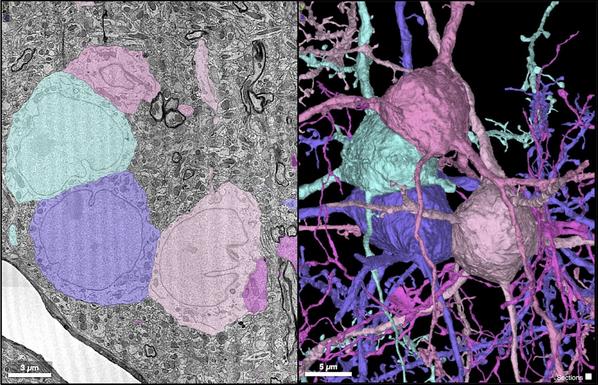
Cell bodies pressed together. There are no synapses there. Just large expanses of unmyelinated surface area. That is ideal for a direct electrical influence between neurons, i.e., ephaptic coupling.

@ekmiller @dbarack has to be inter-cellular chemical computation going on there too. Neurons are cells

@cian @dbarack

Yes, indeed. No one said EFs are doing everything. Rather, the claim is that they doing something.

@dbarack Yes, bruv, yes. We should chat more often. Buy you a drink sometime?
@ekmiller Absolutely! I should come for a visit!
@dbarack @ekmiller Ephaptic interactions might be widespread: Ephaptic Interactions in the Mammalian Olfactory System PMID: 11588203
@dbarack @ekmiller Lately I've been trying to condeptualize spikes as a product of sudden local shifts in the macroscopic pattern of electro[hydro]dynamical activity of the nervous system. Maybe spikes signal transitions in the amorphous, diffuse electrical activity, and could convey some information about the larger, more complicated dynamics