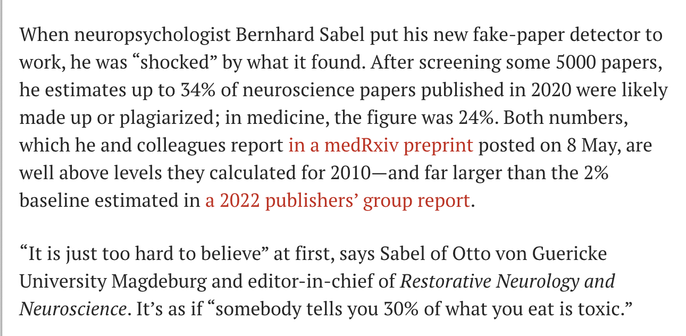
This week, Science published a stunningly irresponsible news story entitled "Fake scientific papers are alarmingly common" and claiming that upward of 30% of the scientific literature is fake.

https://www.science.org/content/article/fake-scientific-papers-are-alarmingly-common

Below, the first two paragraphs of the story.

Headline and intro notwithstanding, the story itself later notes that the detector doesn't actually work and flags nearly half of real papers as fake. Does the reporter just not understand that?

h/t @Hoch
Fake scientific papers are alarmingly common

But new tools show promise in tackling growing symptom of academia’s “publish or perish” culture

@ct_bergstrom @Hoch "Sabel’s tool relies on just two indicators—authors who use private, noninstitutional email addresses, and those who list an affiliation with a hospital. It isn’t a perfect solution, because of a high false-positive rate. Other developers of fake-paper detectors, who often reveal little about how their tools work, contend with similar issues."

WTF?

@karabaic @ct_bergstrom @Hoch In search of a published article - I'll take a blog post - outlining why this preprint is so horrible. Are you working on anything or do you know of anything?

@SusanWillner @ct_bergstrom @Hoch

The false positive rate is horrendous enough. Their plans to keep the details of their fraud detection model closed source and confidential is a 🚩big 🚩red 🚩flag.

If they were confident enough in their model, transparency is the way to show it.

TurnItIn has a 3% false positive rate. That’s enough to destroy many undergraduates’ lives.