
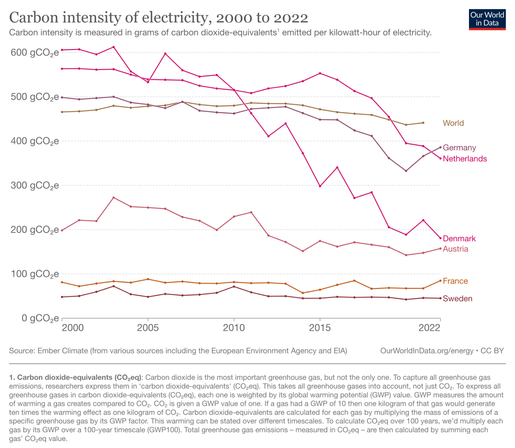
This is a nice race to follow: the evolution of carbon intensity of electricity.
Before 2010 Denmark and the Netherlands were still higher than world average. Then from 2010 Denmark got serious about decarbonising. In the Netherlands we waited until 2018 but we are finally reducing it quickly!
In 2022 it was lower than Germany for the first time. Germany's carbon intensity increased in the last 2 years.
Still a long way to go to reach France and Sweden at the bottom.
Final goal 0!
CO2 emissions per person in the world peaked in 2012 and are rather stable since then.
In the EU it is decreasing but it is still higher than the world average.
The fact that the EU uses less than half CO2 per person than the US is actually a good example for me that you can have a better quality of life and less CO2.
@DewiLeBars This is only half of the story, the other half of global warming comes from other gases that are not tracked by Our World in Data.

@jknodlseder that is right. They also have other GHGs at Out World in Data. This is methane:

https://ourworldindata.org/grapher/per-capita-methane-emissions?tab=chart&country=CHN~USA~OWID_WRL~OWID_EU27

Per capita methane emissions

Per capita methane emissions are measured in tonnes of carbon dioxide-equivalents per person per year.

Our World in Data

@jknodlseder @DewiLeBars The 'known unknowns' and 'unknown unknowns' really matter, I agree. Reminds me of the recent case of Kazakhstan, although it's odd to shed so much light on particular places only.

💥 https://www.theguardian.com/environment/2023/mar/06/revealed-1000-super-emitting-methane-leaks-risk-triggering-climate-tipping-points

Plus, Our world in Data is keen on pushing the Green Growth and Decoupling narratives. Not sure if they hold up against these complexities.

Revealed: 1,000 super-emitting methane leaks risk triggering climate tipping points

Vast releases of gas, along with future ‘methane bombs’, represent huge threat – but curbing emissions would rapidly reduce global heating

The Guardian