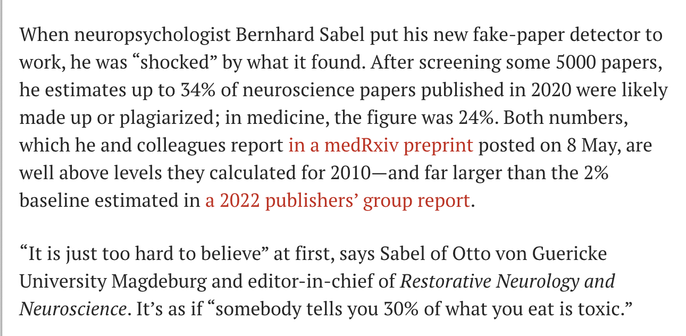
This week, Science published a stunningly irresponsible news story entitled "Fake scientific papers are alarmingly common" and claiming that upward of 30% of the scientific literature is fake.

https://www.science.org/content/article/fake-scientific-papers-are-alarmingly-common

Below, the first two paragraphs of the story.

Headline and intro notwithstanding, the story itself later notes that the detector doesn't actually work and flags nearly half of real papers as fake. Does the reporter just not understand that?

h/t @Hoch
Fake scientific papers are alarmingly common

But new tools show promise in tackling growing symptom of academia’s “publish or perish” culture

The numbers from this story are based on a laughable "fake paper detector" that literally consists of the following ONLY. Do the authors:

1) use private (non-institutional) email addresses and/or have a hospital affiliation,

and

2) have no international coauthors.

That's it.

If these criteria are met, the paper is deemed a "potential red-flag fake publication" and counted toward that 30% tally.

@ct_bergstrom Doesn’t the use of private mail addresses discriminate against Junior faculty? Which Postdoc on a two year contract lists an institutional mail address when the publication might take three years? And then than you’re surprised you didn’t get an answer? 🤨