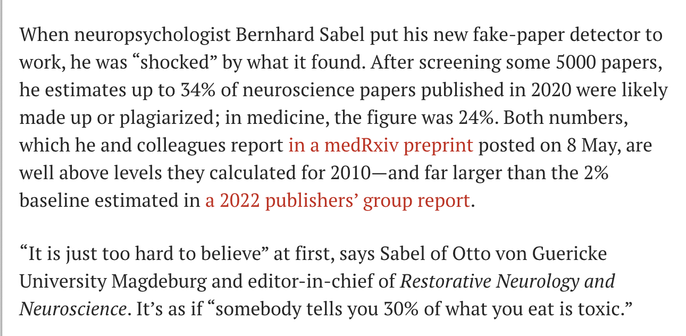
This week, Science published a stunningly irresponsible news story entitled "Fake scientific papers are alarmingly common" and claiming that upward of 30% of the scientific literature is fake.

https://www.science.org/content/article/fake-scientific-papers-are-alarmingly-common

Below, the first two paragraphs of the story.

Headline and intro notwithstanding, the story itself later notes that the detector doesn't actually work and flags nearly half of real papers as fake. Does the reporter just not understand that?

h/t @Hoch
Fake scientific papers are alarmingly common

But new tools show promise in tackling growing symptom of academia’s “publish or perish” culture

The numbers from this story are based on a laughable "fake paper detector" that literally consists of the following ONLY. Do the authors:

1) use private (non-institutional) email addresses and/or have a hospital affiliation,

and

2) have no international coauthors.

That's it.

If these criteria are met, the paper is deemed a "potential red-flag fake publication" and counted toward that 30% tally.

Spin notwithstanding, the technical details within preprint itself make it abundantly clear that the method doesn't work.

In a "juiced" test set with as many fake papers as real ones, the indicators that they use have a sensitivity of 86% and a false alarm rate of 44%.

Yes, they flag 44% of the known real papers as fake.

That's not a detector, it's a coinflip.

This should be a profound embarrassment to everyone involved with the preprint and Science story alike.

https://www.medrxiv.org/content/10.1101/2023.05.06.23289563v1.full.pdf

@ct_bergstrom The method is makes me very unhappy.

There's some congruence between the results and our expectations, but ... I do not believe this task can be responsibly attempted without *analyzing the text and data*. No citation analysis is attempted either. This is nothing like enough.

I would also like an explanation as to why this figure is so much goddamn higher than other estimates, because I can think of several other attempts to quantify this problem, and while many of them are far higher than we should be comfortable with, they're also far *lower* than this.

This is not a responsible document. It is one thing to accuse lots of people of faking studies (I, uh, have done this) but it's another to accuse half of
some nation states of doing it on the basis of a method I would diplomatically describe as 'thin'.

@jamesheathers 100% agreement with all of that.

(Well, they do try a post-hoc test to see if suspected papers by their methods cite other suspected papers by their methods, but it's generous to call that citation analysis.)

@ct_bergstrom Absolutely, and that represents a lot of money left on the table. We have a reasonable idea of what citation patterns can be observed if mills are involved, AND the data is quite accessible. I think if you're going to sling big timber around like this, there's no excuse not to use it.