 Matt Fern
A G1 (Minor) geomagnetic storm is underway, several hours after arrival of a CME produced by an M3.9 X-ray flare on the 4th; a G3 (Strong) geomagnetic storm watch is in effect for the May 8th UTC day. #spaceweather #spacewx
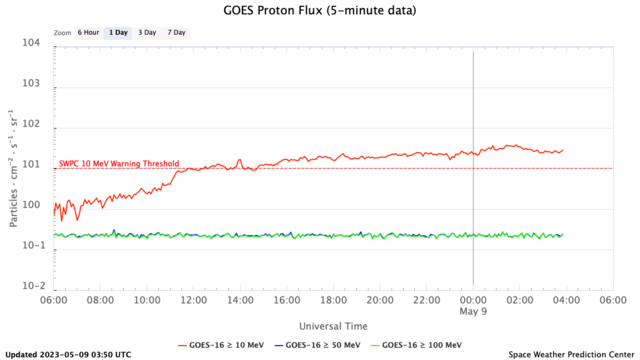
On top of that, a long-duration M1.6 X-ray flare from active region 3296, just north of the center of the solar disk, has produced an enhancement to solar proton flux at Earth (as measured by GOES-16); it may not reach S-scale radiation storm levels this time, but further flare activity or additional CME arrivals could boost it further. #solarflare #spaceweather #spacewx
AR3296 is in a nearly ideal position for launching CMEs at Earth, and coronagraph imagery from SOHO LASCO suggests it might have done just that with this long-duration M1.6 flare. #solarflare #spaceweather #spacewx
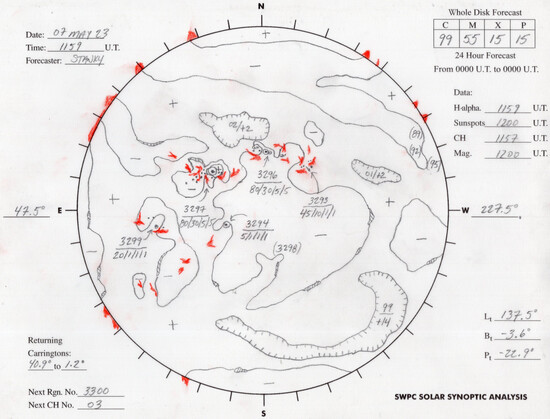
Solar proton flux did eventually reach the S1 (Minor) radiation storm threshold, where it remains for the moment; meanwhile, geomagnetic storm activity seems to have been short-lived and has yet to exceed G1 levels. #solarflare #spaceweather #spacewx
R1 (Minor) radio blackout in progress as X-ray flux has exceeded M1.0 and is increasing rapidly. #solarflare #spaceweather #spacewx
R2 (Moderate) radio blackout conditions now present as flux has exceeded M5.0. #solarflare #spaceweather #spacewx
X-ray flux appears to be peaking near M6.5; early SUVI imagery suggests AR3296 is the likely source of this flare. #solarflare #spaceweather #spacewx
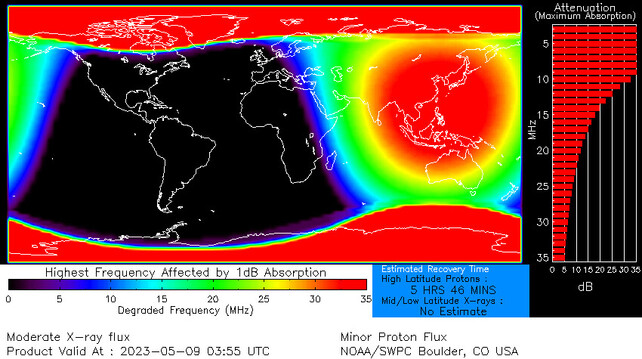
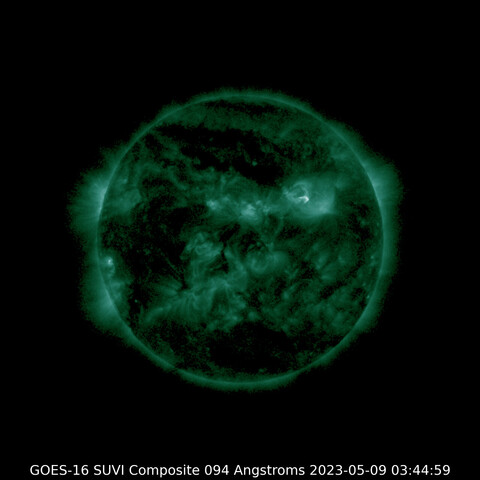
S1 solar radiation storm levels have been maintained for the last 17 hours, and given this flare's location I wouldn't be surprised to see further enhancements to proton flux at GOES-16. #solarflare #spaceweather #spacewx
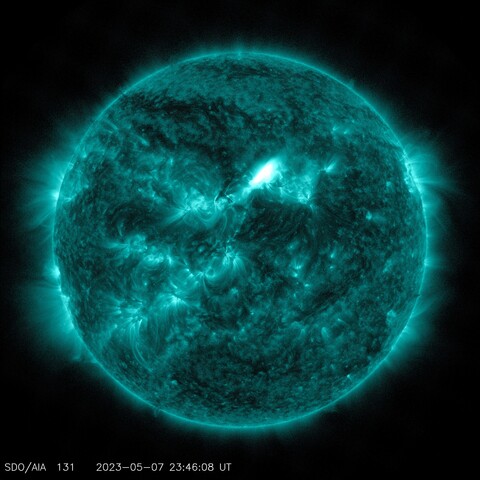
Here's a perfectly-timed capture from the Solar Dynamics Observatory near the peak of the flare. #solarflare #spaceweather #spacewx
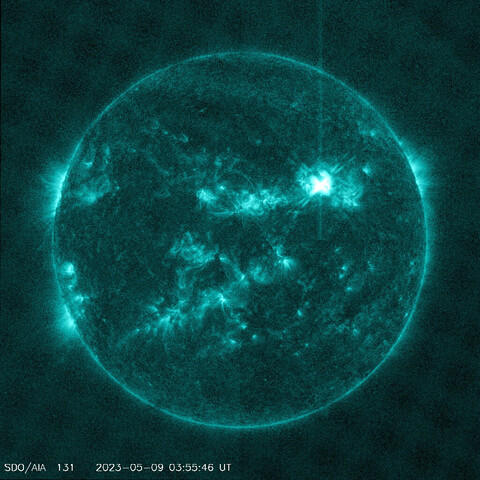
R1 (Minor) radio blackout conditions continue as X-ray flux decays to background; should be back below M1 within the next 5 minutes. #solarflare #spaceweather #spacewx
Another long-ish duration R1 (Minor) radio blackout is wrapping up, courtesy of an M4.2 flare from AR3296, which continues to be the most active region on the visible disk. #solarflare #spaceweather #spacewx
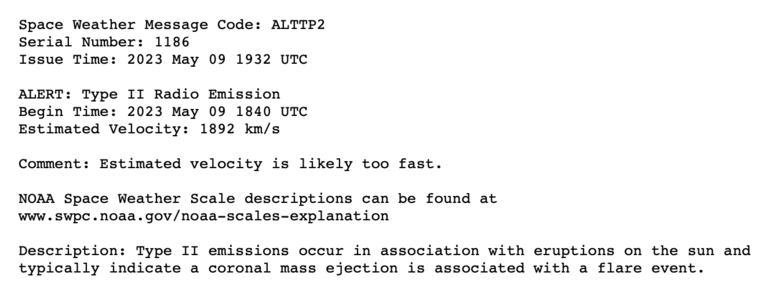
The flare produced radio sweeps consistent with generation of a CME; of particular note is the *exceptionally* high estimated speed of the Type II sweep (1,892 km/sec), which SWPC states in the alert message is likely *too* high and possibly the result of an instrumentation issue. #solarflare #spaceweather #spacewx
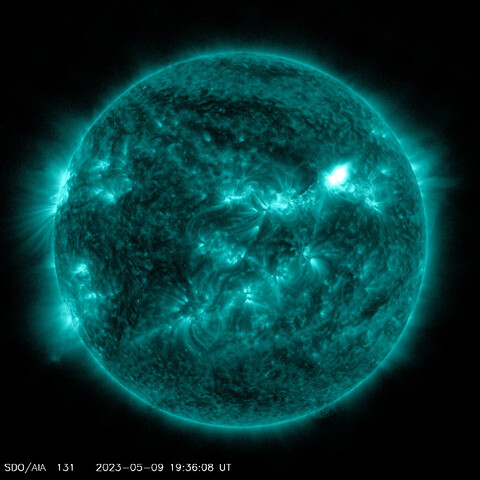
This zoomed-in capture from the Solar Dynamics Observatory can help to illustrate the slow rise and decay of this event; rather than a rapid explosion, this is more of an eruption — a massive blob of plasma, launched from the surface and held (more or less) in place by magnetic fields, emitting X-rays and other electromagnetic radiation until either dissipating or being launched into space in the form of a CME. #solarflare #spaceweather #spacewx
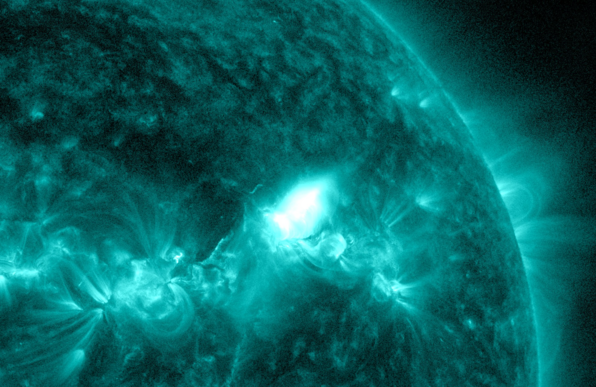
Oh, hey, AR3296 just fired off another M5.0 flare, *just* clearing the R2 (Moderate) radio blackout threshold. This one seems less inclined to stick around than the last one, though. #solarflare #spaceweather #spacewx
G1 (Minor) geomagnetic storm and S1 solar radiation storm conditions are being observed, resulting from apparent CME arrival from a long-duration M1.6 flare from AR3296 a couple days ago. A G2 (Moderate) geomagnetic storm watch is in effect for the May 10th UTC day. #spaceweather #spacewx #aurora
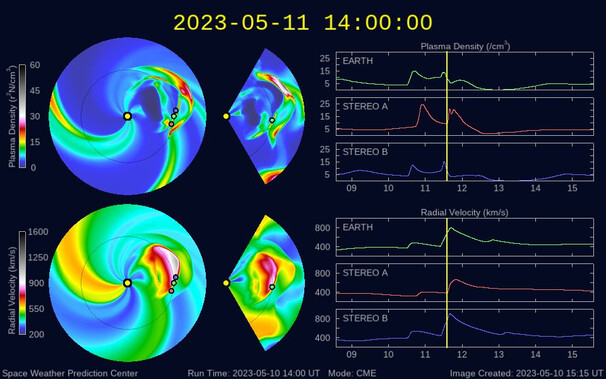
And, as if things weren't busy *enough*, the M4.2 flare from earlier today generated *another* nearly-full-halo CME, as observed by the SOHO satellite's LASCO instrument. #solarflare #spaceweather #spacewx
A G3 (Strong) geomagnetic storm watch has been issued for May 11 (UTC) ahead of expected arrival of this CME, which SWPC's modeling suggests is moving in excess of 1,000 km per second. #spaceweather #spacewx #aurora
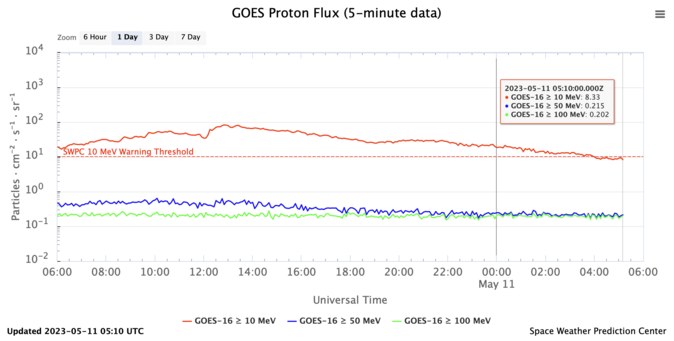
Proton flux at GOES-16 has finally dropped back below the S1 solar radiation storm threshold — for now, anyway. We'll see how long that lasts once the oncoming CME arrives; the last couple have boosted proton levels significantly, and the last came close to the S2 (Moderate) radiation storm level. #spaceweather #spacewx
This is not a great time for DSCOVR to stop feeding solar wind data — ACE is, shall we say, somewhat less consistent. #spaceweather #spacewx
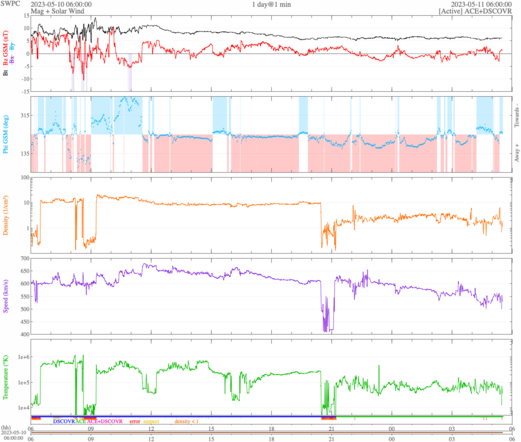
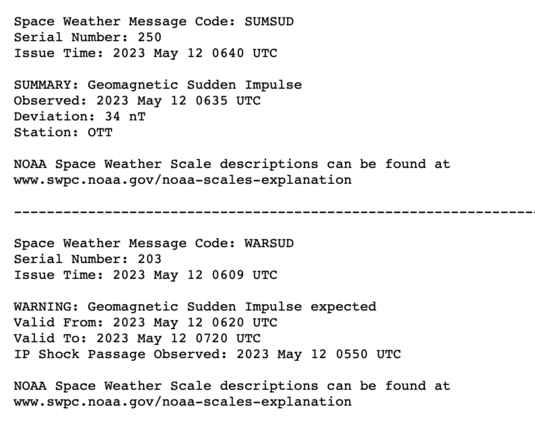
Looks like the CME is just rolling in — solar wind speed at DSCOVR just jumped from ~485 km/sec to ~570 km/sec, accompanied by a slight increase in plasma density; a geomagnetic sudden impulse warning has been issued by SWPC. #spaceweather #spacewx #aurora
If I had to guess, I'd say that the leading edge of the CME just arrived at Earth proper. #spaceweather #spacewx #aurora
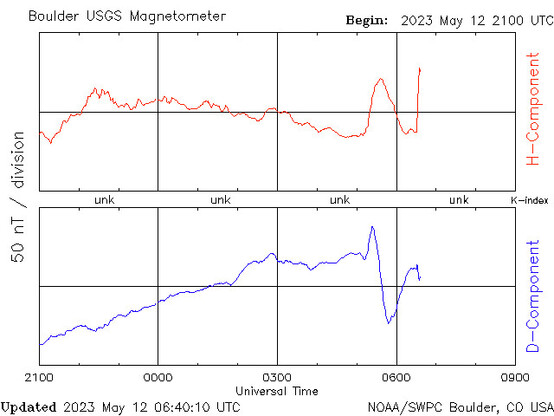
SWPC has issued a geomagnetic sudden impulse summary; a 34 nanoTesla impulse was measured by a magnetometer operated by the U.S. Air Force in Ottawa, Canada. #spaceweather #spacewx #aurora
So far, only brief G1 (Minor) geomagnetic storm conditions have been observed from this CME; it seems like this was only a glancing blow, with the bulk of the mass passing by just ahead of our orbit. #spaceweather #spacewx